
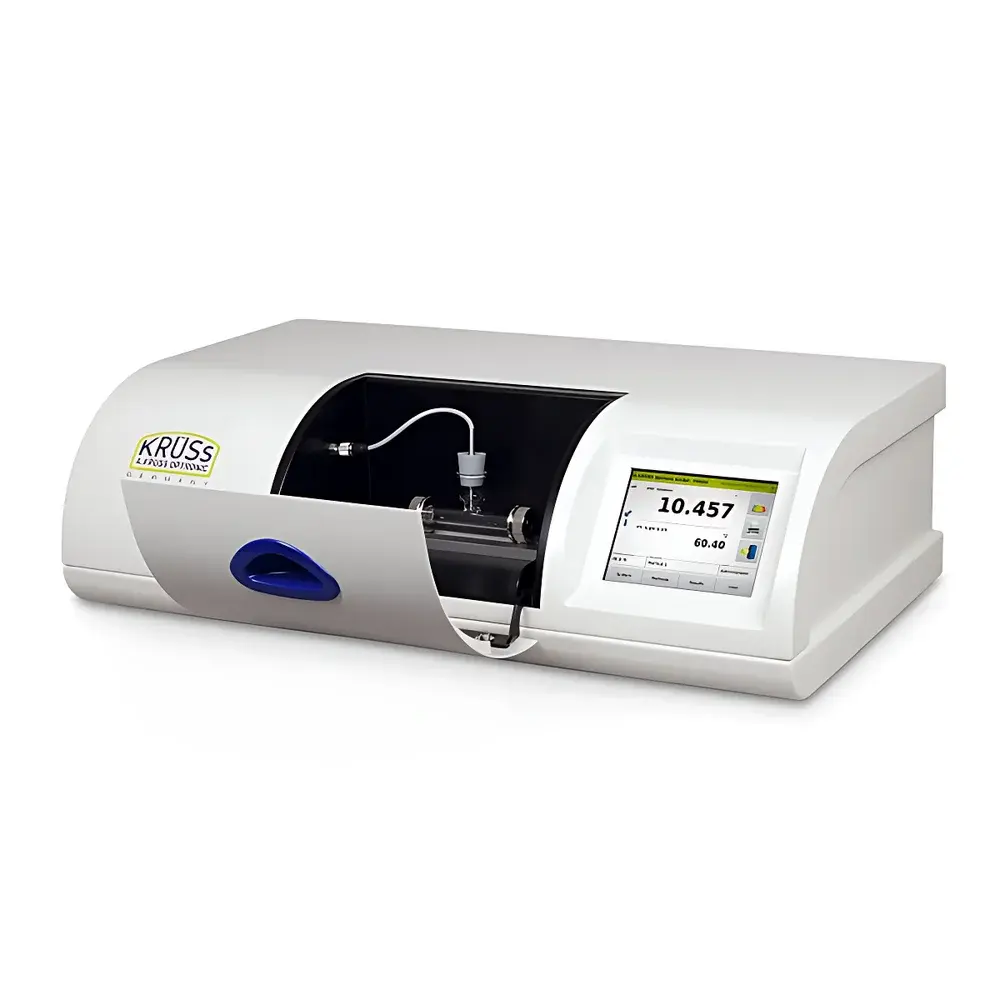
ChemTron P3000 Economical Automatic Polarimeter
| Brand | ChemTron |
|---|---|
| Origin | Germany |
| Model | P3000 |
| Product Type | Automatic Polarimeter |
| Temperature Control | None (field-upgradable) |
| Display | Digital LCD Touchscreen |
| Light Source | LED (589 nm) |
| Measurement Range | ±90°, ±259 °Z |
| Resolution | 0.01° / 0.01 °Z |
| Repeatability | ±0.01° |
| Measurement Time | 1 s |
| Wavelength | 589 nm (fixed) |
| Path Length Compatibility | up to 220 mm |
| Data Storage | 999 entries |
| Interface | RS232 |
| Sensitivity | 0.1% w/w (at OD 3) |
| Calibration | Internal Auto-Calibration |
| Compliance | USP <781>, Ph. Eur. 2.2.7, BP Appendix XVII, JP XVI, ISO 8536-5, ASTM E1254, ICUMSA Method GS4/3-12, OIML R 136, NIST-traceable operation |
Overview
The ChemTron P3000 Economical Automatic Polarimeter is a precision optical instrument engineered for rapid, high-reproducibility measurement of optical rotation in chiral substances—primarily used in pharmaceutical, food & beverage, chemical, and biotechnology quality control laboratories. Based on the well-established principle of plane-polarized light transmission through optically active samples, the P3000 employs a stable, narrow-band LED light source centered at the sodium D-line wavelength (589 nm), ensuring compliance with pharmacopoeial requirements for polarimetric assay. Unlike manual or semi-automatic systems, the P3000 implements real-time angular detection via digital photoelectric sensing and closed-loop signal processing, delivering full-scale measurements—from –90° to +90° (or –259°Z to +259°Z)—in under one second. Its architecture follows the same core optical design as the higher-tier P8000 series, enabling identical measurement kinetics and data fidelity while optimizing cost-of-ownership for routine analysis environments.
Key Features
- Sub-second measurement cycle (≤1 s) across the entire angular range, eliminating throughput bottlenecks in high-volume QC workflows
- High-stability 589 nm LED light source with integrated interference filter—no warm-up time, no lamp replacement, >50,000-hour lifetime
- 3.5-inch full-color capacitive touchscreen interface with intuitive icon-driven navigation and multilingual OS support (English, German, French, Spanish, Chinese)
- Dual-unit display and reporting: simultaneous readout in degrees of optical rotation (°) and International Sugar Scale (°Z), directly traceable to ICUMSA and USP standards
- Onboard temperature sensor (internal cell-path measurement) with 0.1 °C resolution and ±0.2 °C accuracy—enabling automatic temperature compensation to standard reference conditions (20 °C)
- Robust sample cell housing constructed from chemically inert, autoclavable materials; compatible with standard 100 mm, 200 mm, and extended 220 mm polarimetric tubes
- Automatic internal calibration routine accessible via menu—no external standards required for daily verification
- RS232 serial interface for integration into LIMS or laboratory automation platforms; supports ASCII-based command protocol for remote triggering and data export
Sample Compatibility & Compliance
The P3000 accommodates a broad spectrum of liquid-phase chiral analytes—including sucrose solutions, amino acid preparations, antibiotic formulations (e.g., penicillins, chloramphenicol), essential oils, and synthetic intermediates—without requiring dilution or derivatization. Its optical path maintains linearity up to an absorbance (OD) of 3.0, permitting direct analysis of concentrated syrups, viscous extracts, and colored solutions without signal saturation. Regulatory alignment is embedded in both hardware and firmware: all measurement algorithms adhere strictly to USP , Ph. Eur. 2.2.7, BP Appendix XVII, and JP XVI monographs. Instrument validation documentation—including IQ/OQ templates, calibration certificates traceable to NIST SRM 1811, and audit-ready electronic logs—supports GLP and GMP environments. Full compliance with FDA 21 CFR Part 11 is achievable when deployed with validated third-party data management software and user access controls.
Software & Data Management
While the P3000 operates autonomously via its embedded OS, it provides native interoperability with laboratory informatics systems through standardized RS232 communication. Each measurement record includes timestamp, sample ID (user-definable), temperature reading, raw angle value, compensated value (at 20 °C), °Z conversion, operator ID, and instrument serial number. Up to 999 results are retained in non-volatile memory with overwrite protection and chronological indexing. Optional PC-based software (sold separately) enables batch report generation in PDF/CSV format, statistical trend analysis (mean, SD, RSD, min/max), and electronic signature capture per ALCOA+ principles. All stored data include immutable metadata fields required for regulatory audits—ensuring full traceability from acquisition to archival.
Applications
- Pharmaceutical QC: Assay of chiral APIs (e.g., levodopa, ibuprofen, thalidomide analogs), excipient purity verification, and stability-indicating testing per ICH Q5C
- Sugar & Sweetener Industry: Direct determination of sucrose concentration in cane/beet juice, molasses, and finished syrups per ICUMSA GS4/3-12 methodology
- Food & Beverage: Authenticity testing of honey, maple syrup, and fruit concentrates; detection of adulteration via optical rotation deviation
- Academic & Research Labs: Teaching polarimetry fundamentals, kinetic studies of enzymatic racemization, and chiral reaction monitoring
- Essential Oil & Fragrance Manufacturing: Quantification of enantiomeric excess (ee) in limonene, carvone, and citral batches
FAQ
Does the P3000 support temperature-controlled measurement?
No—the base configuration lacks active temperature regulation. However, the instrument includes an internal temperature sensor and full compensation algorithms. External Peltier-controlled cell holders (e.g., ChemTron TC-200 module) can be retrofitted for regulated measurements between 10–40 °C.
Is the 589 nm wavelength configurable?
No—the P3000 uses a fixed-wavelength LED system optimized for pharmacopoeial compliance. Alternate wavelengths (e.g., 405 nm, 546 nm) require dedicated instruments such as the P5000 series.
Can the P3000 be integrated into a networked LIMS environment?
Yes—via RS232-to-Ethernet converters or middleware gateways supporting Modbus RTU or custom ASCII protocols. Validation packages for common LIMS vendors (e.g., LabWare, Thermo SampleManager) are available upon request.
What is the minimum detectable concentration for sucrose?
At 100 mm path length and OD ≤ 3.0, the limit of quantitation is 0.1% w/w (1 g/L), corresponding to a rotation of ~0.05°—well within the instrument’s 0.01° resolution and repeatability specification.
How often does the instrument require recalibration?
Annual factory recalibration is recommended. Daily verification using the supplied quartz control plate (certified ±0.01°) satisfies most internal QA protocols and satisfies USP system suitability requirements.




