
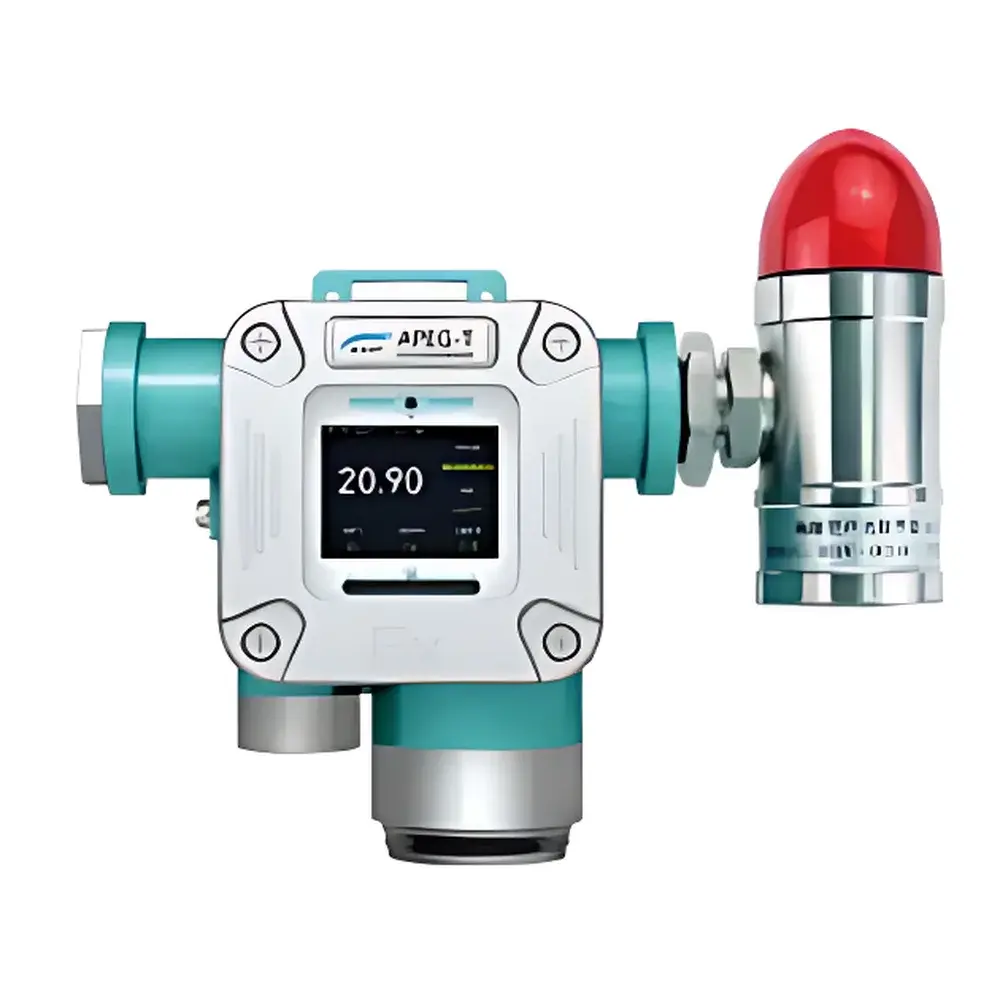
ChemTron H-SAFE Hydrogen Concentration Monitoring Module
| Brand | ChemTron |
|---|---|
| Origin | Germany |
| Model | H-SAFE |
| Detection Range | 0–1000 ppm H₂ |
| Display Resolution | 1 ppm |
| Output Signals | 4–20 mA + RS485 + 2 Relay Outputs |
| Power Supply | 24 VDC |
| Enclosure Rating | IP66 |
| Explosion Protection | Ex d II CT6 |
| Operating Temperature | −30 °C to +55 °C |
| Humidity Range | 10–95% RH (non-condensing) |
| Integrated Temperature & Humidity Sensing | −40 °C to +80 °C / 0–100% RH |
| Data Logging | Operation Log, Alarm Log, Over-Temperature Event Log, Over-Range Event Log |
| Alert Functions | Sensor Fault, Output Failure, Over-Range Usage, Sensor Lifetime Warning, Calibration Due Reminder, Over-Temperature Warning |
Overview
The ChemTron H-SAFE Hydrogen Concentration Monitoring Module is an industrial-grade, intrinsically robust safety interface designed for continuous, real-time detection and intelligent management of hydrogen gas concentrations in laboratory and process environments. Engineered for integration with ChemTron hydrogen generators—and compatible with third-party H₂ supply systems—the H-SAFE module employs electrochemical sensing technology to deliver stable, linear response across its full 0–1000 ppm measurement range. Its core function is to convert raw sensor output into standardized analog (4–20 mA) and digital (RS485 Modbus RTU) signals for seamless interfacing with programmable logic controllers (PLCs), distributed control systems (DCS), safety instrumented systems (SIS), or centralized alarm management platforms. Unlike standalone detectors, the H-SAFE operates as a system-level safety node: it not only reports ambient H₂ levels but actively participates in hazard mitigation by triggering relay-driven shutdown sequences—such as generator interlock, exhaust fan activation, or solenoid valve closure—upon configurable threshold exceedance.
Key Features
- Electrochemical hydrogen sensor with 1 ppm display resolution and factory-calibrated trace-level accuracy
- Dual-output architecture: isolated 4–20 mA current loop for analog process integration + RS485 serial interface supporting Modbus RTU protocol for bidirectional configuration and diagnostics
- Two SPDT relays rated for 250 VAC / 30 VDC, programmable for alarm latching, generator shutdown, or auxiliary device control
- Integrated environmental monitoring: high-accuracy temperature (−40 °C to +80 °C) and relative humidity (0–100% RH) sensors enabling real-time compensation across the entire operating envelope
- Automatic zero-point correction algorithm compensating for baseline drift under varying thermal and humid conditions
- Onboard non-volatile memory storing operation history, alarm events, over-range occurrences, and over-temperature exposures—retaining data through power cycles
- Comprehensive alert framework including sensor fault detection, calibration due notifications, remaining sensor lifetime estimation, and output integrity verification
- Ruggedized aluminum housing rated IP66 for dust-tight and high-pressure water resistance; certified Ex d II CT6 for use in Zone 1 hazardous areas containing Group IIB gases (including H₂)
Sample Compatibility & Compliance
The H-SAFE module is validated for deployment in ambient air matrices under standard atmospheric pressure (±10%) and non-condensing humidity conditions (10–95% RH). It is specifically optimized for post-generation monitoring downstream of ChemTron electrolytic hydrogen generators (e.g., H-GEN series), where hydrogen leakage from fittings, regulators, or manifold connections poses the primary risk vector. The device complies with IEC 60079-1 (flameproof enclosure), EN 61000-6-2/6-4 (EMC immunity and emissions), and meets functional safety requirements aligned with IEC 61508 SIL 2 for safety-related subsystems. Its design supports audit-ready documentation per ISO/IEC 17025 and GLP environments, with full traceability of calibration events, alarm logs, and firmware revisions.
Software & Data Management
Configuration, calibration, and diagnostic access are supported via local IR remote control (included) or RS485-connected host software. All parameter settings—including alarm thresholds (low/medium/high), relay hysteresis, sampling interval, and auto-zero frequency—are stored in write-protected EEPROM. The module generates timestamped event logs compliant with FDA 21 CFR Part 11 requirements when integrated with validated SCADA or LIMS platforms: each log entry includes operator ID (if authenticated), action type, pre-event value, and system state. Remote firmware updates are supported via secure bootloader protocol; no physical reprogramming is required after initial commissioning.
Applications
The H-SAFE module serves as a critical safety layer in hydrogen-dependent workflows across regulated and high-risk sectors. Typical deployments include: inert atmosphere gloveboxes and hydrogenation reactors in pharmaceutical R&D labs; on-site H₂ supply monitoring for fuel cell testing stations; leak surveillance in aerospace propulsion test stands; continuous surveillance in metallurgical annealing furnaces using forming gas blends; and perimeter monitoring at PEM electrolyzer skids in green hydrogen production facilities. Its reliability and certification profile also support compliance with NFPA 55, CGA G-5.4, and OSHA 1910.103 standards for hydrogen handling infrastructure.
FAQ
Is the H-SAFE module compatible with non-ChemTron hydrogen generators?
Yes—it accepts standard 24 VDC power and interfaces via universal 4–20 mA or RS485, enabling integration with most commercial H₂ sources equipped with dry contact or analog output capability.
What maintenance intervals are recommended for sensor longevity?
Electrochemical sensors require annual verification against certified gas standards; the module’s built-in lifetime estimator and calibration reminder reduce unplanned downtime.
Can alarm thresholds be modified remotely without physical access?
Yes—thresholds, relay behavior, and logging parameters are fully configurable via RS485 using Modbus register writes, provided the host system implements appropriate access controls.
Does the H-SAFE support redundant power input or fail-safe relay states?
It features single 24 VDC input with reverse-polarity protection; relay outputs default to de-energized (safe) state during power loss, satisfying fail-safe design principles per IEC 62061.
How is data integrity ensured during network communication?
RS485 transmission includes CRC-16 error checking; all configuration writes require acknowledgment packets, and critical commands (e.g., reset, calibrate) mandate dual confirmation sequences to prevent accidental execution.



