
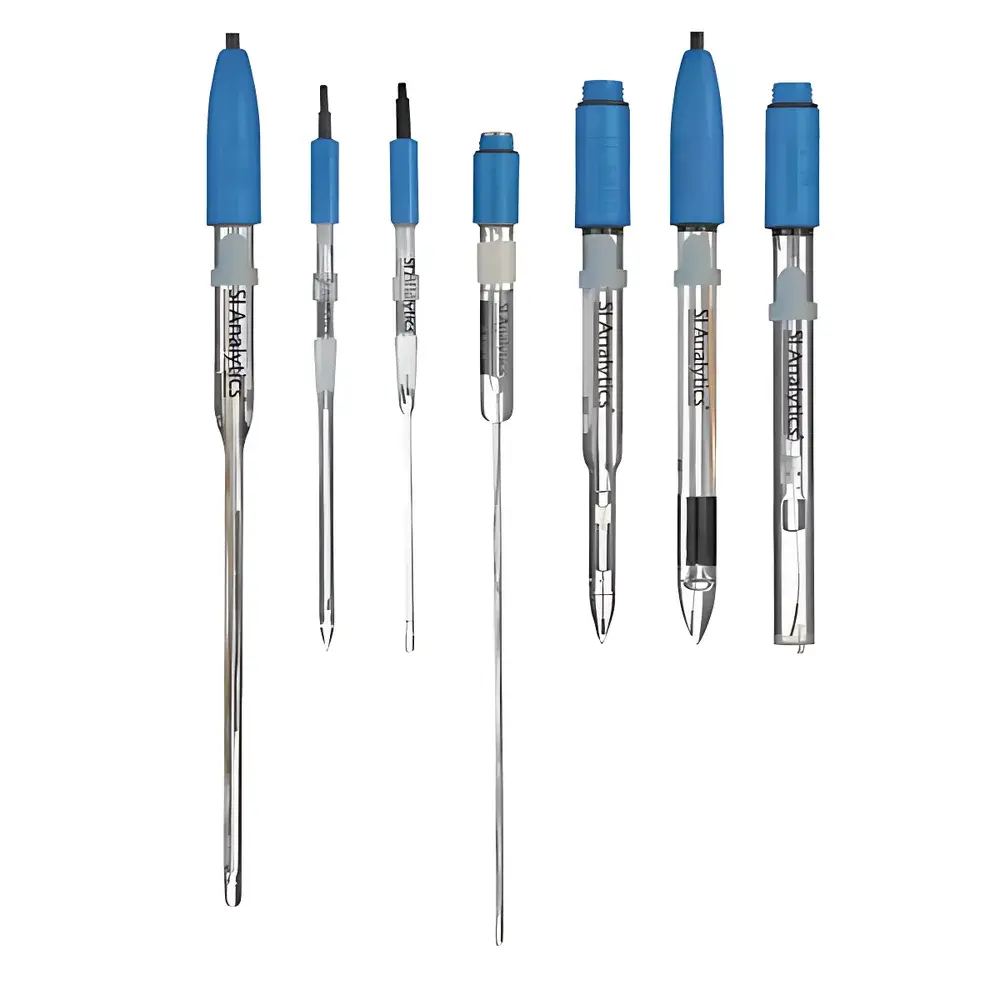
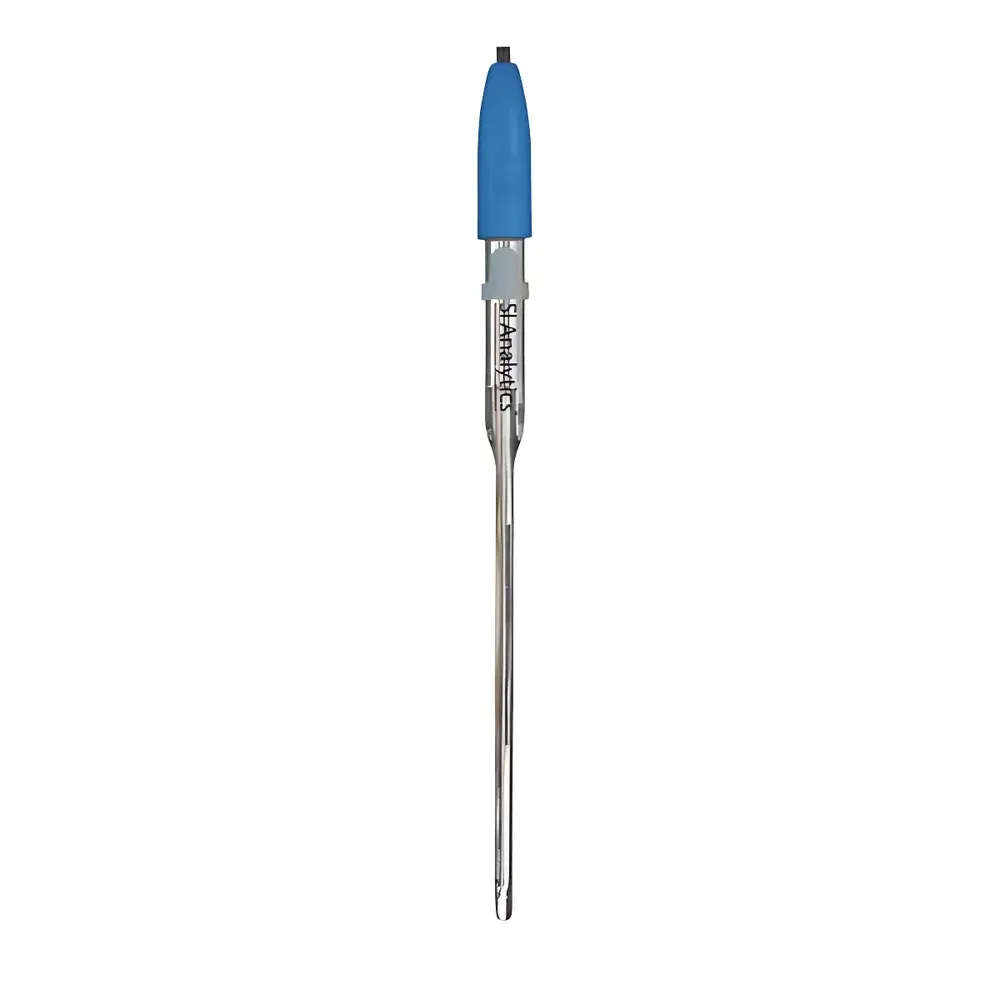
ChemTron ScienceLine A157 Micro-Insertion Surface pH Combination Electrode
| Brand | ChemTron |
|---|---|
| Origin | Germany |
| Model | ScienceLine A 157 |
| Electrode Type | pH Combination Electrode |
| Reference System | Silamid Ag/AgCl |
| Electrode Body Material | Glass (L39 variant: Polypropylene) |
| Zero Point | pH 7.0 ± 0.3 |
| Filling Solution | 3 mol/L KCl (L8880 variant: Referid electrolyte) |
| Sensing Membrane Type | A |
| Connector | SMEK threaded (optional: LS1 ANN, DIN, BNC) |
| Sensing Element Geometry | Cylindrical |
| Temperature Range | –5 to +100 °C |
| pH Measurement Range | 0–14 |
| Membrane Material | Platinum-doped glass |
| Diaphragm Material | Ceramic (standard), porous polyethylene (L8880), or fiber (L39) |
| Integrated Temperature Sensor | Pt1000 (models marked “1M-ID”) |
| Auto-ID Recognition | Yes (DIN/BNC-ID variants) |
Overview
The ChemTron ScienceLine A157 is a high-precision, triple-application pH combination electrode engineered for demanding electrochemical measurement environments in research laboratories, quality control facilities, and industrial process monitoring. Designed according to ISO 3696 (Grade 2 water), ASTM D1293 (pH of water), and IUPAC-recommended potentiometric principles, the A157 employs a stable glass pH-sensing membrane doped with platinum for enhanced response kinetics and long-term drift stability. Its dual-function architecture supports micro-volume measurements (down to 100 µL), insertion into narrow vessels or tubing (e.g., bioreactor ports, microfluidic interfaces), and surface contact applications (e.g., gel, paste, or semi-solid sample analysis). The integrated Silamid reference system—based on a polymer-encapsulated Ag/AgCl element with controlled electrolyte diffusion—ensures robust junction potential stability across varying ionic strengths and minimizes clogging risk in viscous or particulate-laden samples.
Key Features
- Triple-mode design: optimized for micro-volume (<1 mL), insertion (rod-style immersion), and surface-contact (flat-tip) measurement configurations
- Pt-doped glass sensing membrane (Type A) delivering rapid equilibration (<15 s to ±0.02 pH units) and low temperature hysteresis
- Silamid reference system with ceramic diaphragm (standard) or alternative porous polyethylene (L8880) and fiber junctions (L39) for application-specific junction resistance control
- Integrated Pt1000 temperature sensor (in “1M-ID” variants) enabling automatic temperature compensation per NIST SRM 186 pH buffer calibration protocols
- Auto-ID recognition via DIN or BNC-ID connectors—compatible with ChemTron’s SmartLog series and third-party meters supporting EN 61000-6-3-compliant digital handshake protocols
- Glass body construction (except L39: chemically resistant polypropylene) rated for autoclaving at 121 °C / 20 min (non-pressurized cycle); SMEK thread meets DIN 13-1 mechanical sealing standards
Sample Compatibility & Compliance
The A157 electrode demonstrates broad compatibility across aqueous, semi-aqueous, and low-ionic-strength matrices—including cell culture media, pharmaceutical suspensions, food emulsions, and environmental leachates. Its ceramic junction (standard) maintains reproducible liquid junction potential in solutions with conductivity ≥100 µS/cm; the L8880 variant’s Referid electrolyte extends reliable operation down to 20 µS/cm. For non-aqueous or high-protein samples, the optional fiber junction (L39) reduces fouling while preserving response linearity. All variants comply with GLP documentation requirements: each carries a unique serial number laser-etched on the shaft, and batch-certified calibration reports (traceable to PTB and NIST) are provided upon request. The electrode meets IEC 61000-4-2 (ESD immunity) and RoHS 2011/65/EU directives; electrical safety conforms to EN 61010-1:2019 for laboratory equipment.
Software & Data Management
When paired with ChemTron’s SmartLog Pro v4.2 software or compatible third-party platforms (e.g., LabX™, DeltaV™), the A157-ID variants support full audit trail functionality compliant with FDA 21 CFR Part 11. Automatic electrode identification logs model number, serial ID, calibration history, and temperature-compensated slope/mV offset data with user-defined metadata fields. Raw mV and temperature streams are timestamped at 10 Hz resolution and exported in .CSV or .XML formats for statistical process control (SPC) integration. Calibration workflows follow ISO/IEC 17025–recommended dual-point (pH 4.01/7.00 or 7.00/10.01) or three-point protocols, with real-time deviation alerts exceeding ±2 mV from theoretical Nernstian slope (–59.16 mV/pH at 25 °C).
Applications
- Micro-batch QC in biopharmaceutical manufacturing (e.g., monoclonal antibody formulation buffers, ≤500 µL)
- In-line pH monitoring in single-use bioreactors via sterile-insertion port adapters (NS 7.5 standard taper)
- Surface pH mapping of hydrogels, wound dressings, and topical creams using the L39 flat-tip configuration
- Environmental testing of soil pore water extracts and sediment interstitial fluids under ASTM D3921
- Academic research requiring traceable, low-drift electrodes for kinetic pH studies (e.g., enzyme-catalyzed hydrolysis)
- Food science applications including fermented dairy product titration endpoints and meat exudate analysis
FAQ
What is the recommended storage solution for the A157 electrode?
Store immersed in 3 mol/L KCl solution at 4–25 °C; avoid distilled water or dry storage, which dehydrates the glass membrane and increases response time.
Can the A157 be used in HF-containing solutions?
No—standard glass membranes are etched by hydrofluoric acid; use HF-resistant antimony or ISFET-based electrodes instead.
How often should calibration be performed?
Daily for routine QC; before each analytical run in regulated environments (e.g., USP ); after exposure to extreme pH (12), high temperature (>60 °C), or proteinaceous matrices.
Is the SMEK connector interchangeable with common BNC or DIN meters?
Yes—via ChemTron’s certified adapter kits (P/N ADP-SMEK-BNC, ADP-SMEK-DIN), maintaining IP67-rated sealing integrity and signal fidelity up to 1 kHz bandwidth.
Does the “1M-ID” designation imply a fixed 1-meter cable length?
Yes—the “1M” suffix denotes a factory-terminated, shielded coaxial cable (RG-174/U) with integral Pt1000 wiring and digital ID chip; custom lengths require re-certification and are not supported under warranty.






