
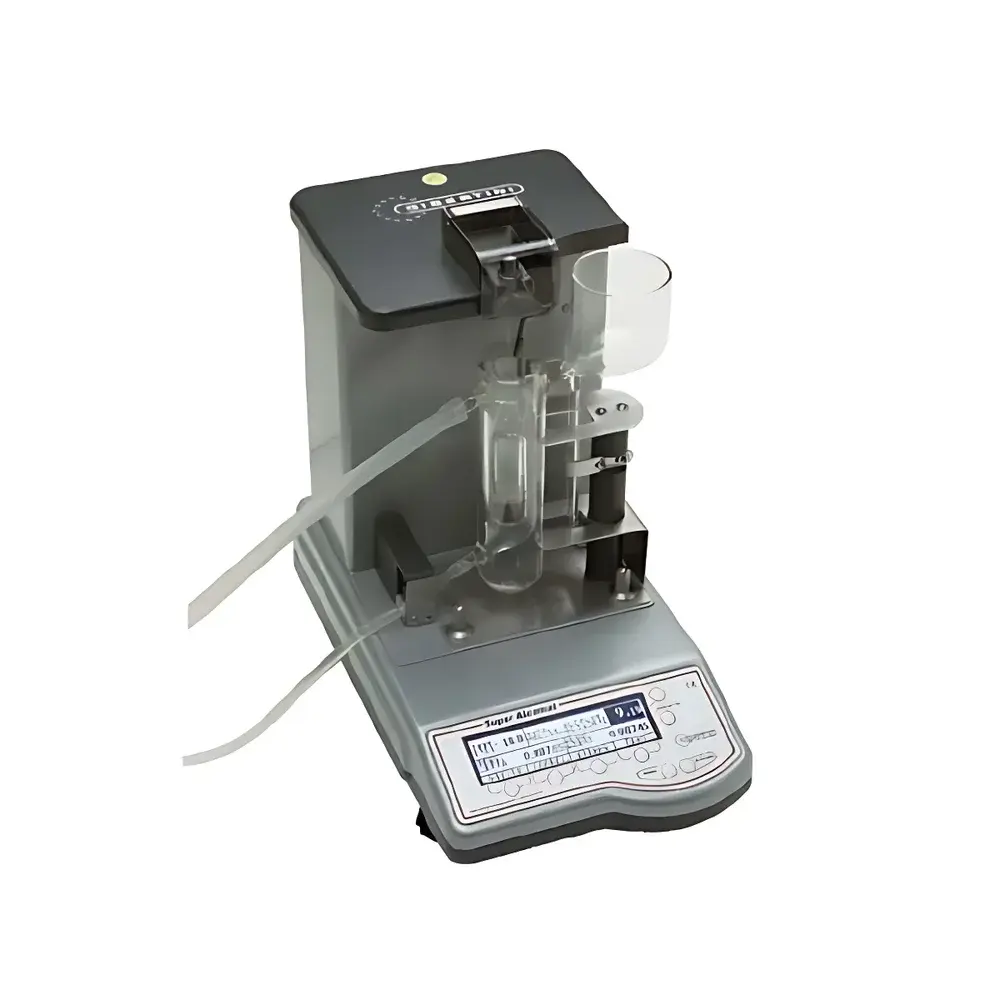
ChemTron Super Alcomat Alcohol Content Analyzer
| Brand | ChemTron |
|---|---|
| Origin | Germany |
| Model | Super Alcomat |
| Alcohol by Volume (ABV) Range | 0.13–98.98% ASV |
| ABV Resolution | 0.01% ASV |
| ABV Repeatability | ±0.03% (at 15–25 °C) |
| Density Range | 0.5000–2.2500 g/cm³ |
| Density Repeatability | ±0.00005 g/cm³ |
| Operating Temperature | 10–30 °C (optimal at 15–23 °C) |
| Display | Backlit LCD with multi-parameter readout |
| Interface | Waterproof keypad |
| Output | RS-232 for optional thermal printer |
| Compliant Standards | ASTM D1120, ISO 3696 (Grade 3 water), OIV Rec. 22/2007, EU Regulation No 2019/1793 (wine analysis) |
Overview
The ChemTron Super Alcomat Alcohol Content Analyzer is a precision density-based instrument engineered for accurate and traceable determination of alcohol content in alcoholic beverages—primarily wine, beer, spirits, and fortified wines—according to the internationally recognized alcohol strength by volume (ASV) standard. It operates on the fundamental principle of hydrostatic weighing, utilizing a calibrated oscillating U-tube densimeter combined with integrated temperature control and real-time density-to-alcohol conversion algorithms compliant with OIV (International Organisation of Vine and Wine) and EU Commission Regulation (EU) 2019/1793. Unlike refractometric or distillation-based methods, the Super Alcomat delivers direct ASV values without sample dilution or distillation, minimizing operator intervention and measurement uncertainty. Its design adheres to metrological best practices for laboratory and inline quality assurance environments, supporting both routine QC testing and regulatory reporting requirements in food & beverage production facilities.
Key Features
- High-precision oscillating U-tube density measurement with temperature-controlled Peltier module (±0.01 °C stability within 15–23 °C ambient range)
- Direct ASV readout from 0.13% to 98.98% with 0.01% resolution and repeatability of ±0.03% under controlled conditions
- Density measurement range of 0.5000–2.2500 g/cm³ at 20 °C, with repeatability of ±0.00005 g/cm³
- Multi-parameter display including real-time sample temperature, density at 20 °C, ASV, and derived scales (°Babo, °Oechsle, °Brix, °Baumé)
- Waterproof membrane keypad and IP54-rated enclosure suitable for wet laboratory and production floor use
- Zero-point calibration and two-point density calibration using certified reference standards (e.g., air and pure water or certified density solutions)
- Time-stamped data logging capability with date/time stamping (YYYY-MM-DD HH:MM format) for GLP-compliant recordkeeping
- RS-232 serial interface for integration with LIMS or optional thermal printer (printer sold separately)
Sample Compatibility & Compliance
The Super Alcomat accommodates clear, low-viscosity liquid samples typical of fermented and distilled beverages—including must, wine, beer wort, lager, cider, brandy, and neutral spirits—provided they are free of suspended solids and bubbles. Sample volume requirement is ≤2 mL per measurement. The instrument complies with key international standards governing alcohol analysis: OIV Method OIV-MA-AS313-01A (2021), ASTM D1120 (Standard Test Method for Alcohol Content of Distilled Spirits), and EU Regulation (EU) 2019/1793 Annex I, Table 1, which mandates density-based ASV determination for official wine control laboratories. Its calibration traceability aligns with ISO/IEC 17025 requirements when used with NIST-traceable density standards. The system supports audit-ready documentation for GMP and HACCP frameworks.
Software & Data Management
No proprietary PC software is required for basic operation; all functions are executed via onboard firmware. However, ASCII-formatted measurement output (including ASV, density, temperature, timestamp, and user ID) is transmitted via RS-232 for seamless ingestion into validated laboratory informatics systems. Data export supports CSV-compatible formatting, enabling direct import into Excel, SQL databases, or enterprise LIMS platforms. For regulated environments, the device supports 21 CFR Part 11-compliant workflows when paired with validated third-party data acquisition software—specifically, electronic signatures, audit trails, and user access controls can be implemented externally. Internal memory retains up to 500 measurement records with full metadata (operator ID, calibration status, ambient conditions).
Applications
- Wine laboratories performing official alcohol certification for labeling and customs clearance
- Breweries monitoring final gravity and calculating ABV during fermentation and packaging QA
- Spirit distilleries verifying proof before bottling and tax assessment
- Contract testing labs serving multiple clients under ISO/IEC 17025 accreditation
- R&D departments developing low-alcohol or alcohol-free formulations requiring precise baseline density tracking
- Regulatory inspection units conducting on-site verification of declared alcohol content
FAQ
What does “ASV” stand for, and how is it different from ABV?
ASV (Alcohol Strength by Volume) is the legally defined term in EU and OIV regulations for alcohol concentration expressed as volume percent at 20 °C—functionally equivalent to ABV but governed by stricter metrological protocols.
Is distillation required prior to measurement?
No. The Super Alcomat measures undiluted, clarified samples directly. Distillation is only necessary if samples contain volatile non-ethanol compounds that interfere with density—rare in standard beer, wine, or spirit matrices.
Can the instrument measure high-sugar musts or fortified wines?
Yes, provided samples are filtered to remove particulates and degassed to eliminate microbubbles. High-density samples (e.g., >1.15 g/cm³) require validation against reference gravimetric methods per OIV Rec. 22/2007.
How often must calibration be performed?
Daily zero-point verification is recommended; full two-point calibration (air + water or certified solution) should be conducted at start-up and after ambient temperature shifts >2 °C or every 8 hours of continuous use.
Does the device support FDA 21 CFR Part 11 compliance out-of-the-box?
The hardware provides time-stamped, user-identifiable data output—but full Part 11 compliance requires integration with validated third-party software that implements electronic signatures, audit trails, and role-based access control.




