
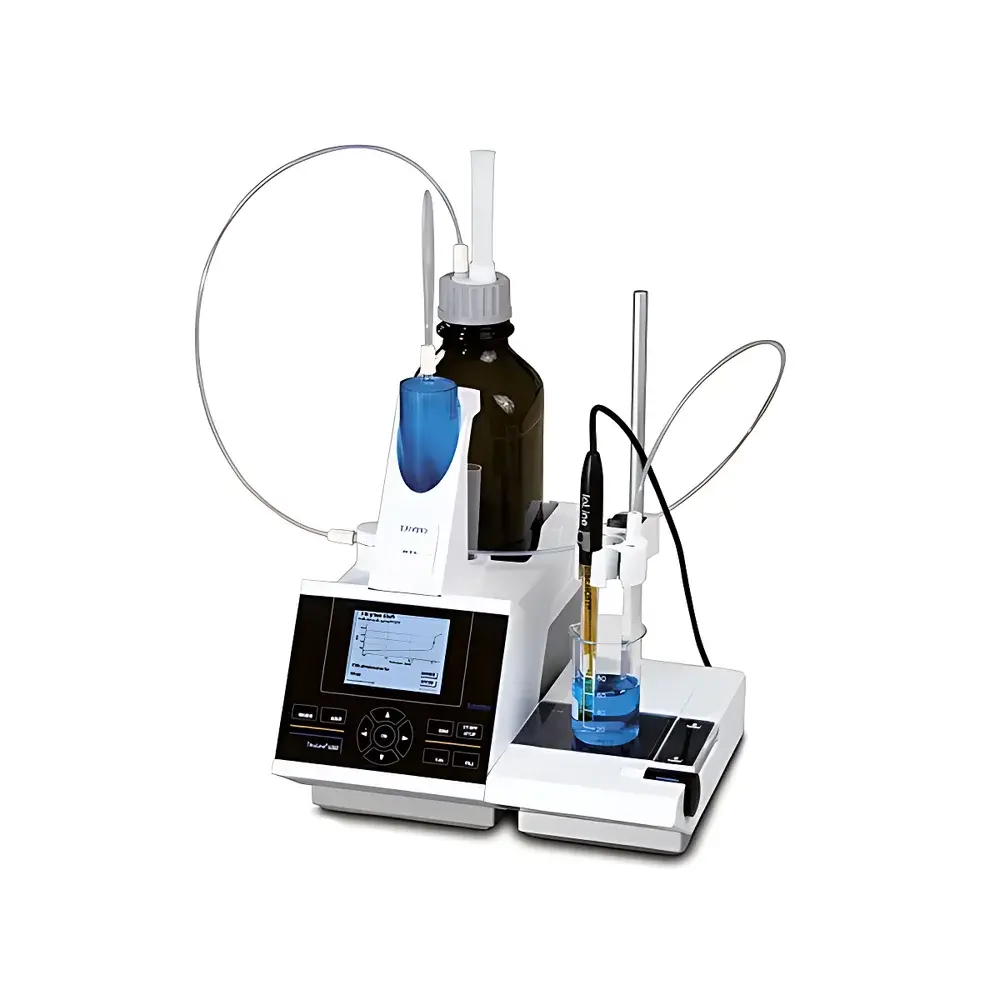
ChemTron TL 7000 Advanced Automatic Potentiometric Titrator
| Brand | ChemTron |
|---|---|
| Origin | Germany |
| Model | TL 7000 |
| Titration Types | General-purpose potentiometric titration |
| pH Range | 3.0–18.0 |
| mV Range | −2000 to +2000 mV |
| Temperature Range | −75 to +175 °C |
| pH Resolution | 0.001 pH |
| mV Resolution | 0.1 mV |
| Temperature Resolution | 0.1 °C |
| pH Accuracy | ±0.002 ±1 digit |
| mV Accuracy | ±0.10 ±1 digit |
| Current (µA) Accuracy | ±0.2 ±1 digit |
| Temperature Accuracy | ±0.2 K ±1 digit |
| Display | 3.5″ 1/4-VGA TFT color touchscreen |
| Method Storage | 50 pre-programmed or user-defined methods |
| Electrode Interfaces | DIN 19262 / BNC (pH/mV), dual 2×4 mm Pt electrodes (dead-stop), PT1000 temperature input |
| Compatible Software | TitriSoft 3.3 |
| GLP Compliance | Full audit trail, electronic signature support, method & result traceability |
Overview
The ChemTron TL 7000 Advanced Automatic Potentiometric Titrator is a modular, high-precision electrochemical platform engineered for reproducible endpoint and equivalence point detection across diverse analytical workflows. Based on classical potentiometric measurement principles—monitoring potential shifts (mV) or pH changes in response to titrant addition—the TL 7000 delivers quantitative results for acid-base, redox, complexometric, precipitation, and non-aqueous titrations. Its architecture integrates a microprocessor-controlled burette drive, real-time signal acquisition from standardized electrode interfaces (DIN 19262/BNC), and thermally compensated measurements via integrated PT1000 temperature sensing. Designed for laboratories requiring regulatory compliance without compromising flexibility, the instrument supports both classical manual titration protocols and fully automated sequences—including dynamic equivalence point search, fixed-increment linear titration, and pH-stat mode—enabling precise control of reaction conditions during kinetic or enzymatic assays.
Key Features
- High-resolution 3.5″ 1/4-VGA color TFT touchscreen with real-time titration curve visualization, supporting remote observation and intuitive parameter navigation
- 50 programmable methods stored internally—each configurable for titrant volume, dosing speed, endpoint criteria (ΔE/ΔV, second derivative, fixed threshold), and post-titration calculations
- Dual-channel electrode interface: standard DIN/BNC for pH/mV/ion-selective electrodes; dedicated dual-platinum terminals for dead-stop (amperometric) titrations
- Radio-frequency electrode identification (RFID) compatibility with ID-enabled sensors—automatically loads calibration history, electrode type, and recommended measurement parameters
- Integrated temperature compensation using PT1000 sensor input (−75 to +175 °C range), ensuring thermodynamic consistency in kinetic or non-aqueous applications
- Modular peripheral connectivity: RS-232 for analytical balances, USB-A for thermal printers, optional TW autosampler integration for unattended multi-sample processing
- Comprehensive error diagnostics with audible alerts and on-screen fault codes during self-test or active titration—facilitating rapid troubleshooting and minimizing downtime
Sample Compatibility & Compliance
The TL 7000 accommodates aqueous, alcoholic, and anhydrous matrices—including glacial acetic acid, chlorobenzene, and dimethylformamide—making it suitable for ASTM D664 (acid number in petroleum), ISO 661 (fat acidity), and AOAC 960.23 (hydroxyl value). Its pH range (3.0–18.0) and extended mV window (±2000 mV) support weak acid/base systems, redox couples with low potential differentials, and low-conductivity non-aqueous media. All data handling adheres to GLP requirements: full electronic audit trail (user, timestamp, method version, raw signal, calculated result), password-protected method editing, and secure export of PDF/CSV reports with embedded metadata. Optional TitriSoft 3.3 software enables 21 CFR Part 11-compliant electronic signatures, role-based access control, and long-term archival in encrypted database format.
Software & Data Management
TitriSoft 3.3 serves as the central command interface for method development, instrument control, and data review. It provides graphical method editor with drag-and-drop step sequencing (e.g., pre-titration conditioning, multi-step additions, pause-for-reagent-addition), real-time overlay of up to four simultaneous curves (pH, mV, dE/dV, temperature), and customizable report templates compliant with ISO/IEC 17025 documentation standards. Raw data files include unprocessed analog signals, interpolated derivatives, and metadata tags (electrode serial number, calibration date, ambient humidity). Export formats include XLSX (for statistical analysis in Minitab or JMP), XML (LIMS integration), and signed PDFs with digital watermarking for regulatory submission.
Applications
In food & beverage labs, the TL 7000 performs standardized titrations per AOAC and EN methods: total acidity in wines (EN 14214), chloride in dairy products (ISO 5725), ascorbic acid by iodometric back-titration, and protein quantification via Kjeldahl distillate titration. Environmental applications include alkalinity profiling (APHA 2320B), FOS/TAC ratio in anaerobic digesters, permanganate oxidizability (ISO 8467), and COD determination using dichromate digestion. Industrial use cases span petrochemical acid number (ASTM D974), pharmaceutical assay of weak bases in non-aqueous solvents (USP ), and soil buffering capacity assessment at controlled pH-stat conditions (ISO 10390).
FAQ
Does the TL 7000 support dual-equivalence-point detection in mixed-acid systems?
Yes—it calculates two distinct endpoints within a single titration curve using second-derivative peak analysis, enabling independent quantification of HCl/H₃PO₄ or Ca²⁺/Mg²⁺ hardness per ISO 6059.
Can the instrument perform pH-stat titrations for enzyme kinetics studies?
Yes—its real-time pH feedback loop maintains setpoint pH during reagent addition, allowing continuous monitoring of hydrolysis rates or buffer capacity under controlled proton activity.
Is TitriSoft 3.3 validated for GMP environments?
TitriSoft 3.3 includes IQ/OQ documentation templates, electronic signature workflows, and audit log export functions aligned with FDA 21 CFR Part 11 Annex 11 requirements.
What burette volumes are supported?
Interchangeable glass burettes of 5 mL, 10 mL, 20 mL, and 50 mL are available, each calibrated to ISO 385 class A tolerances and driven by a 20,000-step stepper motor.
How does radio-electrode identification enhance traceability?
When paired with ChemTron ID electrodes, the system auto-registers sensor model, last calibration date, slope, and offset—preventing mismatched electrode usage and embedding calibration context directly into result files.
Related Products





