
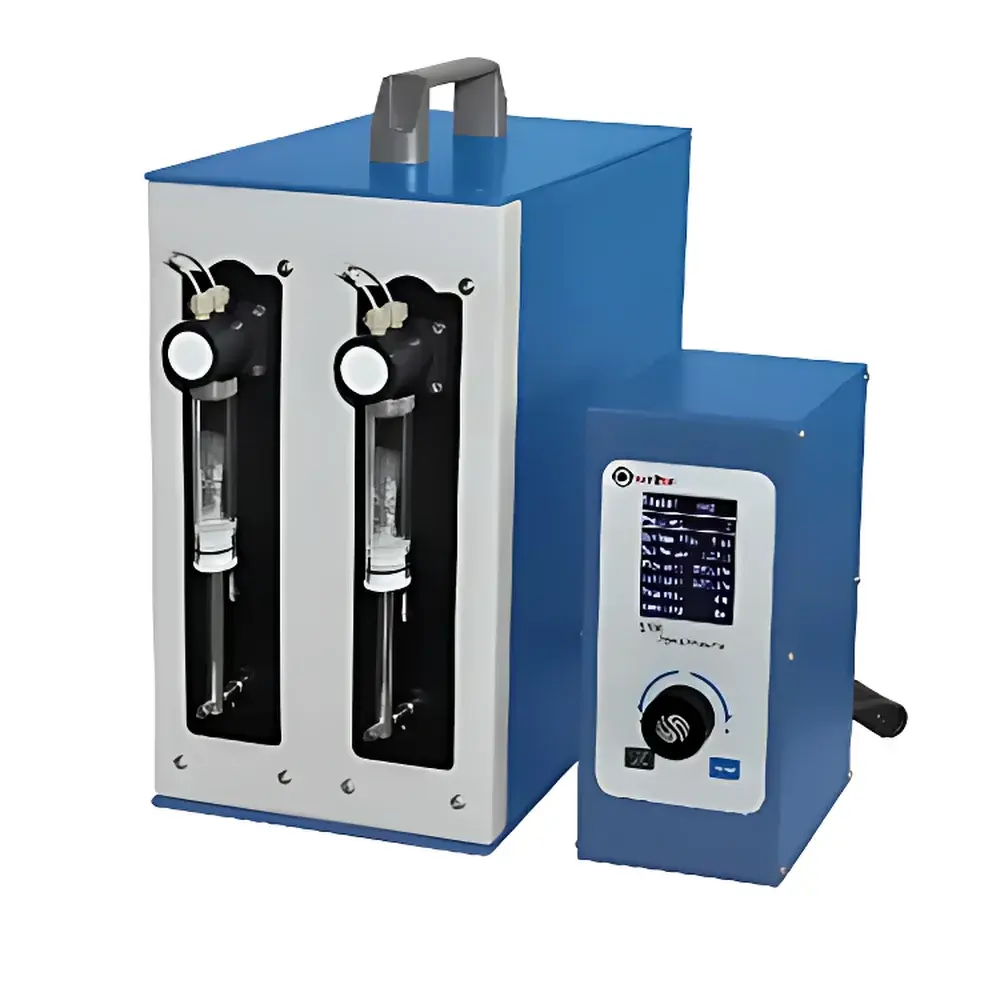
ChemTron Vdose2400 Dual-Channel Precision Liquid Dispensing Pump
| Brand | ChemTron |
|---|---|
| Origin | Germany |
| Model | Vdose2400 |
| Dispensing Unit Configuration | Dual-Channel |
| Flow Rate Range | 1.25 µL/min – 375 mL/min |
| Accuracy | ≤ 0.5% (5 ‰) |
| Dispensing Volume Range per Channel | 50 µL – 25 mL |
| Syringe Material Options | Borosilicate Glass / PTFE |
| Valve Material | Viton / PTFE |
| Valve Type | 3-Port Automated Switching Valve |
| Syringe Resolution | 1/6000 of total syringe volume |
| Communication Interface | RS-232 / RS-485 |
| Power Supply | 110–240 V AC, 50/60 Hz |
| Dimensions (H × W × D) | 305 × 178 × 330 mm |
| Weight | 9.1 kg |
| Order Code | V900702 |
Overview
The ChemTron Vdose2400 is a dual-channel precision liquid dispensing pump engineered for reproducible, programmable fluid handling in analytical laboratories, quality control environments, and automated synthesis workflows. Based on positive displacement piston-syringe actuation, the system operates via calibrated linear motor-driven syringes coupled with a three-port automated switching valve—enabling fully integrated draw, hold, and dispense cycles without manual tubing disconnection. Unlike peristaltic or gear-based pumps, the Vdose2400 eliminates pulsation, backflow, and fluid shear degradation, making it suitable for viscous, volatile, or particulate-laden solutions where volumetric fidelity is critical. Its modular architecture separates the control unit from interchangeable dispensing modules, allowing rapid reconfiguration between low-volume microdispensing (down to 50 µL) and high-throughput macro-transfer (up to 25 mL per channel). Designed and assembled in Germany, the instrument complies with IEC 61000-6-3 (EMC) and IEC 61010-1 (safety), supporting integration into ISO/IEC 17025-accredited testing labs and GLP-compliant environments.
Key Features
- Dual independent dispensing channels with synchronized or asynchronous operation—ideal for reagent addition, dilution series, or parallel sample preparation.
- Automated 3-port valve system enabling seamless suction, priming, dispensing, and waste recovery within a single fluid path—no tube swapping or manual intervention required.
- High-resolution linear actuation (1/6000 of syringe volume) ensures sub-microliter repeatability across the full flow range (1.25 µL/min to 375 mL/min).
- TFT color display with intuitive menu navigation provides real-time feedback on volume delivered, flow rate, valve position, error status, and elapsed cycle time.
- Chemically inert wetted path composed exclusively of borosilicate glass syringes and PTFE/Viton seals—compatible with organic solvents, strong acids, bases, and halogenated compounds.
- RS-232 and RS-485 serial interfaces support deterministic command protocols for integration with LIMS, SCADA systems, PLCs, or custom LabVIEW/Python automation frameworks.
Sample Compatibility & Compliance
The Vdose2400 accommodates a broad spectrum of liquid samples—from aqueous buffers and ethanol-based mobile phases to concentrated HCl (37%), NaOH (50%), acetonitrile, and glycerol-water mixtures (up to 80% w/w). Its glass/PTFE construction meets USP Class VI biocompatibility requirements and resists leaching under prolonged static exposure. The device supports audit-ready operation: all dispense events—including volume, timestamp, valve state, and syringe position—are loggable via serial output and can be mapped to electronic lab notebook (ELN) entries. While not intrinsically 21 CFR Part 11 compliant, its deterministic firmware architecture and non-volatile event logging enable validation pathways for regulated QC/QA applications under GMP/GLP frameworks. Optional firmware upgrades support configurable user roles, electronic signatures, and tamper-evident data export.
Software & Data Management
The Vdose2400 operates standalone via front-panel controls or connects to host software (e.g., ChemTron’s Vdose Control Suite or third-party drivers) for advanced protocol sequencing. Users define multi-step methods—including variable flow rates, pause intervals, conditional valve switching, and volume-triggered transitions—using a hierarchical step editor. All parameters are stored in non-volatile memory with version-stamped backups. Serial communication follows ASCII-based command syntax (e.g., “DISP 1,15.23,2.5” for Channel 1, 15.23 µL at 2.5 µL/s), ensuring deterministic parsing and minimal latency. Data output includes ASCII-formatted timestamps, actual dispensed volume (not just setpoint), motor step count, and valve transition logs—facilitating root-cause analysis during method transfer or troubleshooting.
Applications
- Automated titration workflows requiring precise acid/base addition with real-time pH feedback integration.
- Preparative HPLC fraction collection with volume- or UV-triggered dispensing.
- Cell culture media formulation and serial dilution in bioprocess development.
- Calibration standard preparation for ICP-MS, AAS, and UV-Vis spectrophotometry.
- In-line reagent dosing in continuous flow chemistry reactors (e.g., photochemical or enzymatic synthesis).
- Environmental sample preservation—adding preservatives (e.g., HNO₃, HgCl₂) to field-collected water specimens prior to transport.
FAQ
Can the Vdose2400 be validated for use in pharmaceutical QC labs?
Yes—the hardware design, traceable calibration routines, and deterministic serial logging support IQ/OQ/PQ documentation per ASTM E2500 and EU Annex 11 guidelines.
Is it possible to synchronize dispensing with external triggers (e.g., TTL signals)?
No native TTL input is provided; however, RS-485 polling or host-initiated command sequences allow tight coordination with external instruments via programmable delay and status polling.
What maintenance is required to sustain long-term accuracy?
Annual verification using certified gravimetric standards (e.g., ASTM E542) is recommended; syringe lubrication and valve seal inspection should occur every 6 months under continuous operation.
Does the system support syringe sizes beyond 25 mL?
No—the mechanical design and motor torque are optimized for the 50 µL–25 mL range; larger volumes require alternative pump architectures (e.g., peristaltic or diaphragm).
Can both channels dispense different liquids simultaneously into the same vessel?
Yes—via independent flow programming and timed valve actuation, enabling controlled mixing ratios without cross-contamination.



