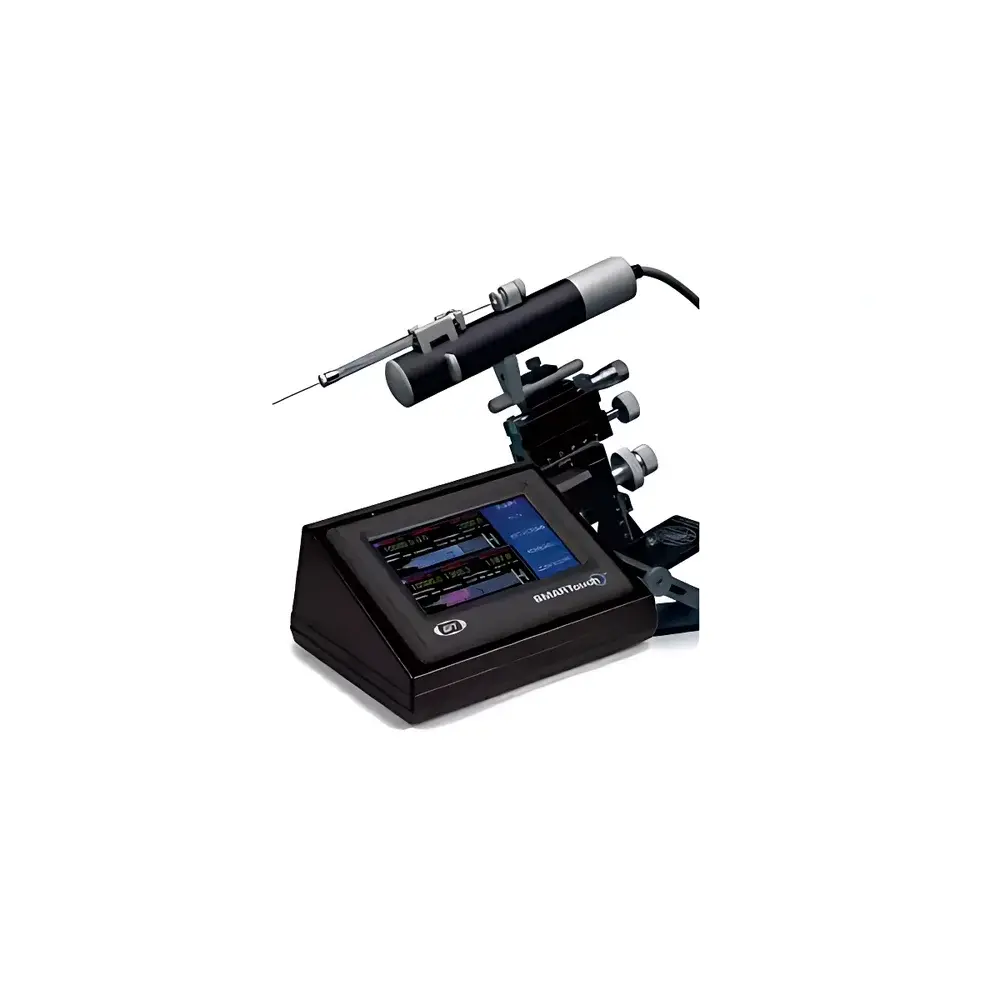
Chengmeng UMP3 Ultra-Micro Perfusion Pump
| Brand | Chengmeng |
|---|---|
| Origin | USA |
| Manufacturer Type | Authorized Distributor |
| Product Category | Imported Instrument |
| Model | UMP3 |
| Instrument Type | Motorized, Programmable |
| Reservoir Capacity | 580 µL |
| Syringe Volume Range | 0.5 µL to 1000 µL |
| Syringe Barrel Diameter | 5.5 mm to 9 mm (ISO Standard) |
| Minimum Dispensed Volume | 580 pL (with 10 µL syringe) |
| Flow Rate Range | 0.5 pL/s to 1000 µL/min (dependent on syringe geometry and motor resolution) |
| Step Resolution | Sub-nanoliter per step |
| Operating Temperature Range | 4–40 °C |
| Vibration Damping | Circular pump housing with optimized stepper motor mounting |
| Control Interface | Dual-channel capacitive touchscreen controller with endpoint limit protection, silent mode, and audit-ready parameter logging |
Overview
The Chengmeng UMP3 Ultra-Micro Perfusion Pump is an engineered solution for precision volumetric delivery in live-tissue microinjection applications. Built upon the validated mechanical architecture of the UMP and UMP2 platforms, the UMP3 integrates a circular, vibration-damped pump body designed to minimize mechanical coupling between the stepper motor and the injection apparatus—critical for intracranial procedures where submicron positional stability directly correlates with tissue integrity. Its core operating principle relies on high-resolution microstepping actuation of ISO-standard glass or plastic syringes (barrel diameters 5.5–9 mm), enabling deterministic displacement control across six orders of magnitude—from 580 picoliters (achieved using a calibrated 10 µL syringe) up to milliliter-scale infusions. Unlike pressure-driven systems, the UMP3 delivers volume-based, closed-loop dispensing without dependency on fluid viscosity or backpressure, making it suitable for consistent delivery of viscous viral vectors, fluorescent dyes, pharmacological agents, or electrophysiological solutions into neural, ocular, embryonic, or invertebrate tissues.
Key Features
- Circular pump housing geometry reduces resonant vibration amplitude by >60% compared to rectangular predecessors—validated via laser Doppler vibrometry at motor speeds up to 12,000 steps/sec.
- Dual-channel capacitive touchscreen controller supports synchronized or independent operation of two UMP3 units, with programmable endpoint limits to prevent over-travel and mechanical stall.
- Silent Mode function suppresses electromagnetic emissions from motor drivers during electrophysiological recording sessions, meeting IEC 61326-1 Class B EMC requirements for low-noise lab environments.
- Interchangeable Luer-lock adapters enable rapid transition between plastic syringes and borosilicate capillary needles (e.g., for stereotaxic deep-brain injections in mice), minimizing tissue shear stress and needle deflection.
- On-device parameter logging includes timestamped volume, speed, acceleration, and direction—exportable as CSV for GLP-compliant experiment documentation.
Sample Compatibility & Compliance
The UMP3 accommodates all ISO 7886-1 compliant syringes with barrel diameters from 5.5 mm (e.g., 10 µL Hamilton glass syringes) to 9 mm (e.g., 1 mL plastic syringes), supporting both aqueous and glycerol-based formulations. It has been validated for use with AAV vectors (1.5–2.5 × 10¹³ vg/mL), Alexa Fluor-conjugated dextrans (10–70 kDa), and osmotically balanced artificial cerebrospinal fluid (aCSF). The system complies with ISO 13485 design controls for medical device accessories and meets essential requirements under EU MDR Annex I for laboratory equipment used in preclinical research. All firmware operations adhere to ALCOA+ principles, with optional audit trail configuration compatible with FDA 21 CFR Part 11 electronic record requirements when deployed with validated LIMS integration.
Software & Data Management
The embedded controller runs real-time Linux OS with deterministic thread scheduling for sub-millisecond command latency. Parameter sets—including volume, ramp rate, dwell time, and acceleration profile—are stored in non-volatile memory with SHA-256 checksum validation. Exported logs include UTC timestamps, operator ID (via optional RFID badge reader), and digital signatures for traceability. Third-party API support (REST/HTTP and Modbus TCP) enables integration with MATLAB, Python-controlled behavioral rigs, or commercial electrophysiology suites (e.g., Spike2, Plexon OmniPlex). Firmware updates are delivered via signed OTA packages with rollback capability.
Applications
- Neuroscience: Stereotaxic delivery of optogenetic constructs into mouse substantia nigra pars compacta (SNc) or hippocampal CA1 with ≤50 µm targeting error.
- Ophthalmology: Subretinal injection of RPE-targeting AAVs using IO-KIT adapter kits; lens capsule delivery via RPE-KIT-compatible cannulas.
- Developmental Biology: Precise yolk sac or neural tube injection in zebrafish embryos (Danio rerio) at 24–48 hpf.
- Entomology: Hemolymph or central nervous system injection in Drosophila melanogaster adults or Manduca sexta larvae using tapered glass capillaries.
- Cardiovascular Research: Intramyocardial delivery of microRNA mimics in neonatal rat ventricular myocytes ex vivo.
FAQ
What syringe types are supported?
The UMP3 accepts all ISO 7886-1 standard syringes with barrel diameters between 5.5 mm and 9 mm—including glass (Hamilton, SGE), polypropylene (BD, Terumo), and fluoropolymer-coated variants.
Can the UMP3 be integrated into automated patch-clamp workflows?
Yes—its Modbus TCP interface allows synchronization with Axon MultiClamp amplifiers and pCLAMP acquisition software for stimulus-triggered drug application during whole-cell recordings.
Is calibration required before each experiment?
No routine recalibration is needed; however, volumetric verification using gravimetric methods (ASTM E542) is recommended quarterly or after syringe type changes.
Does the system support multi-step infusion protocols?
Yes—the touchscreen controller supports up to 99 sequential steps per channel, including variable flow rates, pauses, and bidirectional movement.
How is sterility maintained during long-term in vivo experiments?
All wetted components (Luer adapters, O-rings, syringe plungers) are autoclavable or ethylene oxide–compatible; sterile filtration (0.22 µm) of solutions prior to loading is advised per USP .
Related Products