
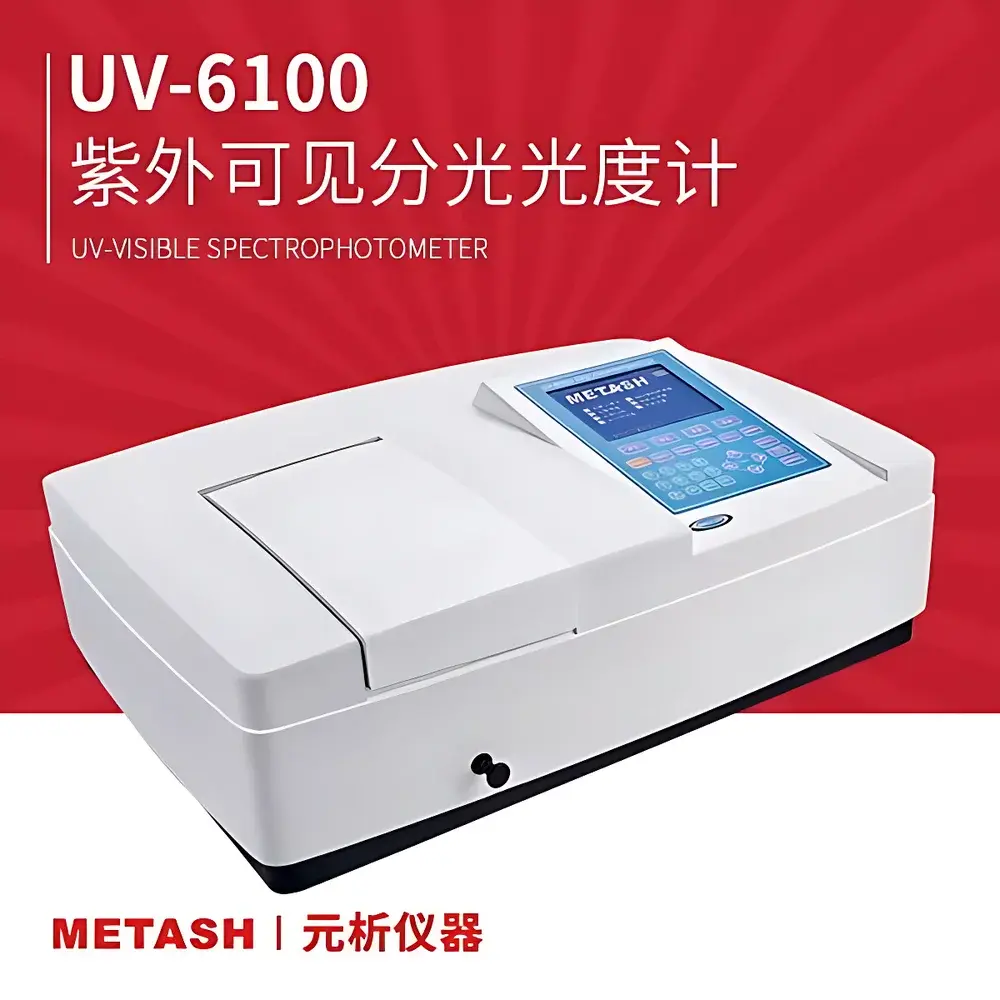
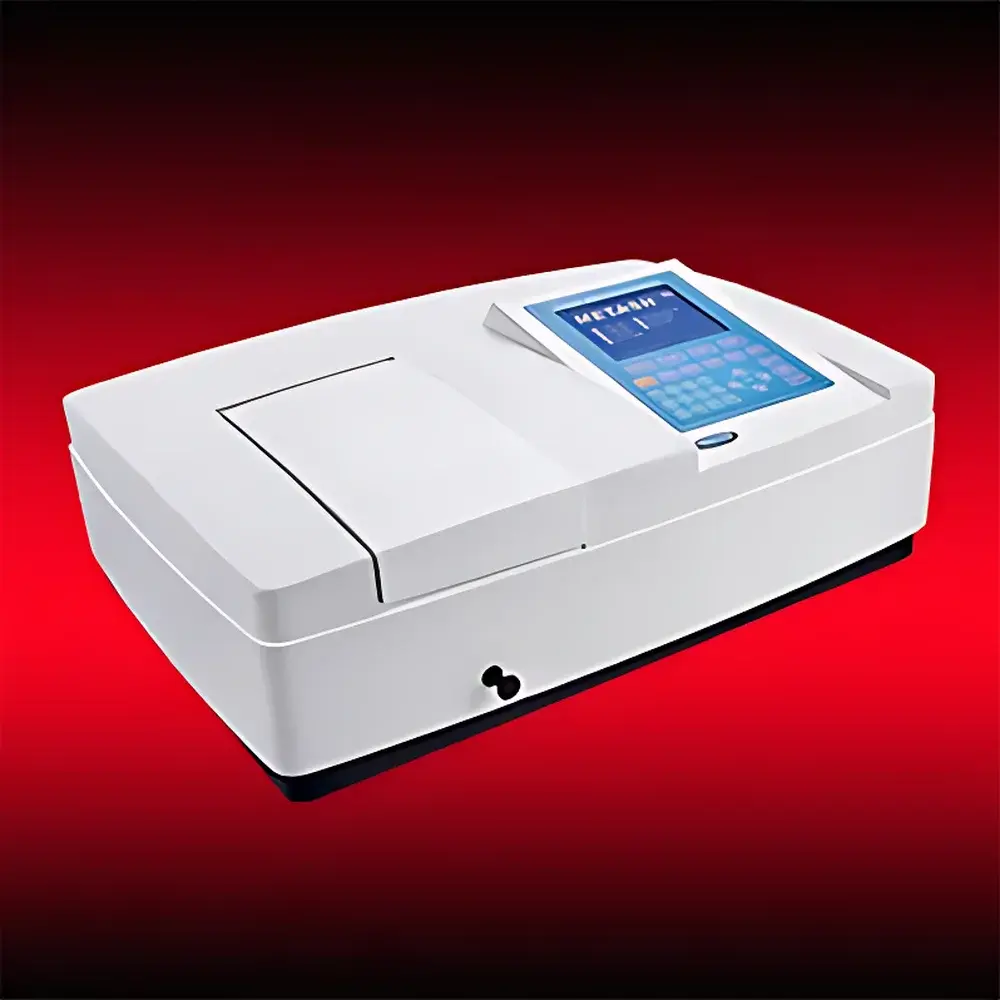
Metash UV-6100 Advanced Scanning UV-Vis Spectrophotometer
| Brand | Metash Instruments |
|---|---|
| Origin | Shanghai, China |
| Manufacturer Type | Original Equipment Manufacturer (OEM) |
| Product Category | Domestic |
| Model | UV-6100 |
| Price Range | USD 7,000–10,000 (FOB Shanghai) |
| Optical Design | Pseudo-Double-Beam Ratio-Monitoring System |
| Detector | Silicon Photocell |
| Wavelength Range | 190–1100 nm |
| Wavelength Scanning Mode | Motorized Auto-Scanning |
| Spectral Bandwidth (SBW) | 1.8 nm |
| Wavelength Accuracy | ±0.1 nm at 656.1 nm (Hg line), ±0.3 nm across full range |
| Wavelength Repeatability | ≤0.1 nm |
| Stray Light | ≤0.05% T at 220 nm (NaI) and 340 nm (NaNO₂) |
Overview
The Metash UV-6100 is a high-performance scanning ultraviolet-visible spectrophotometer engineered for precision quantitative and qualitative analysis in regulated and research laboratory environments. It operates on a pseudo-double-beam ratio-monitoring optical principle—where reference and sample beams are alternately measured via a rotating sector mirror—enabling real-time compensation for source intensity drift without requiring mechanical beam splitters or dual detectors. This architecture delivers enhanced photometric stability over extended acquisition periods, critical for kinetic assays, spectral scanning, and compliance-driven applications. The instrument covers the full UV-Vis spectrum from 190 nm to 1100 nm with a fixed 1.8 nm spectral bandwidth, optimized for resolution and signal-to-noise balance in routine QC and method development workflows. Its monochromator employs a Czerny-Turner configuration with holographic grating and precision stepper-motor-driven wavelength drive, ensuring repeatable positioning and long-term calibration integrity.
Key Features
- Pseudo-double-beam optical system with dynamic reference-beam monitoring to correct for lamp intensity fluctuations during measurement cycles
- 6-inch full-color LED TFT display with intuitive icon-based navigation—enables standalone operation without PC connection for absorbance, transmittance, concentration, and kinetic measurements
- Aerospace-grade 16 mm thick aluminum optical baseplate with suspended optical assembly—minimizes thermal drift and mechanical vibration transmission to the optical path
- Imported deuterium and tungsten-halogen lamps ensure stable output across UV and visible ranges; high-efficiency optics reduce stray light contribution
- Stray light performance ≤0.05% T (measured per ASTM E387 using NaI at 220 nm and NaNO₂ at 340 nm), supporting accurate low-transmittance measurements in turbid or highly absorbing samples
- Wavelength accuracy certified to ±0.1 nm at the hydrogen D-line (656.1 nm), traceable to NIST-standard spectral lines
Sample Compatibility & Compliance
The UV-6100 accommodates standard 10 mm pathlength cuvettes (glass, quartz, or plastic), as well as optional accessories including an 8-position automatic cell changer, micro-volume cuvette holders (down to 50 µL), temperature-controlled Peltier accessory (±0.1 °C stability), integrating sphere for diffuse reflectance, and fiber-optic probes for remote sampling. All hardware and firmware comply with IEC 61010-1 safety standards and electromagnetic compatibility (EMC) requirements per EN 61326-1. The embedded firmware and optional PC software support GLP/GMP operational frameworks: user-level access control (admin/operator/guest), full audit trail with timestamped event logging (including method edits, calibration updates, and data exports), electronic signature capability, and 21 CFR Part 11–compliant data archiving when used with validated software configurations.
Software & Data Management
The included Metash UVWin Pro software provides a comprehensive analytical platform compatible with Windows 10/11. It supports spectral acquisition (up to 3200 data points per scan), multi-wavelength quantitation, time-resolved kinetics (interval programmable from 0.1 s to 9999 s), DNA/protein A260/A280 ratio calculation with built-in extinction coefficients, and custom equation-based concentration modeling. Raw spectral data are stored in vendor-neutral CSV and JCAMP-DX formats; report templates adhere to ISO/IEC 17025 documentation requirements. Data export includes metadata embedding (instrument ID, operator, date/time, method parameters), and all processed results retain traceability to original scans. Software validation packages—including IQ/OQ documentation, test scripts, and UAT protocols—are available upon request for regulated laboratories.
Applications
The UV-6100 is routinely deployed in pharmaceutical QC labs for assay of active pharmaceutical ingredients (APIs) per USP , excipient purity verification, and dissolution profile monitoring. In academic and industrial chemistry settings, it supports reaction monitoring, equilibrium constant determination, ligand-binding studies, and colorimetric enzyme assays (e.g., ELISA, LDH, ALP). Environmental labs use it for nitrate/nitrite quantification (EPA Method 353.2), phosphate (ascorbic acid method), and heavy metal chelation analysis. Food and beverage labs apply it to carotenoid profiling, anthocyanin stability testing, and preservative (e.g., benzoate, sorbate) quantitation per AOAC guidelines. Its robust baseline stability and low stray light enable reliable measurements of biological macromolecules—including oligonucleotides, monoclonal antibodies, and recombinant proteins—in both purified and crude lysate matrices.
FAQ
Does the UV-6100 support wavelength calibration verification using standard reference materials?
Yes—built-in calibration routines accept NIST-traceable holmium oxide (Ho₂O₃) and didymium filters for periodic wavelength verification per ISO 6425.
Can the instrument perform simultaneous multi-wavelength kinetic measurements?
Yes—up to eight user-defined wavelengths can be monitored concurrently during time-scan mode, with independent smoothing and derivative options.
Is the optical baseplate thermally stabilized?
No active temperature control is integrated; however, the massive aluminum baseplate (16 mm thickness) provides high thermal mass and passive stabilization, reducing sensitivity to ambient fluctuations by >70% compared to conventional chassis designs.
What is the minimum detectable absorbance change under static conditions?
Photometric noise is ≤0.0003 Abs (RMS) at 0.5 Abs, measured at 500 nm with 1.0 nm SBW and 1 s integration time—enabling detection of sub-0.1% concentration changes in optimized assays.
Are firmware updates provided free of charge during the warranty period?
Yes—Metash offers complimentary firmware upgrades for bug fixes, regulatory enhancements (e.g., new audit trail fields), and minor feature additions for 24 months post-delivery, delivered via secure USB key or authenticated download portal.





