
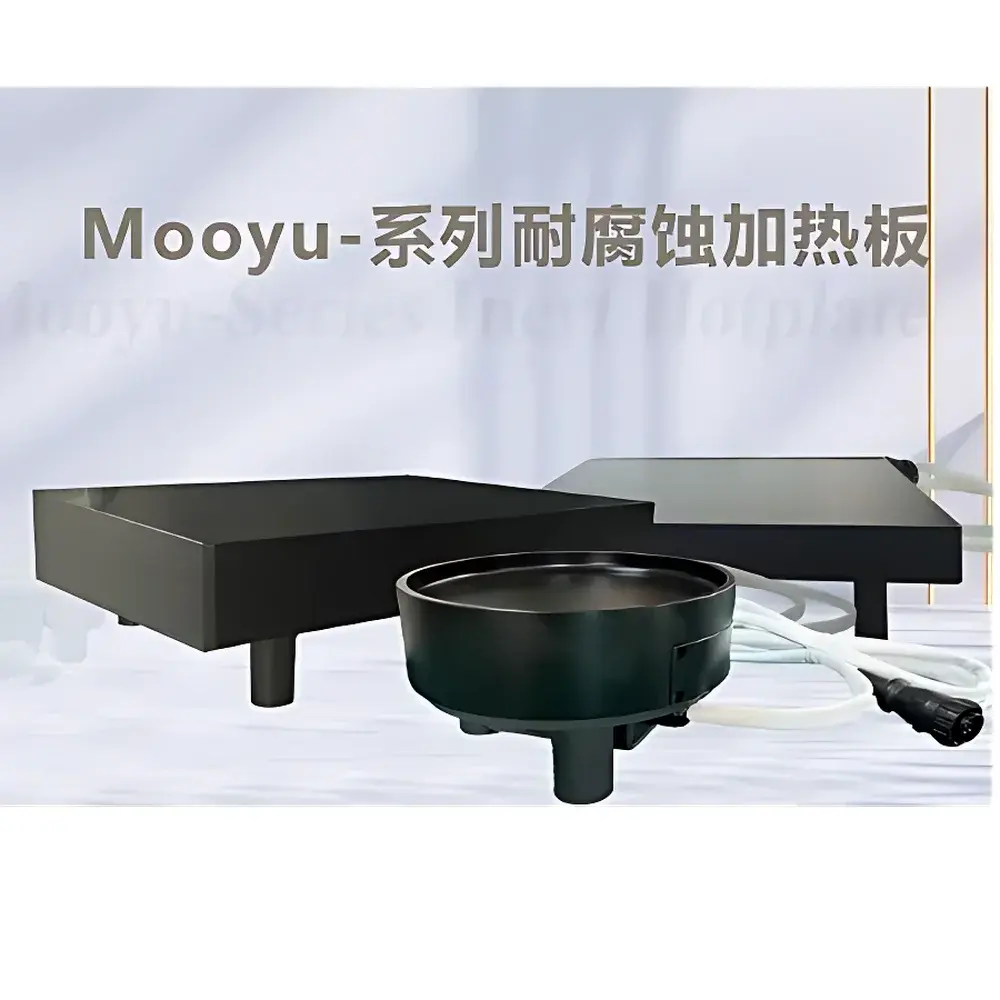
CHINYEE MOOYU-R3 Corrosion-Resistant Programmable Electric Heating Plate
| Brand | CHINYEE |
|---|---|
| Origin | Beijing, China |
| Manufacturer Type | Authorized Distributor |
| Country of Origin | China |
| Model | MOOYU-R3 |
| Heating Power | 2 kW |
| Maximum Temperature | 220 °C |
| Temperature Uniformity | ±1 °C (at 150 °C) |
| Plate Dimensions | 430 × 362 mm |
| Heating Zone Dimensions | 430 × 327 mm |
| Control System | Digital PID with LED Display |
| Surface Material | Isostatically Pressed Graphite with Full PFA Coating |
| Base Protection | Integrated PTFE Underlay |
| Cleanroom Compatibility | ISO Class 5 (100-grade) |
Overview
The CHINYEE MOOYU-R3 is a high-integrity, corrosion-resistant electric heating plate engineered for ultra-trace sample preparation in analytically demanding environments. Unlike conventional metal-sheathed or aluminum-block hotplates, the MOOYU-R3 employs a monolithic isostatically pressed graphite heating plate fully encapsulated in perfluoroalkoxy alkane (PFA), eliminating all metallic components from the thermal interface. This design ensures zero risk of elemental leaching—critical for applications where background contamination from Fe, Cr, Ni, Cu, or Zn must be suppressed below detection limits (e.g., sub-pg/g levels in ICP-MS analysis). Its operational principle relies on resistive Joule heating within the graphite matrix, coupled with precise closed-loop temperature regulation via a microprocessor-controlled PID algorithm. The unit is purpose-built for digestion, evaporation, and concentration steps in geochemical, semiconductor metrology, nuclear fuel cycle, and high-purity chemical synthesis workflows—particularly where compliance with ISO/IEC 17025, ASTM D5683 (for trace metal analysis), and USP heavy metals testing protocols is required.
Key Features
- 100% metal-free construction: No stainless steel, aluminum, or embedded heating wires exposed to sample environment—eliminates cross-contamination pathways.
- Isostatically pressed graphite core: Offers superior thermal conductivity (>120 W/m·K) and near-zero porosity (<0.05%), ensuring surface flatness ≤±5 µm and minimal adsorption of volatile analytes.
- Full-surface PFA coating: Chemically inert across pH 0–14; resistant to HF, aqua regia, fuming HNO₃, and molten alkali fluxes up to 220 °C.
- Precision PID control with real-time digital display: Resolution 0.1 °C; setpoint accuracy ±0.3 °C; ramp-and-soak programming capability with up to 10 user-defined segments.
- Integrated PTFE base underlay: Prevents heat transfer to laboratory bench surfaces and mitigates thermal drift caused by ambient conduction losses.
- Optimized thermal uniformity: ±1 °C across the entire 430 × 327 mm active heating zone at 150 °C—validated per ASTM E220-22 Annex A2 methodology.
- Designed for ISO Class 5 (100-grade) cleanrooms: Low particle shedding (<1 particle/cm²/min @ 0.5 µm), non-outgassing architecture, and static-dissipative housing.
Sample Compatibility & Compliance
The MOOYU-R3 accommodates standard borosilicate glass, quartz, PFA, and quartz-lined digestion vessels—including EPA Method 3050B/3052 vials, ASTM D5683 crucibles, and custom low-volume micro-digestion platforms. Its absence of metal ions satisfies stringent requirements for trace elemental analysis in environmental water, geological reference materials (e.g., NIST SRM 2711a), and high-purity semiconductor process chemicals (SEMI C12 purity grade). The device complies with IEC 61010-1:2010 for electrical safety in laboratory equipment and supports GLP/GMP audit readiness through deterministic temperature logging (via optional RS485/Modbus RTU interface) and configurable event-based data capture aligned with FDA 21 CFR Part 11 electronic record integrity guidelines.
Software & Data Management
While the MOOYU-R3 operates as a standalone instrument with intuitive front-panel controls, it supports external integration via industry-standard communication protocols. An optional RS485 port enables connection to LIMS or SCADA systems using Modbus RTU, allowing remote setpoint adjustment, real-time temperature streaming, and alarm-triggered data export (CSV/TXT). Firmware includes built-in calibration traceability: each unit ships with a factory-verified temperature uniformity map and NIST-traceable calibration certificate (per ISO/IEC 17025 accredited lab). Audit trails—recording operator ID, timestamp, setpoint changes, and deviation alerts—are stored onboard for ≥30 days and exportable for regulatory review.
Applications
- Acid digestion of soil, sediment, and biological tissues prior to ICP-OES/ICP-MS quantification.
- Low-blank evaporation of ultrapure reagents (e.g., sub-boiling distilled HCl, HNO₃) in cleanroom laminar flow hoods.
- Controlled thermal treatment of silicon wafers during pre-clean and post-etch residue analysis.
- Pre-concentration of seawater and groundwater samples for Sr/Nd/Pb isotopic ratio measurements.
- Heating of PFA vials in radiochemical separation workflows (e.g., actinide recovery from spent nuclear fuel).
- Stabilization of calibration standards in certified reference material production facilities.
FAQ
Is the MOOYU-R3 suitable for use with hydrofluoric acid (HF)?
Yes—the full PFA coating provides continuous resistance to concentrated HF up to 220 °C; however, vessel compatibility (e.g., PFA or quartz) must also be verified.
Can temperature uniformity be independently verified?
Yes—users may perform verification using calibrated thermocouple arrays per ASTM E220-22; CHINYEE provides a recommended probe layout and tolerance acceptance criteria with each unit.
Does the unit support multi-step temperature programs?
Yes—up to 10 programmable ramp/soak stages are supported via the PID controller’s built-in scheduler.
What is the expected service life under continuous 200 °C operation?
With proper thermal cycling management (≤3 cycles/day), the graphite-PFA assembly maintains specification compliance for ≥5 years based on accelerated aging tests per IEC 60068-2-14.
Is third-party calibration available?
Yes—CHINYEE partners with ISO/IEC 17025-accredited laboratories in North America and EU for on-site or return-to-factory calibration with uncertainty budgets reported to GUM guidelines.



