
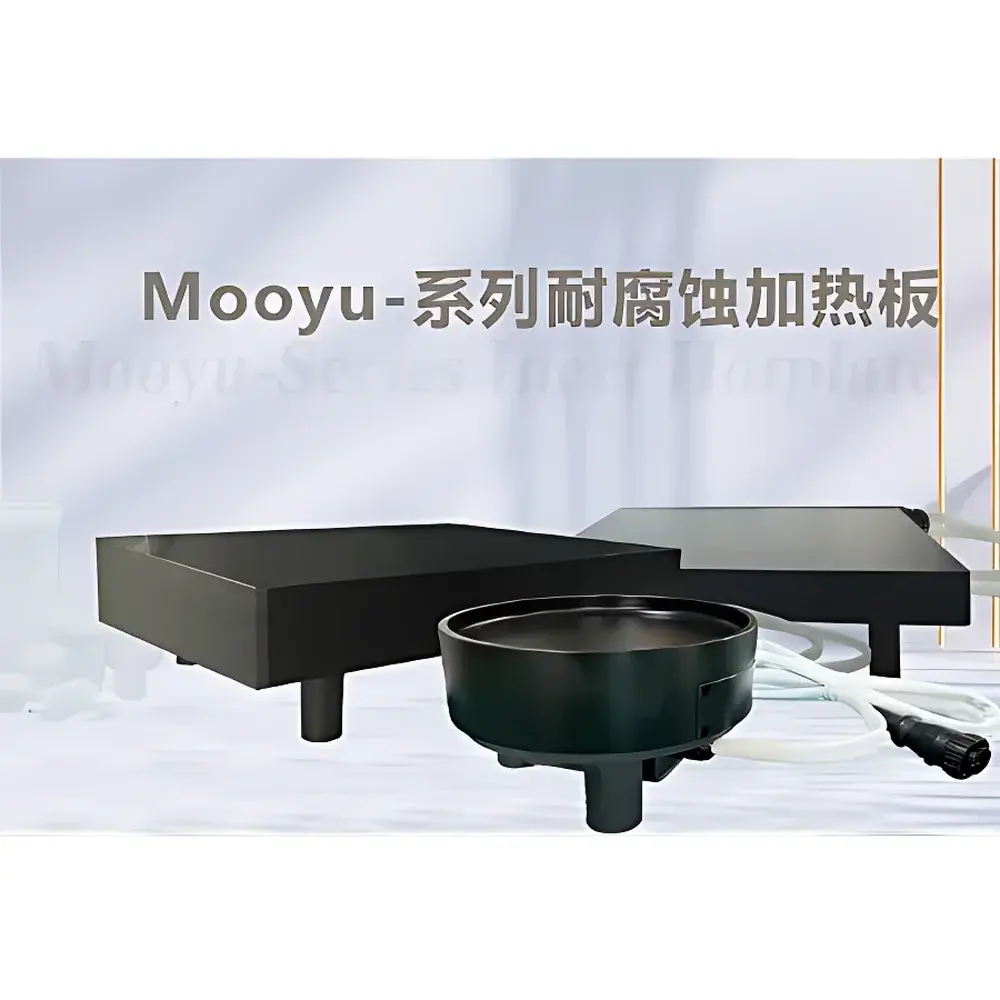
CHINYEE MOOYU-R4 Corrosion-Resistant Graphite Heating Plate with Full PFA Coating
| Brand | CHINYEE |
|---|---|
| Origin | Beijing, China |
| Manufacturer Type | Authorized Distributor |
| Country of Origin | China |
| Model | MOOYU-R4 |
| Heating Power | 1500 W |
| Max. Temperature | 220 °C |
| Temperature Uniformity | ±1 °C (measured across heating zone) |
| Plate Dimensions | 220 × 365 mm |
| Heating Zone Dimensions | 220 × 330 mm |
| Control System | Digital PID Controller with LED Display |
| Surface Material | Isostatically Pressed High-Density Graphite |
| Coating | Full-coverage PFA (Perfluoroalkoxy) |
| Base Protection | Integrated PTFE Underlay |
| Cleanroom Compatibility | ISO Class 5 (100-class) certified operation |
Overview
The CHINYEE MOOYU-R4 is a laboratory-grade corrosion-resistant heating plate engineered for ultra-trace sample preparation in highly sensitive analytical workflows. Unlike conventional metal-sheathed or ceramic heating platforms, the MOOYU-R4 employs a monolithic block of isostatically pressed high-density graphite as its thermal core—ensuring exceptional thermal conductivity, minimal thermal mass, and near-zero outgassing. Its entire working surface—including sidewalls and recessed zones—is uniformly coated with PFA (perfluoroalkoxy), a fluoropolymer offering superior chemical resistance to hydrofluoric acid, aqua regia, hot concentrated alkalis, and aggressive oxidants commonly used in geochemical digestion and semiconductor wafer cleaning. The unit operates without any exposed metallic components, eliminating risks of trace metal contamination—a critical requirement for ICP-MS, HR-ICP-MS, and GDMS sample introduction protocols. Designed for ISO Class 5 (100-class) cleanroom environments, it meets stringent particulate and leachate control standards required in microelectronics metrology and nuclear forensics laboratories.
Key Features
- Full PFA coating applied via electrostatic spray and high-temperature sintering—ensuring pinhole-free coverage and long-term adhesion under cyclic thermal stress (20–220 °C).
- Isostatically pressed graphite heating block with <0.5% porosity—providing rapid thermal response, low thermal drift (<0.2 °C/h at 180 °C), and uniform heat distribution across the 220 × 330 mm active zone.
- Digital PID temperature controller with ±0.3 °C setpoint accuracy, programmable ramp-soak profiles (up to 9 segments), and real-time deviation monitoring.
- Integrated PTFE base underlay prevents heat transfer to lab benches and eliminates condensation-induced corrosion on supporting surfaces.
- Front-panel LED display with intuitive navigation; no software dependency for basic operation—reducing validation burden in regulated environments.
- Compliance-ready architecture: All electronics conform to IEC 61000-6-3 (EMC emission limits) and IEC 61010-1 (safety for laboratory equipment); optional calibration certificate traceable to NIM (National Institute of Metrology, China).
Sample Compatibility & Compliance
The MOOYU-R4 is validated for use with borosilicate glass, quartz, PTFE, PFA, and quartz-lined digestion vessels—including EPA Method 3050B, 3051A, and 3052 applications. Its non-metallic construction ensures compatibility with ASTM D5683 (determination of trace metals in petroleum products) and ISO 17294-2 (water quality—ICP-MS analysis). The unit supports GLP-compliant documentation when paired with external data loggers (e.g., Omega OM-DAQPRO-5300) recording time-stamped temperature profiles. While not inherently 21 CFR Part 11 compliant, audit trails can be generated through third-party validated SCADA interfaces meeting ALCOA+ data integrity principles.
Software & Data Management
The MOOYU-R4 operates in standalone mode with no embedded firmware requiring cybersecurity validation. For automated workflows, analog 0–10 V or 4–20 mA output signals are available (optional module) to interface with PLC-based digestion systems or LIMS-integrated environmental monitoring networks. Temperature logs can be exported via RS-485 Modbus RTU protocol using industry-standard SCADA drivers (e.g., Ignition, WinCC). All configuration parameters—including max ramp rate, hold time, and over-temperature cutoff—are stored in non-volatile EEPROM with write-protection logic to prevent accidental modification during routine operation.
Applications
- Acid digestion of geological samples (silicates, ores, sediments) prior to multi-element analysis by ICP-OES/ICP-MS.
- Low-blank sample evaporation and concentration in clean chemistry labs handling seawater, polar ice cores, or atmospheric particulates.
- Pre-concentration of semiconductor process chemicals (e.g., HF/HNO₃ mixtures for Si wafer etch residue analysis).
- Controlled thermal treatment of calibration standards in reference material production facilities (ISO/IEC 17034 accredited).
- Heating of PFA vials in radiochemical separations where gamma-induced metal leaching must be avoided.
FAQ
Is the MOOYU-R4 suitable for hydrofluoric acid (HF) digestion?
Yes—the full PFA coating provides continuous protection against HF concentrations up to 49% w/w at temperatures ≤200 °C, validated per ASTM D471-18 (fluid resistance testing).
Does the unit include temperature calibration documentation?
Standard delivery includes a factory calibration report (NIST-traceable reference thermometer, 3-point verification at 50 °C, 120 °C, and 200 °C); UKAS-accredited calibration is available upon request.
Can the heating plate be integrated into an automated digestion system?
Yes—RS-485 Modbus RTU and analog output options enable seamless integration with robotic sample handlers and centralized process control systems.
What is the expected service life under continuous 220 °C operation?
Based on accelerated aging tests per IEC 60068-2-2, the PFA coating retains >95% adhesion strength after 2,000 hours at 220 °C; graphite block longevity exceeds 10 years under typical intermittent use (≤8 h/day).
Is cleanroom certification provided with shipment?
Each unit undergoes particle shedding testing per ISO 14644-1 Class 5 protocols in a certified laminar flow hood; a cleanroom suitability certificate is included in the shipping dossier.



