
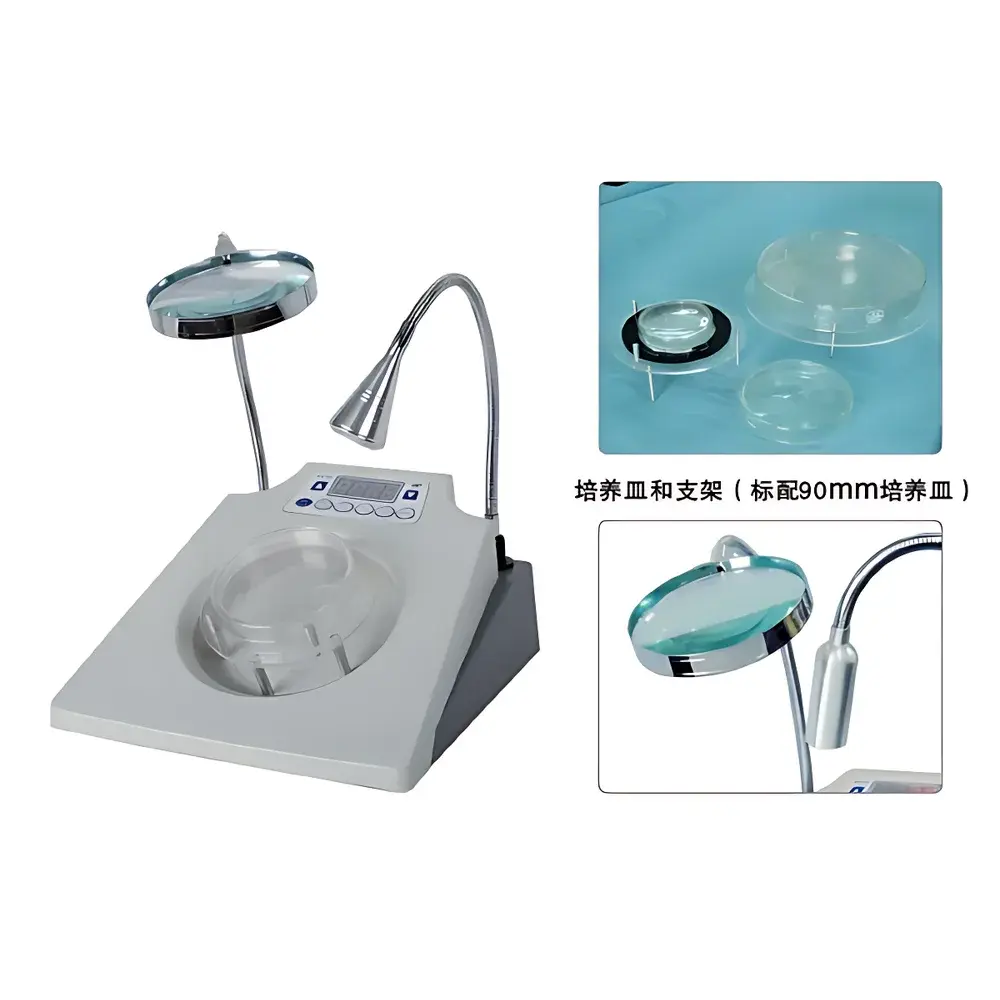
Chu Ding HCC-02 Semi-Automatic Colony Counter
| Brand | Chu Ding |
|---|---|
| Origin | Shanghai, China |
| Manufacturer Type | Authorized Distributor |
| Country of Origin | China |
| Model | HCC-02 |
| Instrument Type | Semi-Automatic Colony Counter |
| Counting Speed | 150 colonies/min |
| Optical Magnification | 3× and 6× |
Overview
The Chu Ding HCC-02 Semi-Automatic Colony Counter is a precision-engineered instrument designed for reliable, operator-assisted enumeration of microbial colonies on standard Petri dishes. Unlike fully automated image-based systems, the HCC-02 employs a tactile pressure-sensing counting mechanism grounded in human-in-the-loop verification—ensuring high traceability and minimal miscounting due to overlapping, faint, or atypical colony morphologies. The device operates on a capacitive pressure transduction principle: when a stylus applies calibrated force to the integrated electronic pressure pad beneath the Petri dish, a discrete count signal is generated and registered in real time. This method eliminates optical ambiguity associated with low-contrast colonies or agar surface irregularities, making it particularly suitable for routine QC laboratories where reproducibility, audit readiness, and procedural simplicity are prioritized over high-throughput automation.
Key Features
- Semi-automatic tactile counting via pressure-sensitive pad—no image analysis software required, reducing computational overhead and validation complexity.
- Dual-field LED illumination system with selectable bright-field and dark-field modes, optimized for visual differentiation of translucent, pigmented, or mucoid colonies on various agar media (e.g., TSA, PCA, VRBA, Sabouraud Dextrose Agar).
- Optical magnification options of 3× and 6×, enabling accurate discrimination of microcolonies ≥0.2 mm diameter without digital zoom artifacts.
- Adjustable pressure sensitivity threshold—calibrated to accommodate diverse stylus types (felt-tip pens, fine-point markers, ergonomic styluses) while minimizing false triggers from incidental contact.
- Configurable audible feedback per count (on/off toggle), supporting both focused manual counting and noise-sensitive environments such as cleanrooms or shared lab spaces.
- Built-in arithmetic averaging function: automatically computes mean colony counts across replicate plates—a critical capability for compliance with ISO 4833-1:2013 and FDA BAM Chapter 3 protocols.
- Real-time zero-reset functionality for rapid plate-to-plate transitions during batch testing sequences.
- USB interface enables direct connection to Windows-based laboratory PCs for timestamped parameter logging—including count timestamps, magnification setting, illumination mode, and user ID (when integrated with LIMS-compatible software).
Sample Compatibility & Compliance
The HCC-02 accommodates standard 90 mm and 100 mm Petri dishes (both plastic and glass), including vented and non-vented variants. Its mechanical design ensures stable positioning without slippage during repeated stylus actuation. The device conforms to general laboratory safety standards for Class II electrical equipment (IEC 61010-1). While not an ISO/IEC 17025-accredited instrument per se, its deterministic counting methodology supports GLP-compliant documentation workflows when paired with controlled SOPs and audit-trail-enabled data export. It meets functional requirements outlined in USP , ISO 7218:2017, and EN ISO 4833-1 for microbiological enumeration in food, pharmaceutical, cosmetic, and environmental testing laboratories.
Software & Data Management
The HCC-02 does not rely on proprietary image-processing algorithms; instead, it functions as a hardware counter with embedded firmware that records each count event locally. When connected to a host PC via USB, it emulates a HID (Human Interface Device) class peripheral, allowing seamless integration with spreadsheet applications (e.g., Microsoft Excel) or custom LIMS interfaces. Exported logs include date/time stamps, count sequence numbers, and optional operator identifiers. No cloud dependency or subscription licensing is involved—ensuring full data sovereignty and alignment with FDA 21 CFR Part 11 principles when used with appropriate electronic signature controls and system validation protocols.
Applications
This instrument is routinely deployed in quality control laboratories across regulated industries: enumeration of aerobic mesophilic bacteria in ready-to-eat foods (per ISO 4833-1); total viable counts in pharmaceutical water systems (USP ); bioburden assessment of non-sterile drug products; microbial load testing of cosmetics (ISO 17516); and coliform detection in drinking water (EPA Method 1603). Its tactile accuracy and low learning curve make it especially valuable for training new technicians, conducting proficiency testing, and performing confirmatory counts following automated system discrepancies.
FAQ
Is the HCC-02 compliant with regulatory standards for pharmaceutical microbiology?
Yes—the device supports execution of compendial methods requiring manual enumeration, and its deterministic counting logic facilitates straightforward validation under GMP Annex 1 and EU GMP Part II frameworks.
Can the pressure sensitivity be calibrated to match specific SOP requirements?
The sensitivity is user-adjustable across three discrete levels; however, formal calibration against traceable force standards requires external metrological verification, which may be performed during IQ/OQ qualification.
Does the unit store counts internally if not connected to a PC?
No—counts are displayed in real time and retained only on-screen until reset; persistent storage requires active USB connection and host-side logging.
What stylus types are recommended for optimal ergonomics and accuracy?
Felt-tip pens (e.g., Staedtler Lumocolor Fine Point) and soft-tipped electronic styluses (e.g., Wacom Intuos Pro stylus) provide consistent pressure distribution and minimize dish deformation.
Is dark-field illumination effective for detecting yeast colonies on chromogenic agar?
Yes—dark-field mode enhances edge contrast of low-pigment yeasts (e.g., Candida albicans on CHROMagar Candida), especially when combined with 6× magnification and proper agar thickness control.




