
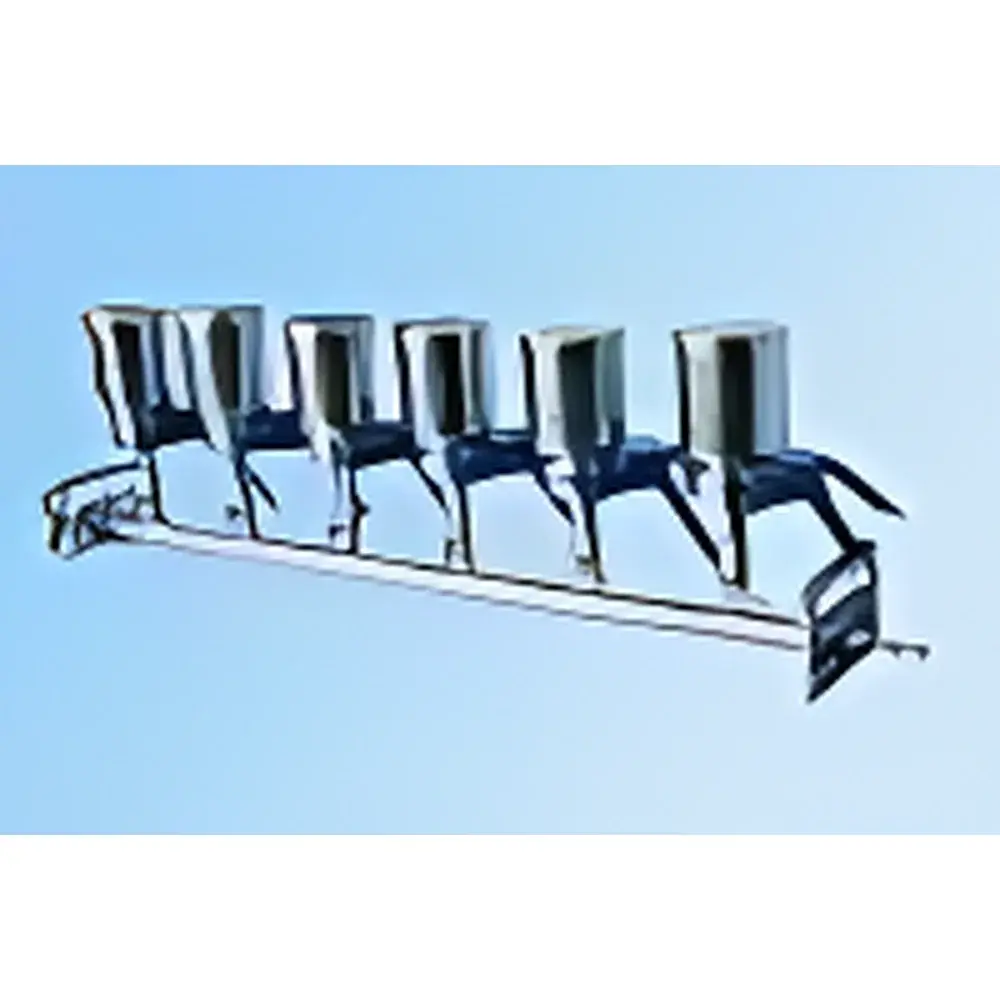
Chu Ding HSF-S6 Six-Station Stainless Steel Solution Filtration System (Microbial Filtration Assembly)
| Brand | Chu Ding Technology |
|---|---|
| Origin | Shanghai, China |
| Manufacturer Type | Authorized Distributor |
| Regional Classification | Domestic (PRC) |
| Model | HSF-S6 |
| Price | USD 2,850 (FOB Shanghai) |
Overview
The Chu Ding HSF-S6 Six-Station Stainless Steel Solution Filtration System is a modular, vacuum-driven microbial and particulate filtration platform engineered for high-throughput, contamination-controlled sample preparation in regulated laboratory environments. It operates on the principle of negative-pressure membrane filtration—where a calibrated vacuum source draws liquid samples through sterile, user-selected membranes mounted on precision-machined stainless steel filter heads. Unlike traditional borosilicate glass filter assemblies, the HSF-S6 eliminates breakage risk and thermal limitations by utilizing 316L austenitic stainless steel—a material certified to ASTM A240 and compliant with FDA 21 CFR Part 117 for food contact surfaces and ISO 8573-1 Class 2 for compressed air system compatibility. Its design supports both qualitative (e.g., microbial colony enumeration per ISO 7218 or USP ) and quantitative (e.g., suspended solids removal per EPA Method 160.2) filtration workflows without cross-contamination between stations.
Key Features
- Modular six-position configuration enables parallel processing of up to six independent samples under identical vacuum conditions—reducing inter-run variability and supporting statistical replication per ISO/IEC 17025 requirements.
- 316L stainless steel construction throughout all wetted components (filter cups, funnels, manifolds, and ball valves), ensuring resistance to >98% of common laboratory solvents, acids (including 6M HCl and 14M HNO₃), alkalis (up to 5M NaOH), and oxidizing agents—validated per ASTM G48 Practice A corrosion testing.
- Individual stainless steel ball valves with PTFE-sealed stems provide precise flow control per station; each valve is rated for 100,000+ actuation cycles and leak-tight performance at −0.095 MPa vacuum.
- Interchangeable aluminum clamping mechanism ensures uniform compressive load (±5 N) across membrane edges—critical for maintaining seal integrity during high-viscosity or particulate-laden filtrations.
- Integrated vacuum manifold with ISO-KF 25 port interface allows direct coupling to oil-free diaphragm pumps meeting ISO 8573-1 Class 0 purity standards, minimizing hydrocarbon carryover into filtrates.
Sample Compatibility & Compliance
The HSF-S6 accommodates standard 47 mm diameter membranes—including mixed cellulose ester (MCE), polyethersulfone (PES), nylon, polycarbonate track-etch (PCTE), and silver membrane variants—enabling method-specific selection per regulatory protocols. It is routinely deployed for: (1) microbiological analysis of water, pharmaceuticals, and cosmetics per ISO 11731, USP , and Ph. Eur. 2.6.27; (2) particulate quantification in injectables and parenterals per USP ; and (3) chlorophyll-a extraction in environmental water per APHA 10200 H. All stainless steel components are autoclavable at 121°C for 30 minutes (EN 285), supporting GLP/GMP-compliant sterilization validation. Device geometry conforms to ISO 7218 Annex B for membrane filter holder dimensional tolerances.
Software & Data Management
While the HSF-S6 is a manually operated mechanical system, its operational consistency supports full integration into electronic lab notebook (ELN) workflows. Each filtration event can be logged with metadata including operator ID, date/time stamp, membrane lot number, vacuum pressure reading (via external digital gauge), and sample identification—ensuring auditability per 21 CFR Part 11 when paired with compliant ELN platforms (e.g., LabArchives, Benchling). Optional vacuum monitoring modules with RS-485 output provide real-time pressure logging for trend analysis and preventive maintenance scheduling.
Applications
- Membrane filtration-based total viable count (TVC) and coliform enumeration in drinking water, wastewater, and bottled beverages per ISO 9308-1 and EPA Method 1603.
- Sterility testing of nonsterile pharmaceutical intermediates and final products per USP and Ph. Eur. 2.6.1.
- Removal of microplastics (>1 µm) from environmental aqueous matrices prior to FTIR or Raman analysis.
- Pre-filtration of HPLC mobile phases and sample solutions to protect analytical columns from particulate fouling.
- Concentration of low-abundance analytes (e.g., cyanobacteria, viruses) via tangential-flow compatible setups using stacked membrane cassettes.
FAQ
Can the HSF-S6 be used with aggressive organic solvents such as acetone or THF?
Yes—316L stainless steel exhibits excellent compatibility with common organics; however, PTFE gaskets (standard) must be verified for chemical resistance per manufacturer’s compatibility chart before extended exposure.
Is calibration required before first use?
No formal calibration is needed, but users should verify vacuum integrity using a calibrated digital manometer and confirm leak rate ≤0.5 mbar/min at −0.09 MPa per ISO 10573:2021 Annex C.
What is the maximum operating temperature for autoclaving?
All stainless steel components are rated for repeated autoclaving at 121°C, 103 kPa (15 psi) for 30 minutes; aluminum clamps require separate validation per EN 14181 due to thermal expansion differences.
Does the system support filter integrity testing (FIT)?
Yes—when used with hydrophilic membranes, the HSF-S6 permits forward-flow and bubble point tests per ASTM F838-22 using external test kits; manifold design ensures uniform pressure distribution across all six stations.
Are replacement parts traceable to material certifications?
Yes—each batch of 316L components ships with mill test reports (MTRs) per ASTM A480/A480M, including tensile strength, hardness, and intergranular corrosion test results.



