
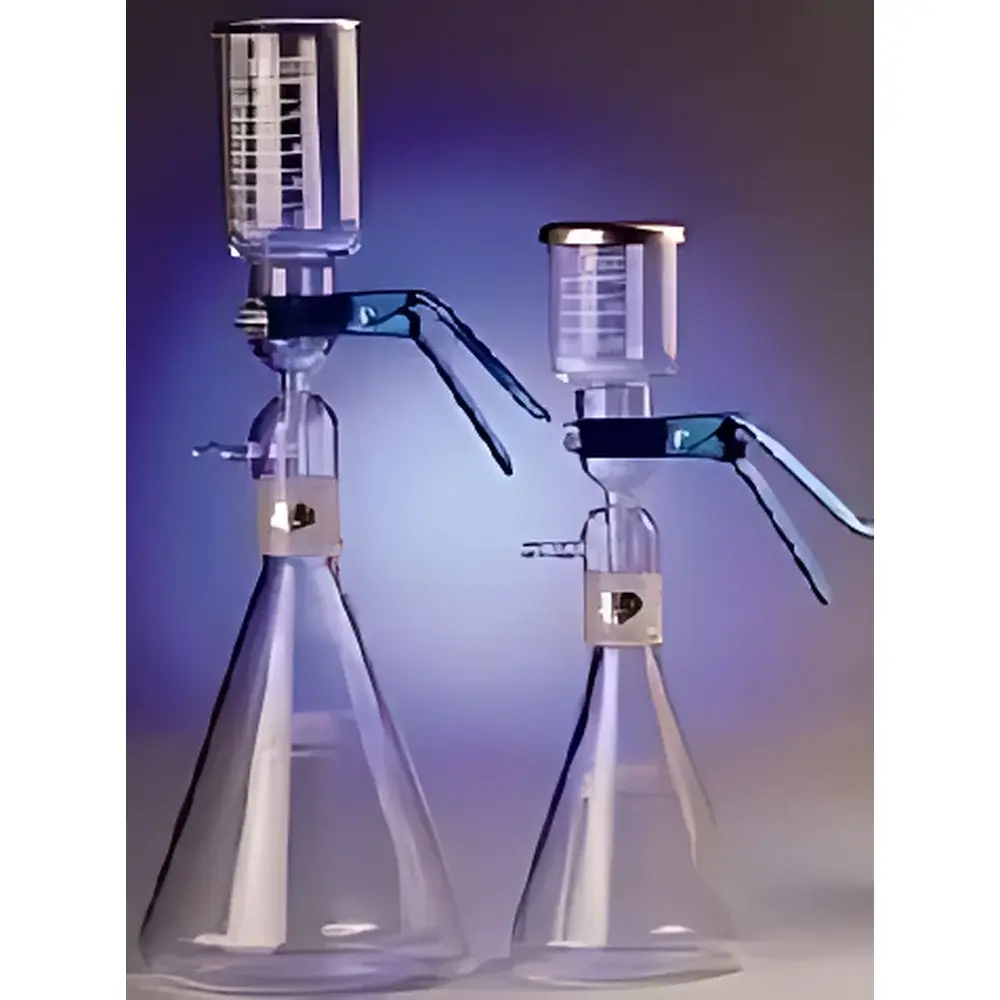
Chu Ding Technology 1000 mL Solvent Filtration Assembly for HPLC Mobile Phase Preparation
| Brand | Chu Ding Technology |
|---|---|
| Origin | Shanghai, China |
| Model | 1000 mL |
| Material | Borosilicate Glass (Type I) |
| Capacity | 1000 mL Collection Flask + 300 mL Filter Funnel |
| Filtration Surface | Fused Porous Glass Disc (Standard Pore Size: 10–16 µm, ASTM E128 Class C) |
| Max Operating Temperature | 270 °C |
| Chemical Resistance | High resistance to acids, alkalis, and common organic solvents (e.g., acetonitrile, methanol, THF, chloroform) |
| Interchangeability | Conforms to ISO 3585 and DIN 12331 dimensional standards for glassware compatibility |
Overview
The Chu Ding Technology 1000 mL Solvent Filtration Assembly is a precision-engineered vacuum-assisted filtration system designed specifically for the preparation and purification of HPLC mobile phases. It operates on the principle of gravity-assisted vacuum filtration, where negative pressure applied to the collection flask draws solvent through a sintered glass frit (sand core filter) seated in a calibrated filter funnel. This configuration enables rapid, particle-free clarification of solvents while simultaneously facilitating partial degassing—reducing dissolved oxygen and microbubbles that may otherwise induce baseline noise, pump cavitation, or column voiding in high-pressure liquid chromatography systems. Constructed entirely from premium-grade borosilicate glass (Type I), the assembly meets international specifications for thermal shock resistance (up to 270 °C), mechanical robustness, and chemical inertness across a broad pH and solvent spectrum. Its modular architecture supports seamless integration with standard laboratory vacuum sources (e.g., diaphragm or water aspirator pumps) and is routinely deployed in QC laboratories, pharmaceutical R&D, and academic analytical chemistry workflows where reproducibility and contamination control are critical.
Key Features
- Borosilicate glass construction compliant with ISO 3585 and DIN 12331 dimensional tolerances—ensures full interchangeability with major global brands including Schott, Kimble, and Wheaton.
- Uniform wall thickness and controlled annealing process deliver consistent pressure resistance and minimize risk of implosion under sustained vacuum (rated for continuous operation at ≤ −0.09 MPa).
- Integrated sintered glass frit disc (standard pore rating: 10–16 µm per ASTM E128 Class C) provides reliable particulate retention without leaching or extractables—critical for low-UV and trace-metal analysis.
- Calibrated 300 mL conical filter cup with volume markings (±2% accuracy) enables precise solvent dosing prior to filtration; 1000 mL triangular collection flask features reinforced base geometry and ground-glass joint (ISO K29/32) for secure, leak-tight sealing.
- Vacuum-compatible PTFE-coated stainless steel clamp ensures uniform compression force across the joint interface, eliminating gasket dependency and minimizing maintenance.
Sample Compatibility & Compliance
The assembly is validated for use with all standard HPLC-grade solvents—including aqueous buffers (pH 1–13), acetonitrile, methanol, isopropanol, tetrahydrofuran, dichloromethane, and ethyl acetate. It is not recommended for hydrofluoric acid, hot concentrated phosphoric acid, or molten alkali metals. The glass components are autoclavable (121 °C, 20 min) and compatible with gamma irradiation sterilization protocols. While the unit itself carries no regulatory certification, its materials and dimensional conformity support compliance with USP , ISO 17025 method validation requirements, and GLP documentation standards when used within controlled SOPs. No plastic or elastomeric wetted parts are present—eliminating concerns over extractables in sensitive LC-MS or ICP-MS applications.
Software & Data Management
This is a manually operated, non-electronic filtration system. No embedded firmware, software, or digital interfaces are included. All operational parameters—including vacuum level, filtration time, and volume processed—are recorded externally via laboratory notebooks or LIMS-integrated electronic lab notebooks (ELNs). For audit readiness, users are advised to document batch numbers of filters used, solvent lots, vacuum source calibration status, and visual inspection records per internal QA procedures aligned with FDA 21 CFR Part 11 principles (where handwritten entries are supplemented by digital signatures and version-controlled SOPs).
Applications
- Pre-filtration and inline degassing of mobile phases prior to HPLC, UHPLC, and LC-MS system priming.
- Clarification of sample diluents, standard stock solutions, and reconstitution solvents in pharmaceutical stability studies.
- Removal of particulates from buffer solutions containing salts prone to crystallization (e.g., phosphate, ammonium acetate).
- Preparative filtration of nanoparticle suspensions or colloidal standards where membrane filter clogging is problematic.
- Supporting ASTM D4176 (clarity testing of diesel fuels) and ISO 4020 (petroleum product filtration) when adapted with appropriate frit ratings.
FAQ
Is the sintered glass frit replaceable?
Yes—the fused disc is mechanically retained and can be removed, cleaned via nitric acid soak or ultrasonic bath, and reinstalled without tools.
Can this assembly be used under positive pressure?
No—it is engineered exclusively for vacuum-driven filtration; pressurized operation risks joint failure and glass fracture.
What vacuum level is recommended for optimal flow rate without foaming?
A stable vacuum of −0.07 to −0.085 MPa is typical; higher differentials may cause turbulent flow and aerosol carryover into the collector.
Are custom pore sizes available for the frit?
Yes—optional frits rated at 5 µm (Class B), 30 µm (Class D), or 50 µm (Class E) per ASTM E128 are available upon request.
Does the unit include a vacuum hose or pump?
No—vacuum source and tubing must be supplied separately; we recommend using fluoropolymer-reinforced vacuum hose rated to ≥ −0.1 MPa.



