
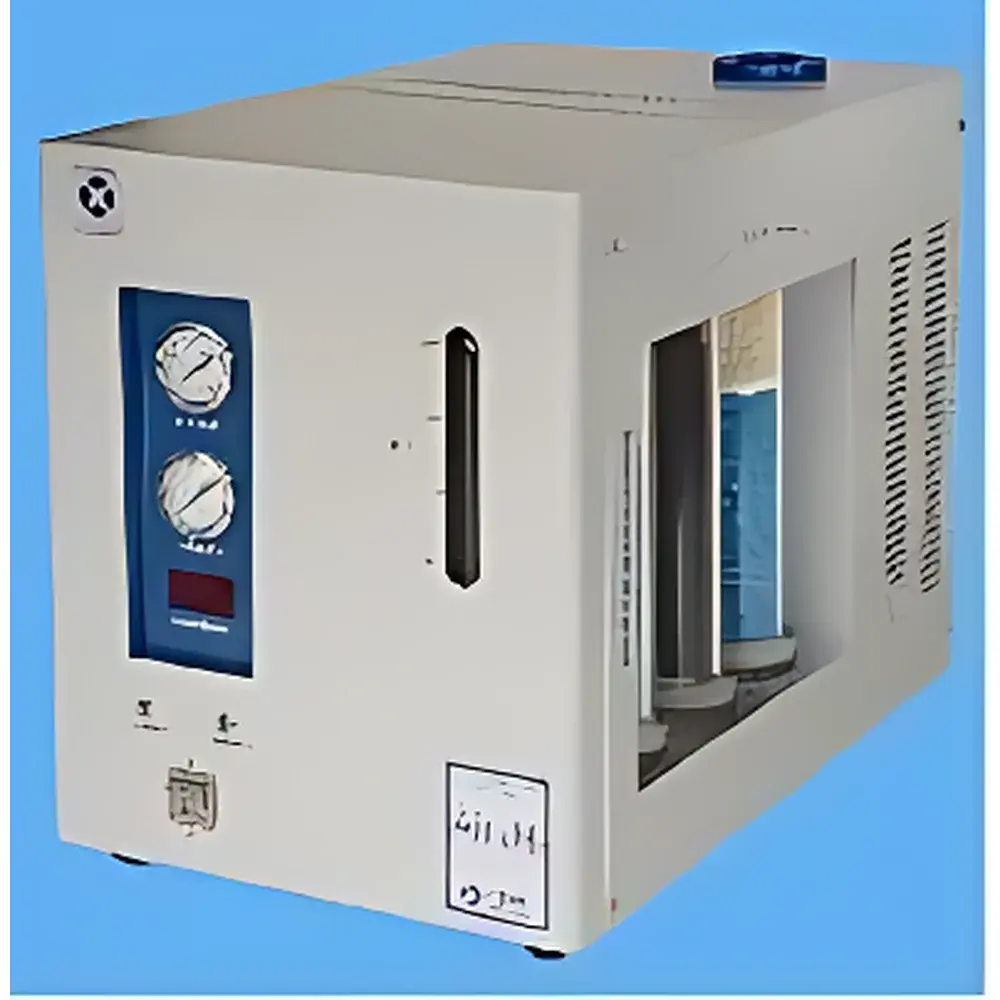
Chu Ding Technology XYAH-300 Hydrogen-Air Combined Gas Generator
| Brand | Chu Ding Technology |
|---|---|
| Origin | Shanghai, China |
| Model | XYAH-300 |
| Air Flow | 0–2000 mL/min @ 0–0.5 MPa (factory-set at 0.4 MPa) |
| H₂ Flow | 0–300 mL/min @ 0–0.4 MPa |
| H₂ Purity | 99.999% |
| Max Power | 350 W |
| Dimensions | 480 × 300 × 365 mm |
| Warranty | 12 months |
Overview
The Chu Ding Technology XYAH-300 Hydrogen-Air Combined Gas Generator is an integrated, benchtop laboratory gas supply system engineered for consistent, on-demand delivery of high-purity hydrogen and instrument-grade compressed air—specifically optimized as carrier, fuel, and combustion gases for gas chromatography (GC), GC–MS, and related analytical platforms. Unlike traditional high-pressure cylinder systems, the XYAH-300 employs membrane-separated alkaline electrolysis for hydrogen generation and a multi-stage oil-free compression and filtration architecture for air production. This dual-path design eliminates reliance on external gas cylinders while maintaining strict compliance with ISO 8573-1 Class 1 compressed air quality requirements and ASTM D6300 specifications for hydrogen purity in chromatographic applications. The unit operates continuously under ambient conditions (15–30 °C, <80% RH), delivering stable flow rates without output decay over extended duty cycles—critical for unattended overnight GC runs or multi-day method validation protocols.
Key Features
- Compact footprint (480 × 300 × 365 mm) enables seamless integration into crowded GC workstations or fume hood environments.
- Dual independent gas paths: Alkaline electrolytic H₂ generation with cylindrical cell design featuring automatic anti-alkaline backflow protection; air path incorporating two-stage pressure regulation and three-stage filtration (particulate → activated carbon → desiccant).
- H₂ output purity certified at ≥99.999% (residual O₂ <1 ppm, H₂O <1 ppm, total hydrocarbons <0.1 ppm) verified via onboard electrochemical sensors and traceable to NIST-traceable calibration standards.
- Real-time digital LED display showing simultaneous H₂ and air flow rates (mL/min), system pressure (MPa), and operational status—enabling immediate verification of gas delivery alignment with method parameters.
- Integrated safety architecture: Overpressure cut-off valves on both gas lines (H₂: 0.45 MPa, Air: 0.55 MPa), thermal shutdown at >75 °C, and automatic power-down upon low-water detection in the electrolyte reservoir.
- Low-maintenance operation: Requires only periodic replenishment of deionized water (≥15 MΩ·cm resistivity) every 7–10 days under continuous 300 mL/min H₂ + 2000 mL/min air load; no consumable filters or membranes within first 12 months.
Sample Compatibility & Compliance
The XYAH-300 is validated for use with all major GC platforms requiring H₂ as fuel gas (FID, FPD, NPD) and/or carrier gas (when configured for low-flow capillary applications), as well as air-dependent detectors (e.g., ECD make-up gas, PID support). Its output meets the gas quality prerequisites defined in USP , EP 2.2.46, and ISO/IEC 17025-accredited laboratories for routine QC testing. The unit complies with IEC 61010-1:2010 for electrical safety and carries CE marking per EU Machinery Directive 2006/42/EC. While not intrinsically rated for Zone 1 hazardous areas, its sealed electrolysis chamber and absence of ignition sources permit safe operation in general laboratory zones per NFPA 55 and CGA G-13 guidelines—provided adequate ventilation (>6 air changes/hour) is maintained.
Software & Data Management
The XYAH-300 operates as a standalone hardware module with no embedded firmware or network interface. All operational parameters are monitored locally via front-panel LED indicators; no data logging, remote control, or USB/RS-232 connectivity is provided. For GLP/GMP-regulated environments, users may integrate the generator into existing facility monitoring systems using optional 4–20 mA analog outputs (available as field-installable upgrade kit) for continuous recording of H₂ flow and system pressure. Audit trails for maintenance events (e.g., water refills, filter replacements) must be manually documented per internal SOPs—no electronic record retention or 21 CFR Part 11-compliant user authentication is implemented.
Applications
- Routine gas chromatographic analysis in pharmaceutical QC labs (residual solvent testing, assay quantification).
- Environmental testing laboratories performing EPA Method 8260/8270 analyses using FID and ECD detection.
- Academic research settings requiring stable, low-cost H₂ supply for method development and column conditioning.
- Food & beverage labs conducting fatty acid methyl ester (FAME) profiling via GC-FID.
- Contract testing organizations supporting multi-instrument GC fleets where cylinder logistics and certification overhead are cost-prohibitive.
FAQ
What is the minimum water resistivity required for optimal H₂ purity?
Deionized water with resistivity ≥15 MΩ·cm (ASTM D1193 Type I) is mandatory. Tap water or distilled-only water will accelerate electrode degradation and reduce H₂ purity below specification.
Can the XYAH-300 supply hydrogen as a carrier gas for capillary GC columns?
Yes—when operated at ≤30 mL/min H₂ flow with back-pressure regulation, it delivers laminar, pulse-free output suitable for split/splitless inlets and PTV injectors per ASTM D3612 Annex A1 recommendations.
Is routine filter replacement required within the first year?
No. The three-stage air filter cartridge and hydrogen particulate filter are rated for ≥5000 hours of continuous operation under specified inlet air quality (ISO 8573-1 Class 4); replacement is only necessary if pressure drop exceeds 0.1 MPa across the filter housing.
Does the unit support external pressure control via analog signal?
Not by default. Analog output capability (4–20 mA for H₂ flow and pressure) is available as a factory-installed option—contact technical support prior to ordering to specify this configuration.
What documentation is provided for regulatory submissions?
A Certificate of Conformance (CoC), Factory Calibration Report (including H₂ purity test data), and Electrical Safety Test Report per IEC 61010-1 are included. Full IQ/OQ protocol templates are available upon request for qualification under ISO/IEC 17025 or FDA 21 CFR Part 11 frameworks.




