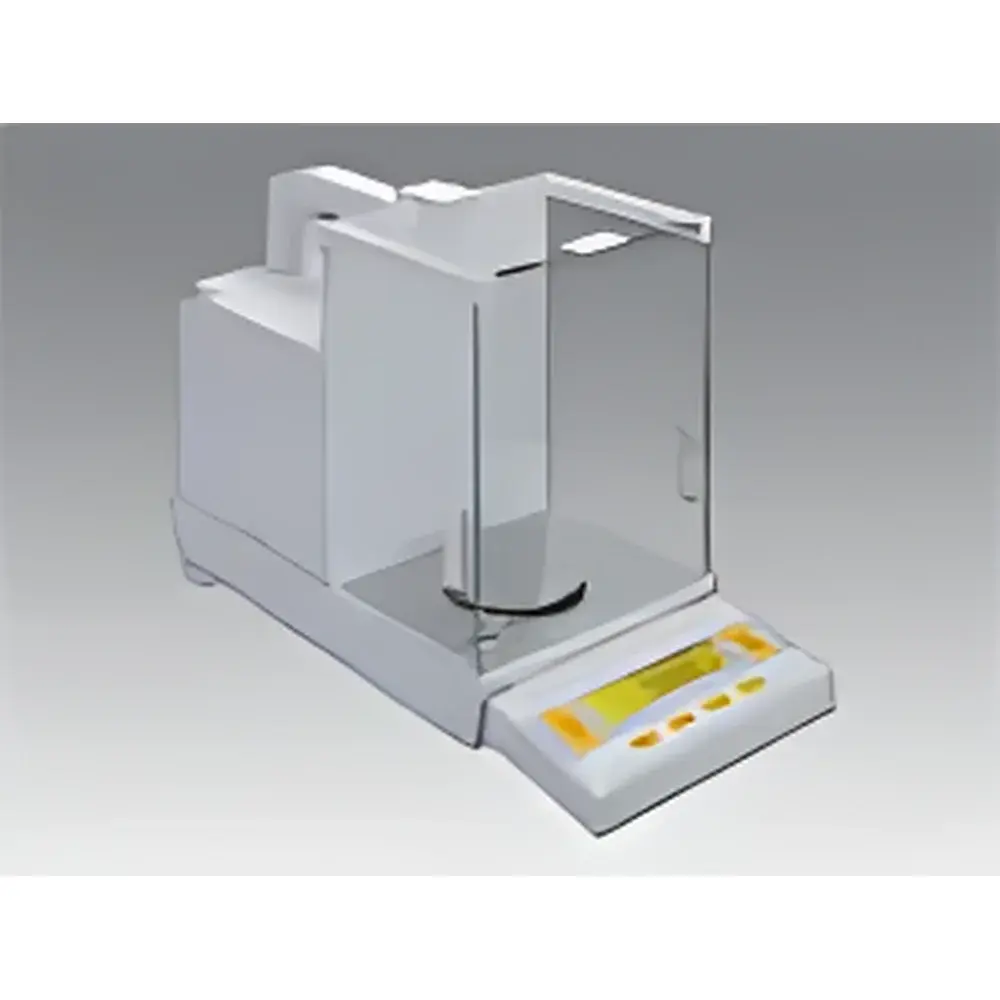
Chu Ding Technology FA1004 Precision Analytical Balance (0.1 mg readability)
| Brand | Chu Ding Technology |
|---|---|
| Origin | Shanghai, China |
| Model | FA1004 |
| Capacity | 100 g |
| Readability | 0.1 mg |
| Repeatability | ≤ 0.1 mg |
| Linearity | ±0.2 mg |
| Draft Shield Dimensions | 195 × 160 × 235 mm |
| Overall Dimensions | 195 × 445 × 300 mm |
| Pan Diameter | Φ90 mm |
| Power Options | AC adapter or 9 V battery |
| Interface | RS232 |
| Compliance | Designed for GLP/GMP-aligned laboratory workflows |
| Features | Electromagnetic force compensation sensor, internal calibration, dynamic temperature compensation, adjustable weighing speed, auto-zero tracking, overload protection, counting & percentage weighing, multi-unit conversion (g, oz, ct) |
Overview
The Chu Ding Technology FA1004 Precision Analytical Balance is a high-accuracy mass measurement instrument engineered for laboratories requiring consistent 0.1 mg readability across a 100 g capacity range. It employs electromagnetic force compensation (EMFC) technology — a fundamental principle in modern analytical balances — wherein the mass-induced displacement of the weighing pan is counteracted by a precisely regulated electromagnetic current; the resulting current magnitude is directly proportional to the sample mass and digitally converted into a stable, high-resolution reading. Unlike strain-gauge-based systems, EMFC eliminates mechanical hysteresis, creep, and long-term drift, delivering superior linearity (±0.2 mg) and repeatability (≤0.1 mg) under controlled ambient conditions. The balance is constructed with a hybrid metal-plastic housing, a corrosion-resistant stainless-steel weighing pan (Φ90 mm), and an integrated draft shield (195 × 160 × 235 mm) to mitigate air-current interference — essential for microgram-level stability. Its dual-power capability (AC adapter or 9 V battery) supports flexible deployment in field labs, teaching environments, or mobile QC stations where outlet access is limited.
Key Features
- Electromagnetic force compensation (EMFC) sensor architecture for zero-mechanical-wear operation and long-term metrological stability
- Adjustable weighing speed and dynamic temperature compensation algorithm to minimize thermal drift during extended sessions
- Four-stage shock absorption system optimized for benchtop environments subject to minor vibrations or footfall
- Backlit LCD display with user-selectable contrast and brightness; supports multiple display modes (gross/net/tare)
- Internal RS232 serial interface compliant with standard laboratory data logging protocols; enables direct connection to PCs, printers, or LIMS
- Integrated below-pan weighing hook for density determination and suspended-load applications
- Configurable auto-zero tracking, programmable auto-calibration intervals, and factory-reset functionality for audit-ready configuration management
- Overload protection with audible and visual alerting; automatic shutdown upon sustained overcapacity exposure
Sample Compatibility & Compliance
The FA1004 accommodates solid, granular, and powdered samples within its 100 g limit, with optimal performance achieved using containers of ≤50 g tare mass to preserve resolution. Its sealed pan chamber and low-profile draft shield permit routine handling of hygroscopic or volatile substances when combined with rapid enclosure and minimal door-opening duration. While not certified to ISO/IEC 17025 or OIML R76 out-of-the-box, the balance’s design adheres to foundational metrological principles referenced in ASTM E898–22 (Standard Guide for Selection and Use of Laboratory Balances) and supports GLP/GMP documentation requirements via its RS232 output, timestamped calibration logs, and traceable parameter settings. Internal calibration routines follow manufacturer-defined procedures aligned with USP and EP 2.1.6 guidelines for analytical balance verification.
Software & Data Management
Data acquisition is facilitated through native ASCII protocol over RS232, supporting integration with third-party software including LabSolutions, WinWedge, and custom Python/Node.js serial parsers. Each transmission includes weight value, unit code (g/oz/ct), status flags (e.g., “STABLE”, “OVERLOAD”, “CALIBRATING”), and optional time stamp when synchronized with host clock. The balance stores up to 99 calibration events in non-volatile memory, each tagged with date, operator ID (if entered), and deviation values — enabling retrospective review during internal audits. All configuration changes (e.g., auto-zero threshold, display mode, unit preference) are retained after power cycle, satisfying basic 21 CFR Part 11 readiness when paired with validated host software enforcing electronic signatures and audit trails.
Applications
This instrument serves as a primary mass standard in academic teaching labs for stoichiometric experiments, pharmaceutical formulation development (API weighing per ICH Q5C), raw material QC in food and chemical manufacturing, catalyst loading in catalysis research, and reference standard preparation in environmental testing labs. Its counting function (with user-input part weight) supports inventory control of small hardware components; percentage weighing aids in dilution series preparation; and density determination mode (via sinker method) supports polymer and ceramic characterization. The FA1004 is routinely deployed in ISO 17025-accredited facilities for non-critical intermediate checks where full traceability to national standards is maintained via external calibration with Class E2 weights.
FAQ
What calibration standards are recommended for routine verification?
Class E2 stainless-steel weights (certified to ISO 9001 or ISO/IEC 17025) are recommended for daily verification at 5%, 50%, and 100% of capacity.
Does the FA1004 support external calibration with user-provided weights?
Yes — external calibration mode accepts manual entry of reference weight value and initiates adjustment of internal gain parameters accordingly.
Is the RS232 interface optically isolated?
No — it is electrically isolated via on-board transient voltage suppression but does not include galvanic isolation; use of a USB-to-RS232 converter with isolation is advised in noisy industrial settings.
Can the balance operate continuously on battery power?
Battery life is approximately 8–12 hours under typical intermittent-use conditions; continuous operation depletes the 9 V alkaline cell within 4–6 hours.
How is temperature drift compensated during extended weighing sessions?
The built-in thermistor monitors internal sensor housing temperature in real time, applying a linear correction coefficient derived from factory thermal mapping across 15–30 °C.