
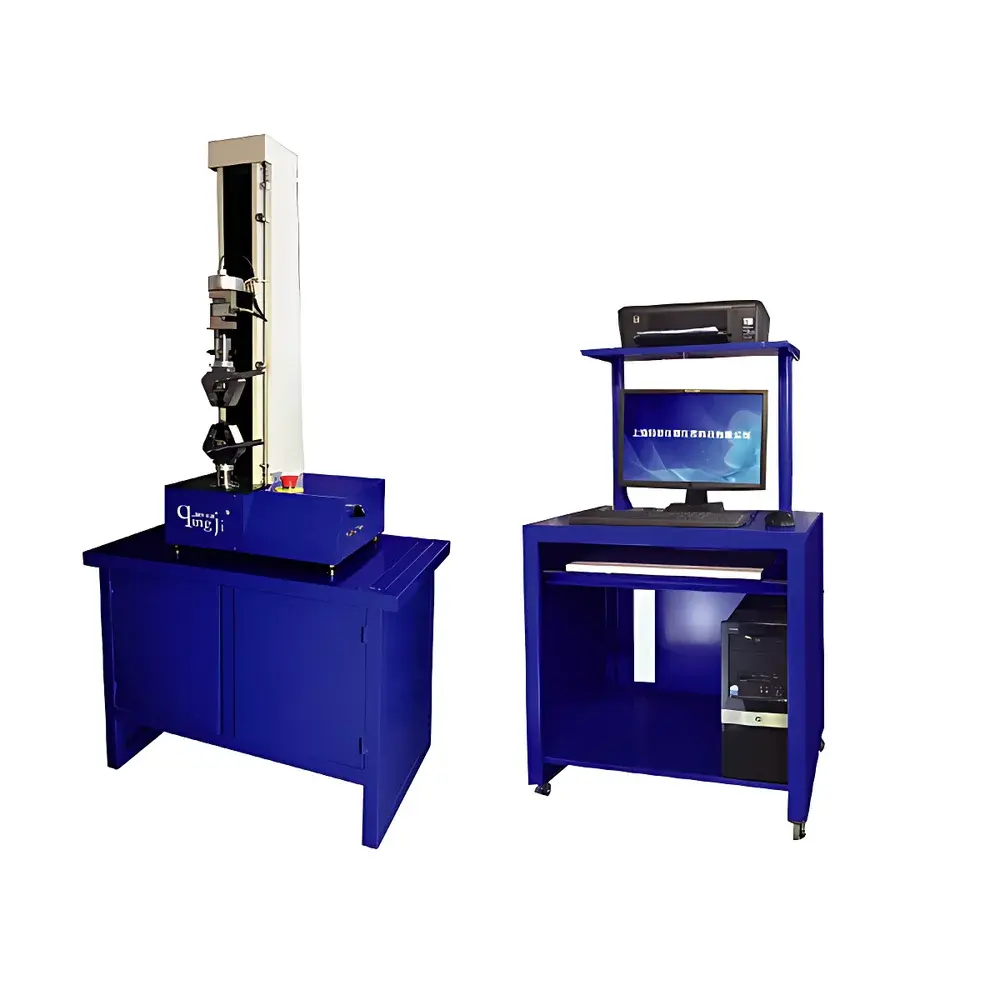
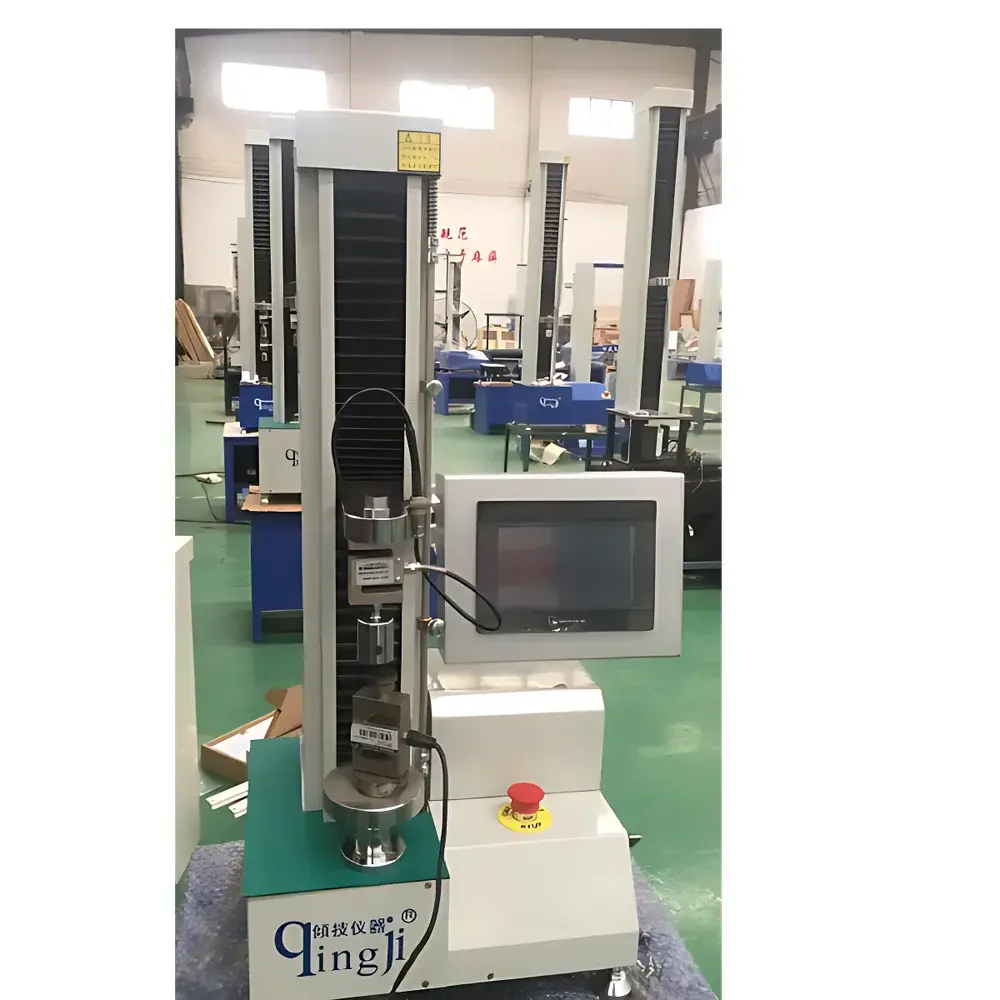
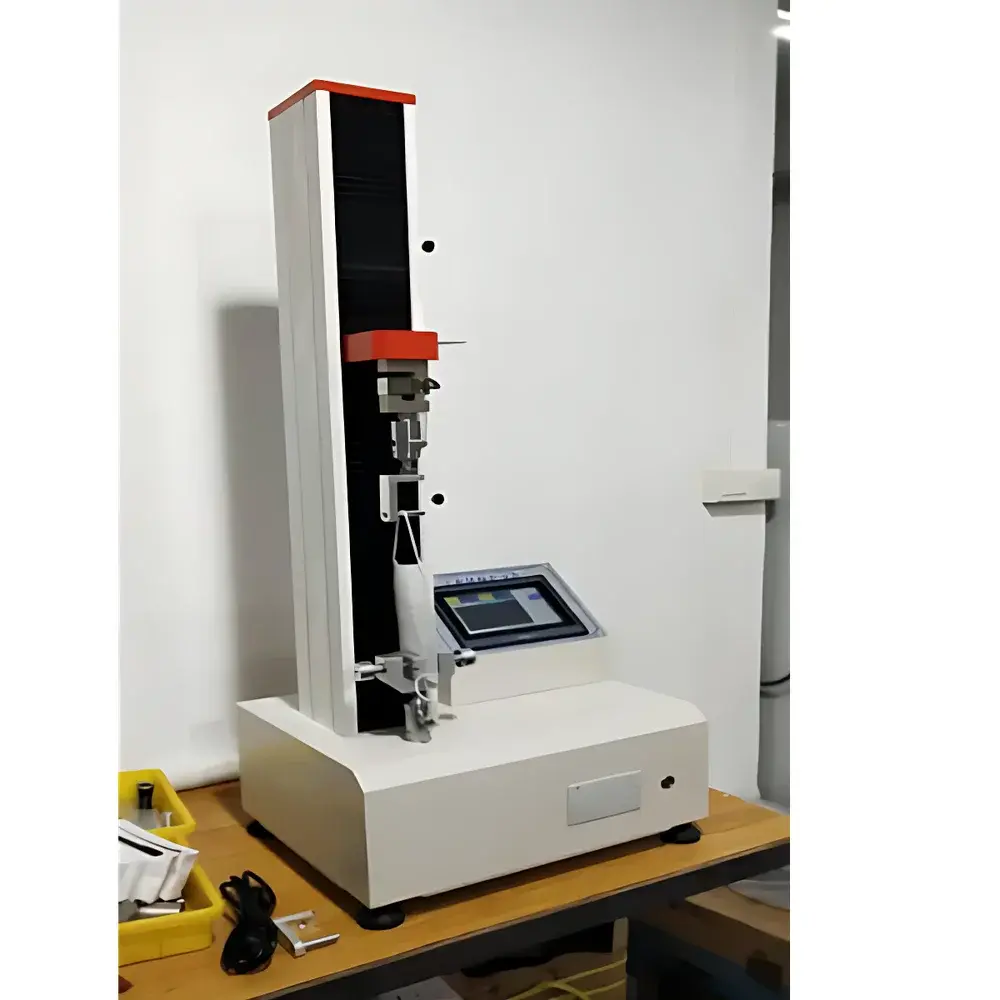
QJ210 Spring Tensile and Compression Testing Machine by Qingji
| Brand | Qingji |
|---|---|
| Model | QJ-210 |
| Type | Electromechanical Universal Testing Machine |
| Load Capacity | 0–2.5 kN |
| Load Accuracy | ±0.5% |
| Speed Range | 0.001–300 mm/min |
| Speed Accuracy | ±0.5% |
| Stroke Accuracy | ±0.5% |
| Displacement Accuracy | ±0.5% |
| Effective Width | 150 mm |
| Max Stroke | 300 mm (extendable) |
| Safety Features | Electronic travel limit protection, emergency stop button |
| Unit Weight | ~45 kg |
Overview
The QJ210 Spring Tensile and Compression Testing Machine is an electromechanical universal testing system engineered for precision mechanical property evaluation of metallic springs, elastomeric components, wire forms, and other quasi-static load-bearing elements. Based on servo-controlled linear actuation and high-stability load cell measurement, the instrument operates on the fundamental principle of controlled displacement or force-controlled loading, compliant with standardized test methodologies defined in ISO 7500-1 (static calibration of uniaxial testing machines), ASTM E4 (practices for force verification), and ISO 5893 (tensile and compression testing machines). Designed for laboratory and quality control environments, the QJ210 delivers repeatable, traceable mechanical data—including yield strength, ultimate tensile strength, compressive modulus, and spring rate—within its 2.5 kN capacity range. Its compact footprint (~45 kg), modular stroke extension capability, and dual-mode operation (standalone LCD control or PC-integrated testing) make it suitable for R&D labs, Tier-1 component suppliers, and in-house QC departments requiring GLP-aligned documentation without full-scale hydraulic infrastructure.
Key Features
- Electromechanical actuation system with brushless servo motor and precision ball-screw transmission, enabling smooth, low-noise operation across the full speed range (0.001–300 mm/min)
- High-resolution load cell calibrated to ±0.5% accuracy per ISO 7500-1 Class 1 requirements; optional traceable calibration certificate available upon request
- Integrated 5.7-inch full-color TFT LCD interface supporting real-time dynamic display of force (N), displacement (mm), and stress–strain curves during test execution
- Dual-control architecture: independent local operation via front-panel keypad or full remote control via USB-connected Windows-based software with automated report generation
- Rigid aluminum extrusion frame with electrostatic powder-coated finish, optimized for dimensional stability and long-term repeatability under cyclic loading
- Comprehensive safety suite including programmable electronic stroke limits, hardware-based emergency stop circuit, and overload cut-off logic
Sample Compatibility & Compliance
The QJ210 accommodates a broad spectrum of spring geometries—including compression coils, tension springs, torsion legs, Belleville washers, and custom-formed wire components—within its 150 mm effective width and 300 mm standard stroke envelope (extendable per user specification). Fixturing supports standard wedge-type grips, compression platens, and spring centering fixtures compliant with ISO 10272 (spring testing terminology) and GB/T 25711 (Chinese national standard for spring mechanical property testing). All firmware and control algorithms are designed to meet general requirements for instrument qualification under ISO/IEC 17025:2017 Clause 6.4 (equipment verification), and raw test data files adhere to vendor-neutral CSV export formats compatible with third-party statistical analysis tools used in FDA-regulated environments.
Software & Data Management
The included PC software provides full test method definition, real-time data streaming, multi-curve overlay, automatic peak detection, and customizable reporting per ISO 6892-1 (tensile testing of metallic materials) or internal SOP templates. Audit trails record operator ID, timestamp, calibration status, and parameter modifications—supporting basic 21 CFR Part 11 readiness when deployed with Windows user access controls and file encryption. Raw data logs include force, displacement, time, and calculated engineering stress/strain at ≥100 Hz sampling rate. Export options include PDF (with embedded signature fields), Excel (.xlsx), and XML for LIMS integration. No cloud dependency: all processing occurs locally; no telemetry or remote vendor access enabled by default.
Applications
- Verification of spring rate (k-value) and linearity deviation per DIN 2091 and ISO 2690
- Compression set testing of elastomeric isolators and gaskets under sustained load
- Proof loading and relaxation behavior assessment of pre-stressed coil assemblies
- Quality conformance testing for automotive suspension components, medical device actuators, and aerospace fastening systems
- Educational use in mechanical engineering laboratories for Hooke’s law validation and material stiffness comparison
FAQ
Is the QJ210 compliant with ISO/IEC 17025 for accredited testing laboratories?
Yes—the system meets the general equipment suitability criteria outlined in ISO/IEC 17025:2017 Section 6.4. Full compliance requires user-performed periodic verification using certified reference standards and documented uncertainty budgets.
Can the machine perform cyclic fatigue testing?
No. The QJ210 is designed exclusively for static and quasi-static monotonic tests (tension/compression/bending). It does not support programmed load reversal or high-frequency cycling required for fatigue analysis.
What is the recommended recalibration interval?
Annual recalibration is advised for routine QC use; more frequent verification (e.g., daily zero-check, weekly standard-load verification) is required under GMP/GLP conditions.
Does the software support multi-language UI or only English?
The standard software interface is English-only. Localization is not offered; however, all exported reports and data headers are ASCII-encoded and fully editable in external applications.
Is third-party certification (e.g., NIST-traceable calibration) available at time of purchase?
Yes—optional factory-applied NIST-traceable calibration with certificate (ISO/IEC 17025-accredited provider) can be arranged prior to shipment for an additional fee.



