
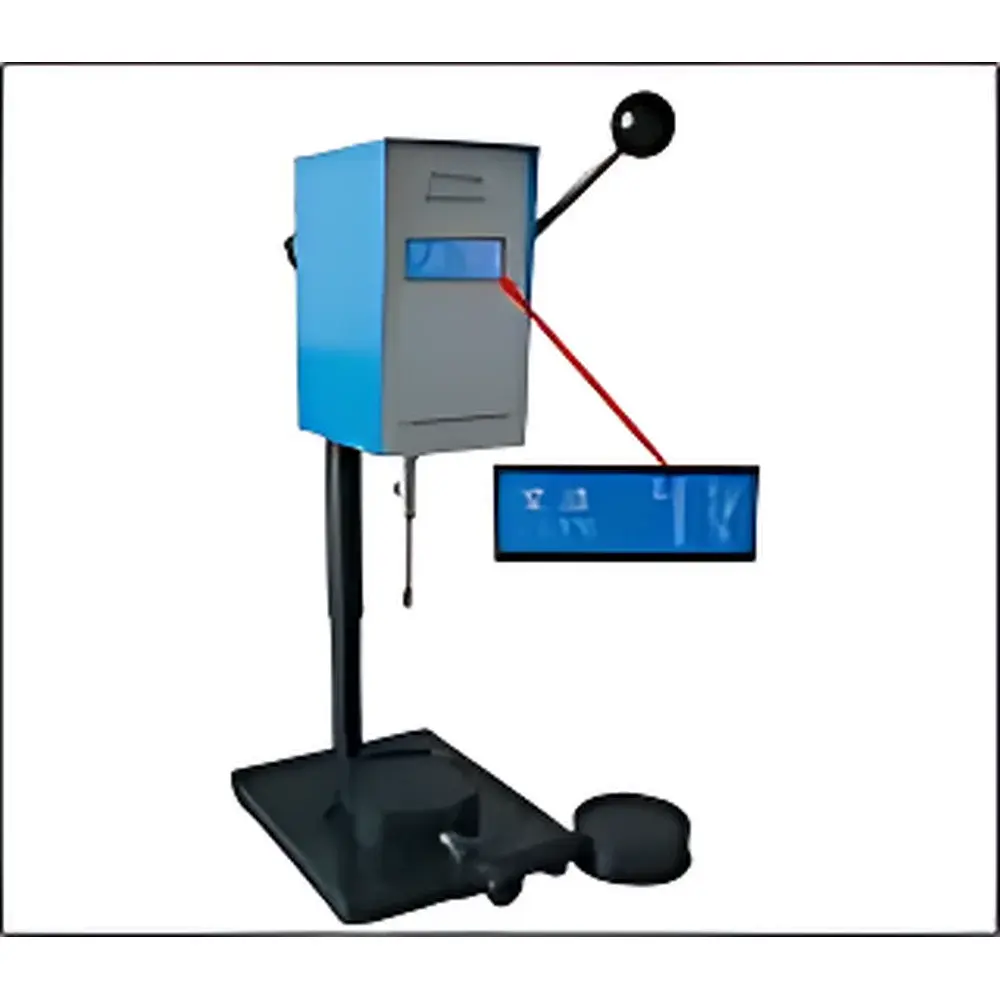
STM-IVB Intelligent Krebs Viscometer
| Origin | Shanghai, China |
|---|---|
| Manufacturer Type | Authorized Distributor |
| Origin Category | Domestic (China) |
| Model | STM-IVB Intelligent Krebs Viscometer |
| Pricing | Available Upon Request |
| Power Supply | 220 V AC, 50 Hz |
| Rotor Speed | 200 rpm ± 0.5 rpm |
| Rotor Dimensions | 54 mm × 7.9 mm × 0.8 mm |
| Sample Container | Φ85 mm × 85 mm (H) |
| Measurement Range | 40.2–141.0 KU |
| Load Range | 32–1099 g |
| Viscosity Range (CP) | 27–5250 cP |
| Accuracy | ±2% of full scale |
| Repeatability | ±1% of full scale |
| Display | LCD showing real-time KU value, load (g), CP-equivalent viscosity, and ambient temperature |
| Dimensions (L×W×H) | 180 × 210 × 470 mm |
| Net Weight | 7 kg |
Overview
The STM-IVB Intelligent Krebs Viscometer is a precision-engineered instrument designed specifically for the standardized measurement of paint and architectural coating viscosity using the Krebs Unit (KU) scale. It operates on the fundamental principle of rotational resistance torque measurement under controlled shear conditions—specifically, the torque required to maintain a constant rotational speed of 200 rpm using a standardized paddle-type rotor (ASTM D562 geometry) immersed in the sample. Unlike general-purpose rotational viscometers, the STM-IVB implements a proprietary logarithmic conversion algorithm that maps measured load (in grams) to the empirically calibrated KU scale—a unit widely adopted in industrial paint formulation, quality control, and regulatory documentation for brush- and roller-applied coatings. The device complies fully with ASTM D562 “Standard Test Method for Viscosity of Paints, Varnishes, Lacquers, and Related Products by Krebs-Stormer Viscometer” and GB/T 9269 “Determination of Viscosity of Paints and Varnishes—Krebs-Stormer Method,” ensuring traceable, internationally recognized test results. Its microprocessor-based architecture enables real-time signal conditioning, outlier rejection via weighted statistical filtering, and automatic stabilization of readings—minimizing operator influence and enhancing measurement robustness across batch-to-batch QC workflows.
Key Features
- Microcontroller-driven operation with integrated high-stability DC motor delivering precise 200 rpm ± 0.5 rpm rotation—maintained independently of sample rheology or ambient load variation.
- Backlit LCD interface simultaneously displaying four critical parameters: Krebs Units (KU), applied load (g), centipoise-equivalent viscosity (cP), and ambient temperature (°C)—enabling immediate cross-parameter correlation without external calculation.
- Automated data validation engine performing real-time weighted averaging and dynamic outlier suppression—discarding transient spikes beyond the central 90% confidence band to improve repeatability to ±1% of full scale.
- Calibrated paddle rotor (54 mm × 7.9 mm × 0.8 mm) and standardized sample cup (Φ85 mm × 85 mm) conforming strictly to ASTM D562 dimensional tolerances for geometric reproducibility.
- Rugged aluminum alloy chassis with vibration-damped base and ergonomic height-adjustable sample stage—optimized for benchtop stability during extended QC shifts.
- Comprehensive self-diagnostic startup sequence verifying motor response, sensor linearity, thermal drift compensation, and display integrity prior to measurement initiation.
Sample Compatibility & Compliance
The STM-IVB is validated for Newtonian and mildly non-Newtonian liquid-phase samples typical of architectural paints, latex emulsions, primers, sealers, and water-based coatings. It accommodates samples with apparent viscosities ranging from 27 to 5250 cP (equivalent to 40.2–141.0 KU), covering the full operational envelope specified in ASTM D562. Sample volume requirement is fixed at 500 mL within the supplied cylindrical cup, ensuring consistent immersion depth (20 mm below surface) and shear field geometry. All mechanical and electronic components meet IEC 61010-1 safety standards for laboratory electrical equipment. Calibration certificates are traceable to NIM (National Institute of Metrology, China) and include as-found/as-left verification against certified reference standards. The instrument supports GLP-compliant recordkeeping when paired with optional RS-232 output and third-party LIMS integration.
Software & Data Management
While the STM-IVB operates as a standalone benchtop instrument, its RS-232 serial interface enables bidirectional communication with external PCs running Windows-based data acquisition software (optional). Raw torque, load, temperature, and time-stamped KU values can be streamed at 10 Hz for post-acquisition statistical analysis. Export formats include CSV and Excel-compatible .xls—facilitating automated report generation aligned with internal SOPs or external audit requirements (e.g., ISO/IEC 17025, FDA 21 CFR Part 11 compliant systems with appropriate user access controls and audit trail modules). Firmware updates are performed via secure USB-to-serial adapter, with version history and checksum validation embedded in each release.
Applications
- Quality assurance of incoming raw materials (e.g., thickeners, resins, pigments) prior to dispersion and let-down stages.
- In-process viscosity monitoring during paint manufacturing—particularly for adjusting rheology modifiers to achieve target KU for spray, brush, or roller application profiles.
- Batch release testing per customer specifications referencing ASTM D562 or contractual KU tolerances (e.g., 92.5 ± 1.5 KU).
- Formulation development support—correlating KU values with sag resistance, leveling behavior, and film build uniformity in OEM coating labs.
- Regulatory submission packages requiring documented viscosity consistency across production lots (e.g., EPA, CE marking dossiers).
- Educational use in polymer science and coatings engineering curricula for hands-on demonstration of empirical viscosity units and shear-dependent flow behavior.
FAQ
What standards does the STM-IVB comply with?
It conforms to ASTM D562 and GB/T 9269, with mechanical dimensions, rotor geometry, and test protocol fully aligned to both specifications.
Can the STM-IVB measure viscosity in centipoise directly?
Yes—it computes and displays an equivalent cP value derived from the KU-to-cP conversion curve defined in ASTM D562 Annex A1, intended for comparative assessment only—not absolute rheological quantification.
Is calibration verification required before each test?
No daily recalibration is needed; however, a two-point verification using certified standard oils (e.g., 100 cP and 1000 cP) is recommended at the start of each shift per ISO/IEC 17025 Clause 6.5.
Does the instrument support automatic temperature compensation?
It measures ambient temperature continuously and displays it alongside KU data, but does not perform active thermal correction—users must control lab temperature per ASTM D562’s 23 ± 2 °C requirement.
What maintenance is required for long-term accuracy?
Annual verification of rotor cup geometry, motor speed stability, and load cell linearity by an accredited service provider is advised; routine cleaning of rotor and cup with solvent-compatible lint-free wipes is sufficient between samples.



