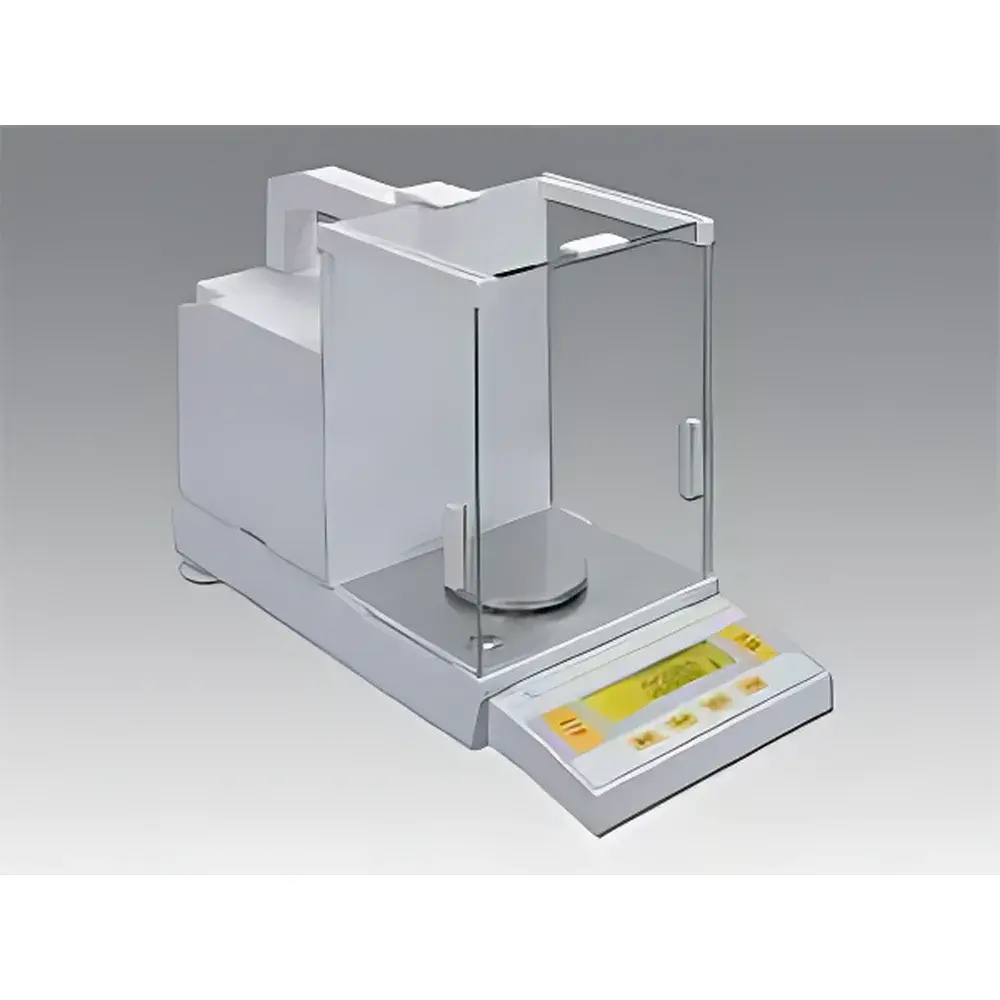
Chu Ding Technology FA1104 Precision Analytical Balance
| Brand | Chu Ding Technology |
|---|---|
| Origin | Shanghai, China |
| Model | FA1104 |
| Capacity | 110 g |
| Readability | 0.1 mg |
| Repeatability | ≤ 0.1 mg |
| Linearity | ±0.2 mg |
| Pan Diameter | Ø90 mm |
| Draft Shield Dimensions | 195 × 160 × 235 mm |
| Overall Dimensions | 195 × 445 × 300 mm |
| Power Options | AC adapter or 9 V DC battery |
| Interface | RS232 |
| Features | Internal calibration, electromagnetic force compensation sensor, dynamic temperature compensation, adjustable counting mode, unit conversion (g, oz, ct), auto-zero tracking, overload protection, fault diagnostics |
Overview
The Chu Ding Technology FA1104 Precision Analytical Balance is a high-resolution laboratory balance engineered for accurate mass determination in research, quality control, and educational environments. Utilizing an electromagnetic force compensation (EMFC) transduction principle—where the restoring force required to maintain equilibrium is measured electronically—the FA1104 delivers superior stability, minimal drift, and immunity to mechanical hysteresis commonly observed in strain-gauge-based systems. With a maximum capacity of 110 g and readability of 0.1 mg (100 µg), it meets the performance requirements for Class I analytical applications per ISO 9001 and ASTM E898-22 guidelines. Its compact footprint, integrated draft shield, and dual-power capability (AC adapter or 9 V battery) support flexible deployment across benchtop labs, field testing stations, and mobile teaching setups.
Key Features
- Electromagnetic force compensation sensor architecture ensures long-term stability and eliminates creep-related error common in resistive load cells.
- Backlit LCD display with adjustable contrast for optimal readability under varied ambient lighting conditions.
- Internal calibration function with automatic initiation at user-defined intervals or temperature thresholds (±1.5 °C deviation triggers recalibration).
- Dynamic temperature compensation algorithm continuously adjusts zero and span outputs to mitigate thermal drift across operating range (10–30 °C).
- Four-stage shock absorption system minimizes vibration-induced instability during sensitive measurements.
- Adjustable weighing speed (fast/standard/precise modes) allows optimization for throughput versus resolution requirements.
- RS232 serial interface enables direct data export to LIMS, Excel, or custom QA software; supports ASCII protocol with configurable baud rate (9600 default).
- Integrated below-balance weighing hook facilitates density determination, magnetic susceptibility testing, and suspended sample measurement.
- Configurable auto-zero tracking range (0.01–1.0 g) prevents false zero shifts due to minor environmental fluctuations.
Sample Compatibility & Compliance
The FA1104 accommodates samples up to 110 g on its Ø90 mm stainless-steel weighing pan, compatible with standard labware including weighing boats, crucibles, vials, and filter papers. Its enclosed draft shield (195 × 160 × 235 mm) provides effective air current isolation without requiring external enclosures. The balance complies with international metrological standards including OIML R76-1 (2021) for non-automatic weighing instruments and satisfies functional prerequisites for GLP and GMP environments—including audit-trail-ready calibration logging when paired with compliant host software. While not certified to FDA 21 CFR Part 11 out-of-the-box, its RS232 output supports integration into validated systems meeting electronic record and signature requirements.
Software & Data Management
Data acquisition is supported via native RS232 connectivity using standard terminal emulation (e.g., PuTTY, Tera Term) or proprietary PC software (available upon request). The balance transmits real-time weight values, status flags (e.g., stable, overload, calibration needed), and unit identifiers in ASCII format. Timestamping requires external synchronization; however, batch ID tagging and sample count labeling are programmable through command-line syntax. Firmware supports user-defined tare memory recall and multi-step calibration routines traceable to internal reference masses. All configuration parameters—including auto-zero threshold, display update rate, and unit preference—are stored in non-volatile memory and persist through power cycles.
Applications
- Quantitative gravimetric analysis in pharmaceutical formulation development and raw material assay verification.
- Weighing of reference standards and certified reference materials (CRMs) for calibration traceability.
- Moisture content determination via loss-on-drying protocols (LOD) when interfaced with halogen moisture analyzers.
- Counting small components (e.g., tablets, microelectronics, seeds) with statistical confidence based on average piece weight.
- Density measurement of solids and liquids using Archimedean displacement principles with optional accessories.
- Teaching fundamental metrology concepts—including uncertainty propagation, repeatability assessment, and linearity validation—in undergraduate chemistry and physics laboratories.
FAQ
What is the recommended calibration frequency for the FA1104 in a regulated environment?
Calibration should be performed before first use, after relocation, following significant ambient temperature changes (>2 °C), and at defined intervals aligned with internal SOPs—typically daily for critical QC work or per ASTM E898-22 Annex A2 guidance.
Does the FA1104 support external calibration weights?
Yes; the balance accepts external Class E2 or better calibration masses via manual calibration mode, though internal calibration is preferred for routine operation to minimize handling errors.
Can the FA1104 be used in a fume hood?
Not recommended; the draft shield is designed for ambient benchtop use. Fume hood airflow exceeds shielding capacity and may induce buoyancy errors or instability.
Is the RS232 interface optically isolated?
No; the interface is electrically coupled and requires proper grounding to prevent noise coupling in shared lab networks.
What is the warm-up time required for optimal accuracy?
Minimum 30 minutes after power-on at stable room temperature (20–25 °C); extended stabilization (60 min) is advised for sub-0.1 mg precision applications.