
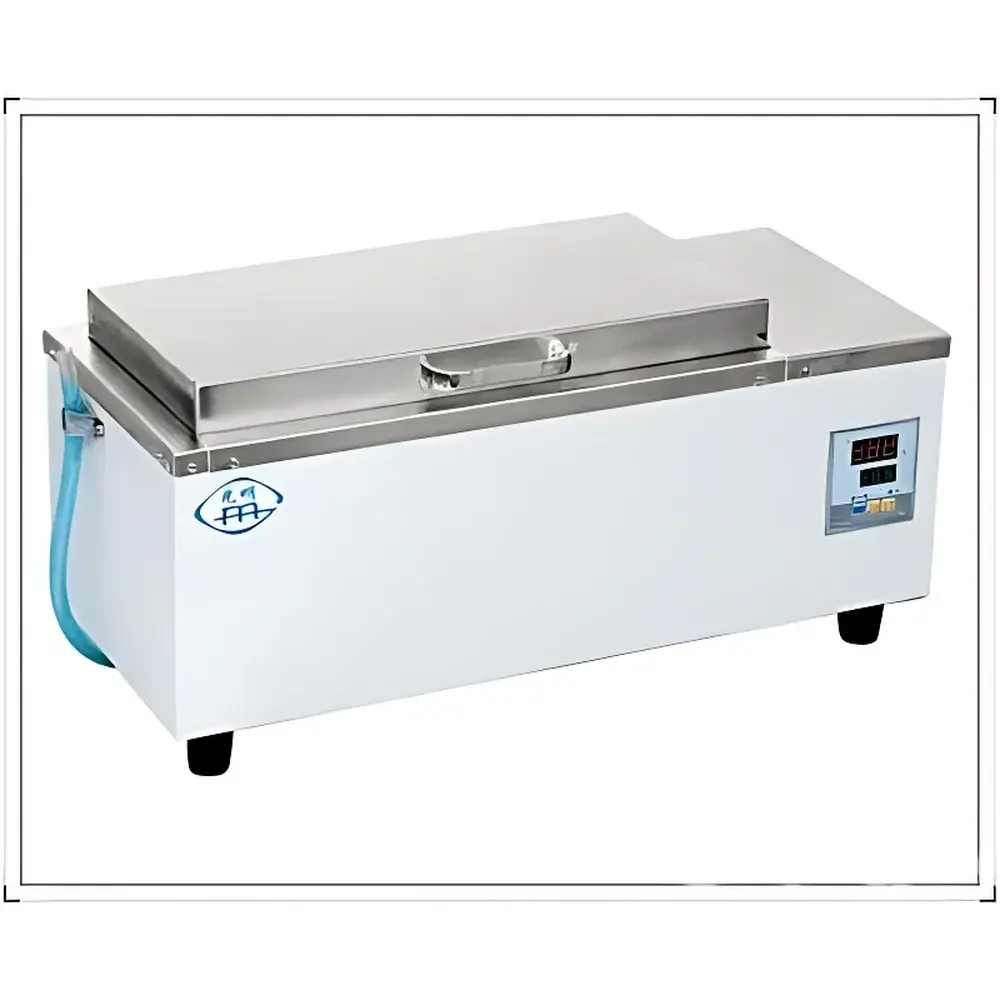
Chu Ding Technology HHW21-600 Digital Display Electric Constant-Temperature Water Bath
| Brand | Chu Ding Technology |
|---|---|
| Origin | Shanghai, China |
| Manufacturer Type | Authorized Distributor |
| Country of Origin | China |
| Model | HHW21-600 |
| Power Rating | 750 W |
| Chamber Dimensions (L×W×H) | 600 × 300 × 150 mm |
| Temperature Control Range | 37–65 °C |
| Control Type | Microprocessor-Based Digital Controller |
| Construction | Stainless Steel Interior & Lid, Electrostatically Powder-Coated Exterior |
| Compliance | CE-marked per EN 61000-6-3 (EMC) and EN 61000-6-2 (Immunity) |
Overview
The Chu Ding Technology HHW21-600 Digital Display Electric Constant-Temperature Water Bath is a precision-engineered thermal management system designed for stable, uniform, and repeatable temperature control in laboratory environments. Operating on resistive heating principles with PID-regulated microprocessor feedback, the unit maintains setpoint accuracy within ±0.5 °C across its operational range of 37–65 °C—optimized for applications requiring physiological or moderate-temperature stability, including serological testing, microbial culture incubation, reagent warming, and low-temperature sterilization protocols. Its sealed stainless steel chamber (600 × 300 × 150 mm) ensures long-term corrosion resistance against aqueous and mildly alkaline solutions, while the electrostatically coated mild steel exterior provides mechanical durability and chemical splash resistance. Unlike open-bath configurations, this water bath integrates a fully enclosed lid and insulated sidewalls to minimize evaporative heat loss and ambient thermal drift—critical for extended-duration assays and GLP-compliant workflows.
Key Features
- 750 W high-efficiency heating element with rapid thermal response and low thermal inertia
- Digital microprocessor controller featuring real-time temperature display, adjustable setpoint memory, and auto-tuning PID algorithm for minimized overshoot and stabilized equilibrium
- Stainless steel (SUS304) inner tank and hinged lid—weld-seam free, electropolished finish for ease of cleaning and compliance with ISO 13485 cleanroom handling requirements
- Over-temperature cut-off protection and dry-run safety shutdown to prevent heater damage during low-fluid conditions
- Front-panel LED indicators for power status, heating active state, and alarm activation
- Level-sensing fill line etched into interior wall to ensure optimal immersion depth and thermal homogeneity
Sample Compatibility & Compliance
The HHW21-600 accommodates standard laboratory glassware—including 50 mL to 1 L beakers, test tube racks (up to 16 mm diameter), centrifuge tubes, and Petri dish stacks—without obstruction. Its uniform temperature distribution (±0.3 °C spatial variation at 37 °C, measured per ASTM E1112) supports reproducible results in clinical diagnostics, such as serum bilirubin stability testing (CLSI EP17-A2), or enzyme activity assays requiring strict thermal preconditioning. The unit meets IEC 61010-1:2010 safety standards for electrical equipment used in laboratory settings and complies with electromagnetic compatibility directives EN 61000-6-2 and EN 61000-6-3. While not certified for Class II biological safety or USP sterilization validation, it is routinely deployed in pre-sterilization warm-up stages and validated as ancillary equipment under ISO/IEC 17025-accredited quality systems.
Software & Data Management
This model operates as a standalone analog-digital hybrid instrument without embedded data logging or network connectivity. Temperature setpoints and real-time readings are displayed via a 4-digit LED screen; no external software interface or USB/RS-232 port is provided. For laboratories requiring audit trails, users may integrate optional third-party calibrated thermistors (e.g., Fluke 561 or Omega HH309A) connected to validated data acquisition systems compliant with FDA 21 CFR Part 11 requirements. All manual operation records—including batch numbers, start/end times, and observed temperatures—must be documented in paper-based or electronic lab notebooks aligned with ALCOA+ principles (Attributable, Legible, Contemporaneous, Original, Accurate, Complete, Consistent, Enduring, Available).
Applications
- Pre-warming of culture media prior to inoculation in microbiology labs (per ISO 11133)
- Controlled denaturation studies of serum proteins and immunoglobulins
- Accelerated evaporation of organic solvents in analytical sample preparation
- Constant-temperature conditioning of viscometry standards and calibration oils
- Low-energy pasteurization of diagnostic reagents (e.g., complement components) at 56 °C for 30 min
- Supporting ASTM D92 flash point testing procedures where bath pre-conditioning is specified
FAQ
What is the maximum recommended water fill level for optimal thermal uniformity?
The engraved fill line indicates the upper limit for consistent heat transfer; exceeding it may impair lid closure and increase evaporation-driven temperature fluctuation.
Can this unit be used with oil or glycol-based heat transfer fluids?
No—its design, materials, and safety certifications are validated exclusively for deionized or distilled water; substitution with non-aqueous media voids warranty and compromises thermal cutoff reliability.
Is the temperature sensor traceable to NIST standards?
The internal Pt100 RTD sensor is factory-calibrated; users must perform periodic verification using an NIST-traceable reference thermometer (e.g., Hart Scientific 1529) per ISO/IEC 17025 Section 6.5.
Does the unit support external temperature probe input for remote monitoring?
No—this is a closed-loop, self-contained system without auxiliary sensor inputs or analog output signals.
How often should maintenance cleaning be performed to sustain performance?
Weekly descaling with 5% citric acid solution is recommended when using tap water; monthly inspection of heater terminals and gasket integrity is advised for continuous-use environments.



