
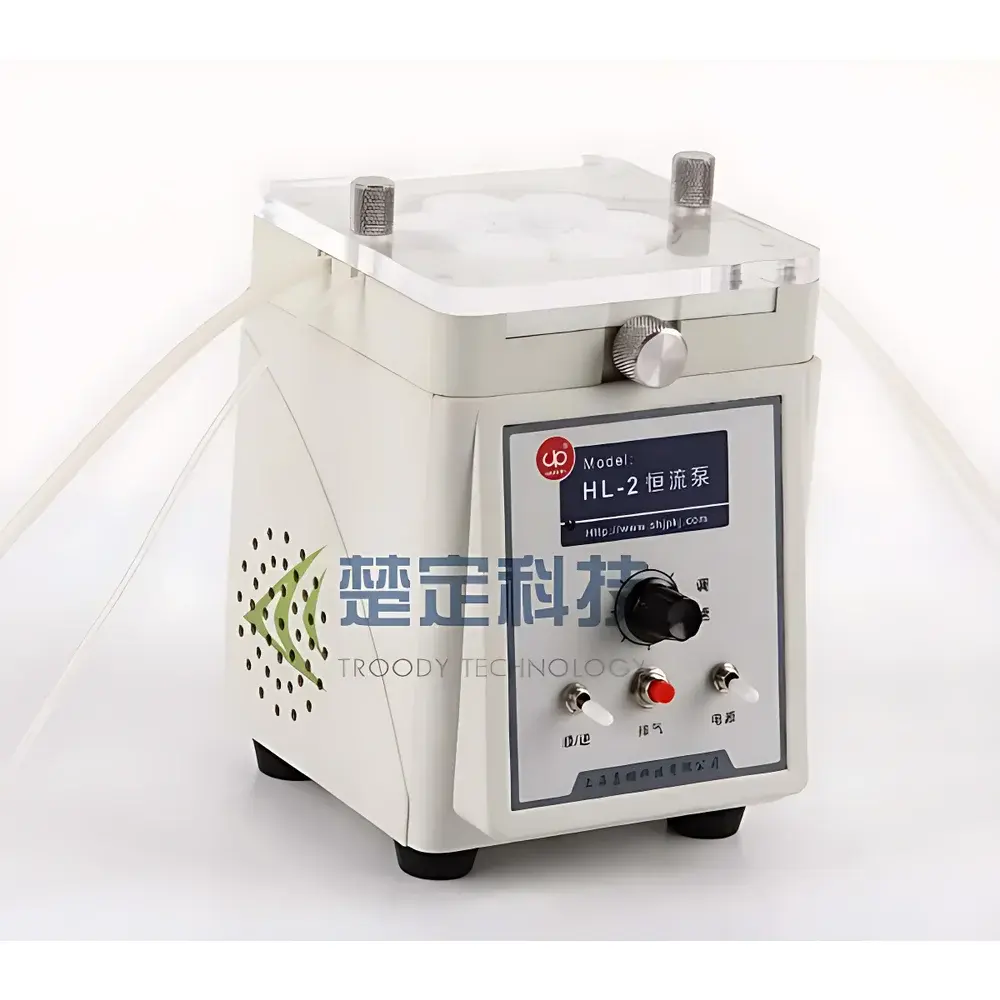
Chu Ding Technology HL-2 Dual-Channel Peristaltic Pump
| Brand | Chu Ding Technology |
|---|---|
| Origin | Shanghai, China |
| Model | HL-2 |
| Flow Rate Range | 1–600 mL/h per channel (dual-channel) |
| Speed Range | 0–65 rpm |
| Maximum Pressure | ≥3 kg/cm² |
| Dimensions | 120 × 120 × 180 mm |
| Pump Head Material | Standard elastomeric tubing (HL-2S variant features PTFE-compatible pump head) |
| Display | Digital speed readout (HL-2B/HL-2D/HL-2S variants) |
| Drive Type | Mechanical stepless (infinitely variable) transmission |
Overview
The Chu Ding Technology HL-2 Dual-Channel Peristaltic Pump is an engineered solution for precise, pulse-free fluid delivery in laboratory-scale applications requiring independent control of two parallel flow paths. Based on the principle of peristalsis—where rollers compress flexible tubing to displace fluid without contacting internal pump components—the HL-2 ensures contamination-free transfer of sensitive, viscous, or chemically aggressive liquids. Its robust mechanical design employs a stepless (infinitely variable) gear-driven transmission system, enabling stable rotational speed control across its full 0–65 rpm range. Each channel operates independently, delivering 1–600 mL/h with high volumetric reproducibility and minimal flow pulsation. The pump is optimized for continuous operation under moderate backpressure (≥3 kg/cm²), making it suitable for gravity-fed or pressurized systems in analytical sample introduction, chromatography auxiliary delivery, cell culture media perfusion, and reagent dosing workflows.
Key Features
- Dual independent channels with synchronized or asynchronous speed control—enabling simultaneous delivery of two different fluids or redundant flow paths
- Mechanically actuated stepless speed regulation—no electronic feedback loop required; delivers long-term stability and immunity to electromagnetic interference
- Compact footprint (120 × 120 × 180 mm)—designed for benchtop integration in fume hoods, biosafety cabinets, and automated workstations
- Interchangeable pump head configurations—standard elastomer-compatible head for aqueous and mild solvents; optional PTFE-compatible head (HL-2S variant) for enhanced chemical resistance to organic solvents, acids, and bases
- Digital RPM display (HL-2B, HL-2D, HL-2S models)—provides real-time rotational speed verification for method documentation and audit readiness
- No internal valves, seals, or wetted metal parts—eliminates risk of cross-contamination and simplifies cleaning and maintenance
Sample Compatibility & Compliance
The HL-2 supports standard peristaltic tubing sizes (e.g., Tygon® LFL, PharMed® BPT, Norprene®), with flow performance calibrated for inner diameters from 0.5 mm to 3.2 mm. It accommodates both aqueous buffers and moderately aggressive solvents when paired with chemically compatible tubing and the optional PTFE pump head (HL-2S). While not certified to ISO 8573 or FDA 21 CFR Part 11 out-of-the-box, the pump’s mechanical architecture and digital speed logging (on equipped variants) support alignment with GLP and GMP documentation requirements when integrated into validated systems. Its pressure rating (≥3 kg/cm² ≈ 294 kPa) complies with typical demands of low-pressure HPLC auxiliary lines, dialysis circuits, and environmental sampling manifolds. No CE, UL, or RoHS markings are affixed; users are advised to verify local regulatory acceptance prior to deployment in clinical or regulated manufacturing environments.
Software & Data Management
The base HL-2 model operates as a standalone analog device with manual speed adjustment via front-panel knob. HL-2B, HL-2D, and HL-2S variants integrate a digital LED display showing real-time RPM, facilitating manual calibration traceability and operator verification. These models do not include USB, RS-232, or analog output interfaces; however, external data loggers may be used to record panel-displayed RPM values at user-defined intervals. For fully automated integration, third-party programmable logic controllers (PLCs) or DAQ systems can interface with the pump’s external start/stop and direction control terminals (available upon request). All firmware-independent operation ensures deterministic response timing and eliminates software-related validation overhead in regulated labs.
Applications
- Parallel solvent delivery in gradient HPLC or LC-MS auxiliary systems
- Continuous nutrient/media perfusion in bioreactor and organ-on-chip platforms
- Controlled reagent addition in titration, enzymatic assay, and kinetic reaction monitoring
- Waste or filtrate removal in ultrafiltration and tangential flow filtration setups
- Calibration standard delivery in environmental water quality analyzers (e.g., COD, TOC, phosphate)
- Low-shear transfer of shear-sensitive suspensions—including microbial cultures, liposomes, and microencapsulated formulations
FAQ
Is the HL-2 compatible with organic solvents such as acetone or chloroform?
Only the HL-2S variant—with its PTFE-compatible pump head and properly selected tubing (e.g., FluoroFlex® or Chem-Dura®)—is recommended for intermittent use with aggressive organics. Standard elastomer heads must be avoided with such solvents.
Can flow rate be calibrated against gravimetric or volumetric standards?
Yes. Flow accuracy is directly proportional to rotational speed and tubing geometry. Users may perform in-house calibration using certified graduated cylinders and analytical balances per ASTM D1193 or ISO 5725 guidelines.
Does the pump support remote start/stop or analog speed control?
The base HL-2 does not include these functions, but optional terminal blocks for external TTL-level start/stop and 0–5 V analog speed input are available upon special order.
What tubing sizes are supported, and how is tubing life monitored?
Tubing inner diameters from 0.5 mm to 3.2 mm are supported. Tubing fatigue is visually assessed by checking for cracking, flattening, or loss of elasticity—typical service life ranges from 100 to 500 hours depending on speed, pressure, and chemical exposure.
Is technical documentation available in English for IQ/OQ protocol development?
Yes. Factory-issued dimensional drawings, mechanical specifications, and tubing compatibility tables are provided in English upon request for installation qualification (IQ) and operational qualification (OQ) support.



