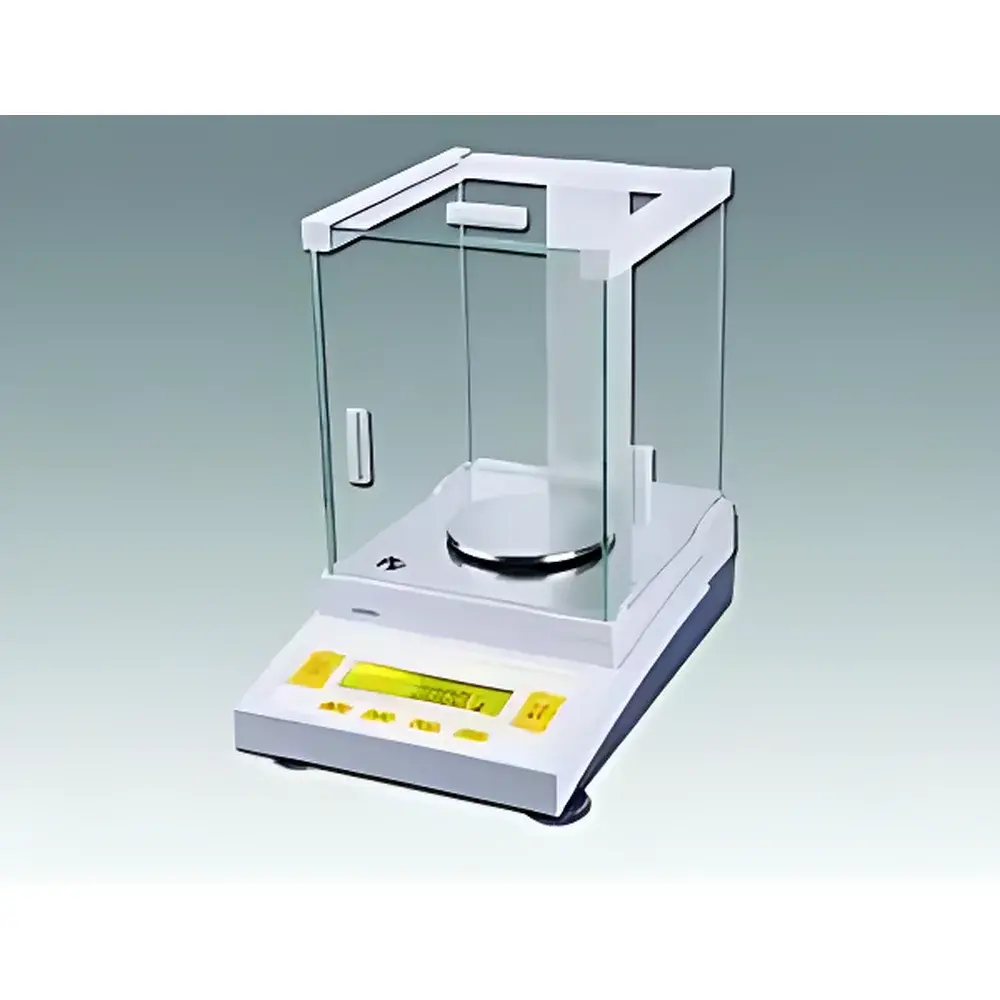
Chu Ding Technology JA2003 Precision Analytical Balance
| Brand | Chu Ding Technology |
|---|---|
| Model | JA2003 |
| Capacity | 200 g |
| Readability | 1 mg |
| Repeatability | ≤1 mg |
| Linearity | ±2 mg |
| Pan Diameter | Ø110 mm |
| Draft Shield Dimensions | 198 × 225 × 240 mm |
| Overall Dimensions | 212 × 330 × 323 mm |
| Power Options | AC adapter or 9 V DC battery |
| Display | Backlit LCD |
| Interface | RS232 |
| Compliance | Designed for GLP-compliant environments |
| Key Features | Electromagnetic force compensation sensor, dynamic temperature compensation, adjustable weighing speed, auto-zero tracking, overload protection and alarm, multi-unit conversion (g, oz, ct), internal below-balance hook, counting mode, full-range tare |
Overview
The Chu Ding Technology JA2003 Precision Analytical Balance is an entry-level electromagnetic force compensation balance engineered for reliable mass measurement at 1 mg readability across a 200 g capacity. It operates on the principle of electromagnetic force restoration—where the downward gravitational force exerted by a sample is precisely counterbalanced by an electromagnetic field generated in response to load-induced displacement of a precision beam. This architecture eliminates mechanical hysteresis and creep associated with strain-gauge-based systems, delivering superior long-term stability and reproducibility. Designed for routine laboratory use in quality control, academic teaching labs, pharmaceutical pre-formulation, and industrial material verification, the JA2003 meets fundamental metrological requirements for non-regulated or low-criticality applications. Its compact footprint, integrated draft shield, and dual-power capability (AC or 9 V battery) support flexible deployment in field settings, mobile labs, or benchtop environments where mains power is intermittent.
Key Features
- High-stability electromagnetic force compensation sensor with zero drift suppression and dynamic temperature compensation circuitry
- Backlit monochrome LCD display with high-contrast characters for visibility under varied ambient lighting
- Five-sided transparent glass draft shield (198 × 225 × 240 mm) providing unobstructed viewing and effective airflow isolation
- Adjustable weighing speed settings to optimize response time versus stability trade-offs for viscous, volatile, or thermally sensitive samples
- Full-range tare function with programmable auto-zero tracking threshold to maintain baseline integrity during extended operations
- Integrated below-balance hook enabling density determination, magnetic susceptibility assessment, or suspended weighing protocols
- Overload protection system with audible and visual alarm activation when load exceeds 200 g ±5%
- RS232 serial interface compliant with standard ASCII command protocol for direct connection to PCs, printers, or LIMS
- Multi-unit conversion (grams, ounces, carats) with user-selectable decimal places (0–3)
- Counting mode with sample-set calibration for discrete-part inventory management in manufacturing and packaging QA
Sample Compatibility & Compliance
The JA2003 accommodates solid, granular, and low-volatility liquid samples within its Ø110 mm stainless steel weighing pan. The draft shield ensures stable readings for powders, fine chemicals, and hygroscopic materials by minimizing convective air currents. While not certified to OIML R76 or NIST Handbook 44 for legal-for-trade applications, the balance is constructed and calibrated per internal technical specifications aligned with ISO 9001 quality management principles. Its design supports basic Good Laboratory Practice (GLP) documentation workflows—particularly when paired with external software that logs timestamped weight events, operator ID, and calibration status. It is suitable for educational labs, internal QC checkpoints, and R&D screening where traceability is managed via manual recordkeeping or third-party data capture tools.
Software & Data Management
The built-in RS232 interface enables real-time data streaming using standard terminal emulation (e.g., PuTTY, Tera Term) or custom scripts (Python, LabVIEW). No proprietary software is bundled; however, the device responds to common SCPI-like commands including WEIGHT?, TARE, UNIT g, and COUNT ON/OFF. Weight outputs are transmitted as ASCII strings terminated by carriage return/line feed (CR/LF), facilitating integration into Excel macros, SQL databases, or MES platforms. Audit trail functionality is not embedded but can be implemented externally through serial logging solutions that timestamp each received value and associate it with user-defined metadata. For regulated environments requiring FDA 21 CFR Part 11 compliance, external validation of the entire data chain—including cabling, driver firmware, and host application—is required.
Applications
- Quantitative reagent dispensing and formulation checks in chemistry and biology teaching laboratories
- Raw material lot verification in food processing, cosmetics, and nutraceutical manufacturing
- Sample preparation for HPLC, GC, or ICP-MS analysis where sub-milligram accuracy is not mandated
- Classroom demonstrations of mass conservation, stoichiometry, and unit conversion principles
- Inventory control of small components (e.g., screws, PCBs, seeds) via piece-counting mode
- Preliminary density measurements using sinker method with optional accessories
- Calibration verification of lower-tier balances using certified reference weights (Class M2 or better)
FAQ
What is the maximum permissible error (MPE) for the JA2003 at full scale?
Per manufacturer specification, linearity deviation is ±2 mg across the full 200 g range; repeatability is ≤1 mg under controlled environmental conditions (20 ±2 °C, <60% RH, no drafts).
Does the JA2003 support internal calibration?
No—it lacks motorized internal calibration weights. External calibration using traceable standards (e.g., ASTM E617 Class M2) is required before first use and after relocation or significant ambient change.
Can the balance operate continuously on battery power?
Yes—the 9 V alkaline battery provides approximately 20 hours of continuous operation under typical usage; low-battery indicator activates at ~6.2 V.
Is the RS232 interface optically isolated?
No—electrical isolation is not implemented; use of a USB-to-RS232 converter with galvanic isolation is recommended for noise-prone industrial settings.
What environmental conditions affect measurement stability?
Air currents, thermal gradients near the balance, static charge buildup on samples, and vibration from adjacent equipment significantly impact settling time and final value consistency; placement on a dedicated anti-vibration table is advised.