
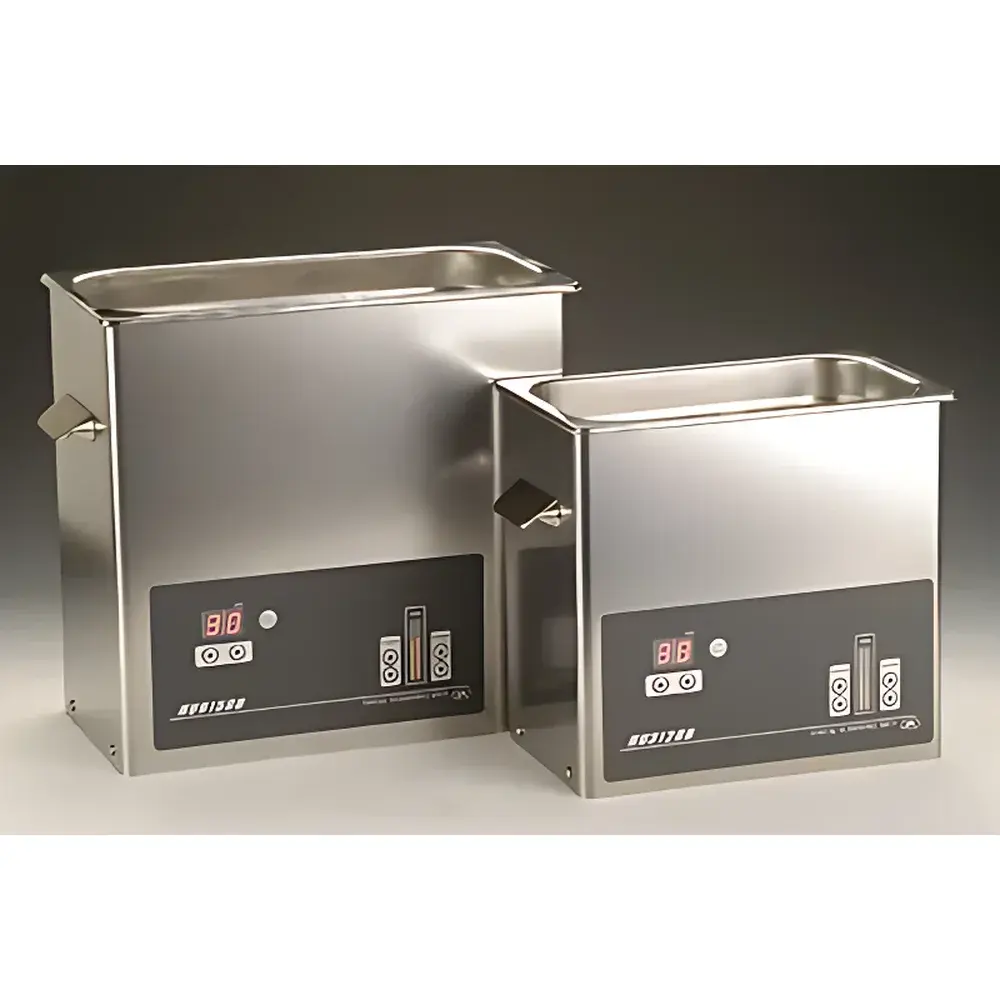
HU10300/40B Pharmaceutical-Compliant Ultrasonic Cleaner
| Origin | Shanghai, China |
|---|---|
| Manufacturer Type | Authorized Distributor |
| Country of Origin | China |
| Model | HU10300/40B |
| Capacity | 10 L |
| Power Output | 300 W |
| Operating Frequency | 40 kHz |
| Power Adjustment Range | 20–100% |
| Tank Dimensions (L×W×H) | 300 × 250 × 150 mm |
| Timer Range | 0–99 min |
| Weight | 8.5 kg |
| Display Type | Digital LED with Power & Timer Indication |
| Compliance | Designed to meet USP <701>, EP 2.2.27, and ChP 2020 General Chapter 0212 requirements for ultrasonic cleaning in pharmaceutical sample preparation |
Overview
The HU10300/40B Pharmaceutical-Compliant Ultrasonic Cleaner is an engineered laboratory instrument designed specifically to support analytical sample preparation workflows mandated by modern pharmacopoeial standards—including the United States Pharmacopeia (USP ), European Pharmacopoeia (EP 2.2.27), and Chinese Pharmacopoeia (ChP 2020, General Chapter 0212). It operates on the principle of high-frequency acoustic cavitation: at 40 kHz, ultrasonic energy induces controlled microbubble formation, growth, and implosive collapse within the cleaning bath medium—generating localized pressures exceeding 1000 atm and transient temperatures above 5000 K. This physical mechanism enables efficient removal of particulate residues, organic contaminants, and adsorbed solutes from glassware, stainless-steel tools, filter housings, and dissolution apparatus components without chemical intervention. Unlike general-purpose cleaners, the HU10300/40B integrates precise digital control over power intensity (20–100% stepless adjustment) and exposure duration (0–99 minutes), ensuring reproducible energy delivery critical for method validation and regulatory audit readiness.
Key Features
- Digital LED interface with real-time display of set time, elapsed time, and power level—enabling traceable parameter logging during SOP execution
- Stainless-steel tank (304 grade) with dimensions 300 × 250 × 150 mm, optimized for uniform acoustic field distribution and minimal standing-wave interference
- Fixed-frequency transducer system operating at 40 kHz—selected per pharmacopoeial guidance for balanced cavitation efficiency and minimal sample degradation risk in aqueous and hydroalcoholic media
- Adjustable power output (20–100%) allows optimization for delicate instruments (e.g., HPLC vials, pipette tips) or robust residue removal (e.g., tablet punches, mortar sets)
- Overheat protection circuitry and auto-shutdown upon timer expiration ensure operator safety and equipment longevity
- Low-noise transducer mounting and insulated housing reduce ambient sound pressure levels to ≤55 dB(A) at 1 m—suitable for shared laboratory environments
Sample Compatibility & Compliance
The HU10300/40B is validated for use with standard laboratory consumables including borosilicate glassware (vials, flasks, beakers), stainless-steel tools (spatulas, forceps), polymer-based filters (nylon, PTFE), and ceramic crucibles. Its operational parameters align with ICH Q5A(R2) and WHO TRS 992 Annex 4 recommendations for cleaning validation of equipment used in non-sterile pharmaceutical manufacturing. The device supports GLP/GMP-aligned documentation practices through manual entry of batch numbers, analyst IDs, and cleaning cycles into lab notebooks. While not intrinsically compliant with FDA 21 CFR Part 11, its digital timer and power settings facilitate integration into electronic lab notebook (ELN) systems that provide audit trails, electronic signatures, and version-controlled SOP linkage.
Software & Data Management
The HU10300/40B is a standalone hardware platform with no embedded firmware or network connectivity. All operational parameters are set locally via front-panel controls; no proprietary software is required. However, its deterministic behavior—repeatable timing accuracy (±1 sec), stable frequency output (<±0.2% drift over 8 h), and linear power response—makes it suitable for inclusion in validated analytical methods where instrument configuration must be documented as part of method transfer packages. Users may record settings manually or integrate the unit into broader data acquisition frameworks using external timers or PLC-triggered start/stop signals.
Applications
- Pre-cleaning of dissolution test apparatus (USP Apparatus 1–4) prior to calibration and routine use
- Decontamination of HPLC autosampler vials, syringe filters, and column frits between batches
- Removal of residual active pharmaceutical ingredients (APIs) from tablet compression tooling in QC laboratories
- Supporting extraction protocol development under ChP 0212 guidelines for herbal matrixes requiring standardized sonication conditions
- Routine maintenance of microbiological sampling equipment (membrane filters, contact plates) in environmental monitoring programs
FAQ
Is the HU10300/40B certified for GMP use?
No independent GMP certification is issued by the manufacturer; however, the unit’s design, repeatability, and parameter control meet foundational requirements for inclusion in GMP-compliant cleaning validation protocols when operated under documented SOPs.
Can this unit be used for ultrasonic extraction of botanicals?
Yes—it is frequently deployed in early-stage extraction method development for herbal monographs, though final process qualification must account for matrix-specific variables (particle size, solvent polarity, temperature sensitivity) per ICH Q5C.
Does it support temperature control?
No built-in heating or cooling function is included; external water baths or chillers may be employed if thermal regulation is required for specific pharmacopoeial procedures.
What is the expected service life of the transducers?
Under normal laboratory usage (≤6 h/day, deionized or distilled water bath), transducer lifespan exceeds 5 years with periodic inspection for delamination or impedance drift.
How does it differ from the HU10300/50B model?
The HU10300/50B operates at 50 kHz, offering finer cavitation bubbles and reduced mechanical stress—suited for fragile samples—but lower energy density per cycle compared to the 40 kHz variant, which provides stronger particle dislodgement for heavily soiled surfaces.



