
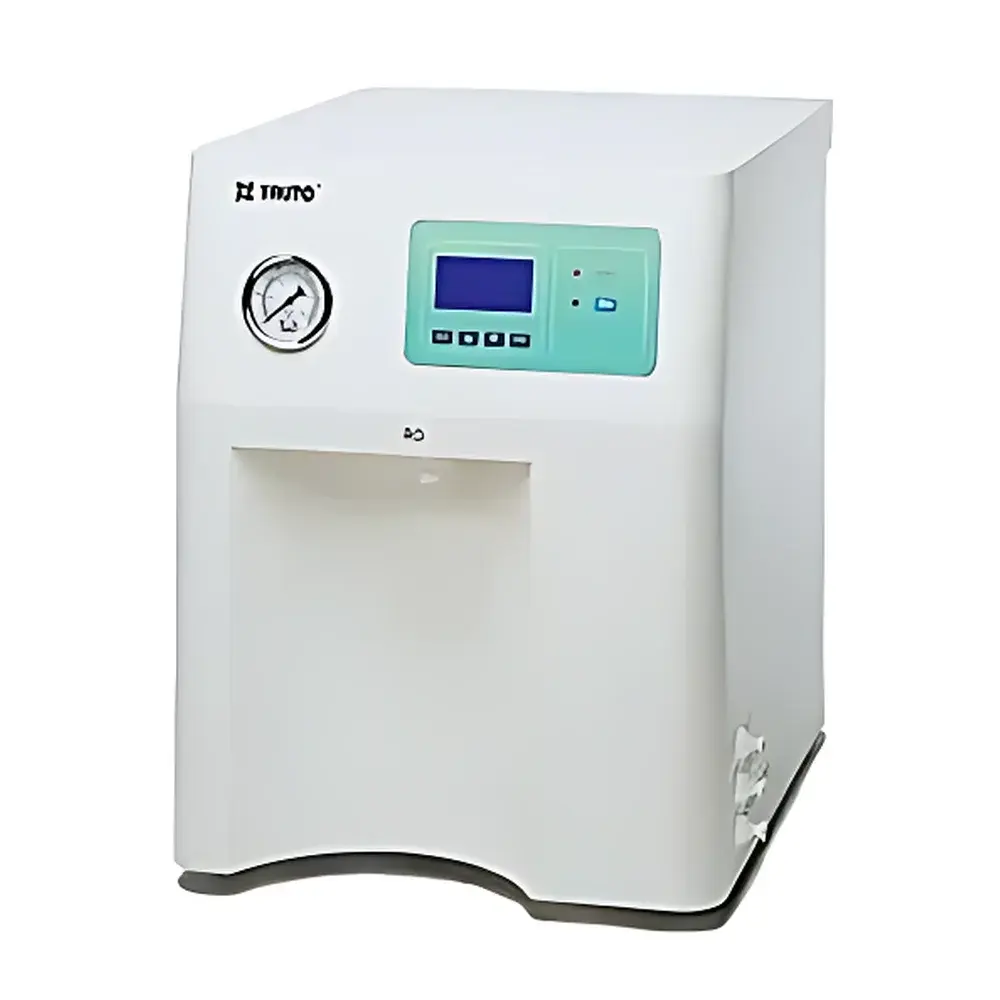
Chu Ding Technology RH-N-5 Ultra Pure Water System
| Brand | Chu Ding Technology |
|---|---|
| Origin | Shanghai, China |
| Manufacturer Type | Authorized Distributor |
| Product Category | Domestic |
| Model | RH-N-5 |
| Pricing | Upon Request |
Overview
The Chu Ding Technology RH-N-5 Ultra Pure Water System is a fully integrated, microprocessor-controlled laboratory water purification platform engineered for consistent production of Type III pure water (per GB/T 6682–1992) and high-purity water meeting stringent analytical requirements. It employs a multi-stage purification architecture centered on reverse osmosis (RO), followed by optional ion exchange, activated carbon adsorption, UV oxidation (185/254 nm), and terminal 0.2 µm filtration. The system operates on municipal tap water (0.5–4.0 bar inlet pressure) and delivers stable output at 5 L/h nominal flow rate (25 °C), with instantaneous dispensing capacity ≥2.0 L/min. Its design prioritizes operational autonomy—incorporating automated start/stop cycles, scheduled RO membrane flush routines, real-time conductivity/resistivity monitoring, and self-diagnostic alerts for low feed pressure, exhausted consumables, or out-of-specification water quality. This architecture ensures compliance with ISO 3696:1987 (Grade 3 water) and supports downstream use in regulated environments where trace-level contamination control is critical.
Key Features
- Intelligent microcontroller-based operation with blue-backlit LCD interface displaying real-time resistivity (MΩ·cm), conductivity (µS/cm), TOC (ppb), and system status
- Automated RO membrane flushing cycle to minimize fouling and extend service life under variable feed water conditions
- Hermetically sealed pressurized storage tank eliminating headspace air contact and preventing airborne microbial recontamination
- Self-protection logic against source water interruption, low inlet pressure, or high temperature—preventing dry-run damage
- Consumable life tracking with visual and audible alerts for timely replacement of pre-filters, RO membranes, and polishing cartridges
- Optional upgrade path to Type I ultra-pure water specification via enhanced RO + dual-stage ion exchange + 185 nm UV + 0.2 µm final filter
- Core components—including RO membranes, ion exchange resins, and UV lamps—sourced from globally certified OEM suppliers
Sample Compatibility & Compliance
The RH-N-5 is validated for compatibility with sensitive analytical instrumentation requiring low ionic, organic, and particulate burden—including atomic absorption spectrometry (AAS), inductively coupled plasma mass spectrometry (ICP-MS), liquid chromatography-mass spectrometry (LC-MS), ion chromatography (IC), and trace metal analysis. Its purified water output conforms to multiple international benchmarks: GB/T 6682–1992 (Type III), ISO 3696:1987 (Grade 3), and ASTM D1193–2022 (Type IV). When configured with optional terminal filtration and UV oxidation, it achieves performance aligned with ASTM D1193–2022 Type I specifications (resistivity ≥10 MΩ·cm at 25 °C, TOC <10 ppb, bacteria 0.2 µm <1/mL). The system supports GLP/GMP-aligned documentation through audit-ready event logs and configurable user access levels.
Software & Data Management
While the RH-N-5 operates via embedded firmware without external PC dependency, its onboard controller maintains a non-volatile event log recording timestamps for all critical operations—including power cycles, alarm triggers, consumable replacements, and water quality excursions. All parameters are stored with UTC-synchronized timestamps and retain data integrity across power loss. Optional RS-232 or USB-C interface enables integration into centralized lab infrastructure management systems for remote status polling and periodic export of calibration and maintenance records. Firmware updates are performed via secure USB stick upload, supporting version traceability and change control per ISO/IEC 17025 Clause 5.9.
Applications
- Preparation of standards and mobile phases for HPLC, UHPLC, and GC
- Routine rinsing of volumetric glassware and sample vials in QC/QA laboratories
- Feed water for amino acid analyzers, capillary electrophoresis systems, and enzymatic assays
- Diluent for spectroscopic techniques including AAS, ICP-OES, and UV-Vis quantitation
- Reagent formulation in molecular biology workflows requiring endotoxin-free water (with optional 0.1 µm filter)
- BOD/COD testing and environmental water analysis where background interference must be minimized
FAQ
What is the minimum inlet water pressure required for stable operation?
The RH-N-5 requires a sustained feed pressure between 0.5 bar and 4.0 bar; operation below 0.5 bar will trigger automatic shutdown.
Can the system be validated for FDA 21 CFR Part 11 compliance?
While the base unit does not include electronic signature capability, its event logging architecture supports Part 11 readiness when integrated with compliant third-party LIMS or ELN platforms.
Is deionized water output suitable for cell culture applications?
Standard RH-N-5 output meets general lab-grade requirements but is not sterile or pyrogen-free; for mammalian cell culture, additional 0.1 µm sterilizing filtration and endotoxin removal modules are mandatory.
How often must the RO membrane be replaced under typical municipal feed conditions?
Service intervals range from 12 to 24 months depending on feed water TDS and hardness; the system’s built-in usage counter and pressure differential monitoring provide objective replacement guidance.
Does the unit support continuous 24/7 operation?
Yes—the sealed tank and thermal management system permit unattended operation within ambient temperatures of 0–45 °C and relative humidity ≤85% RH, provided corrosive vapors are excluded.



