
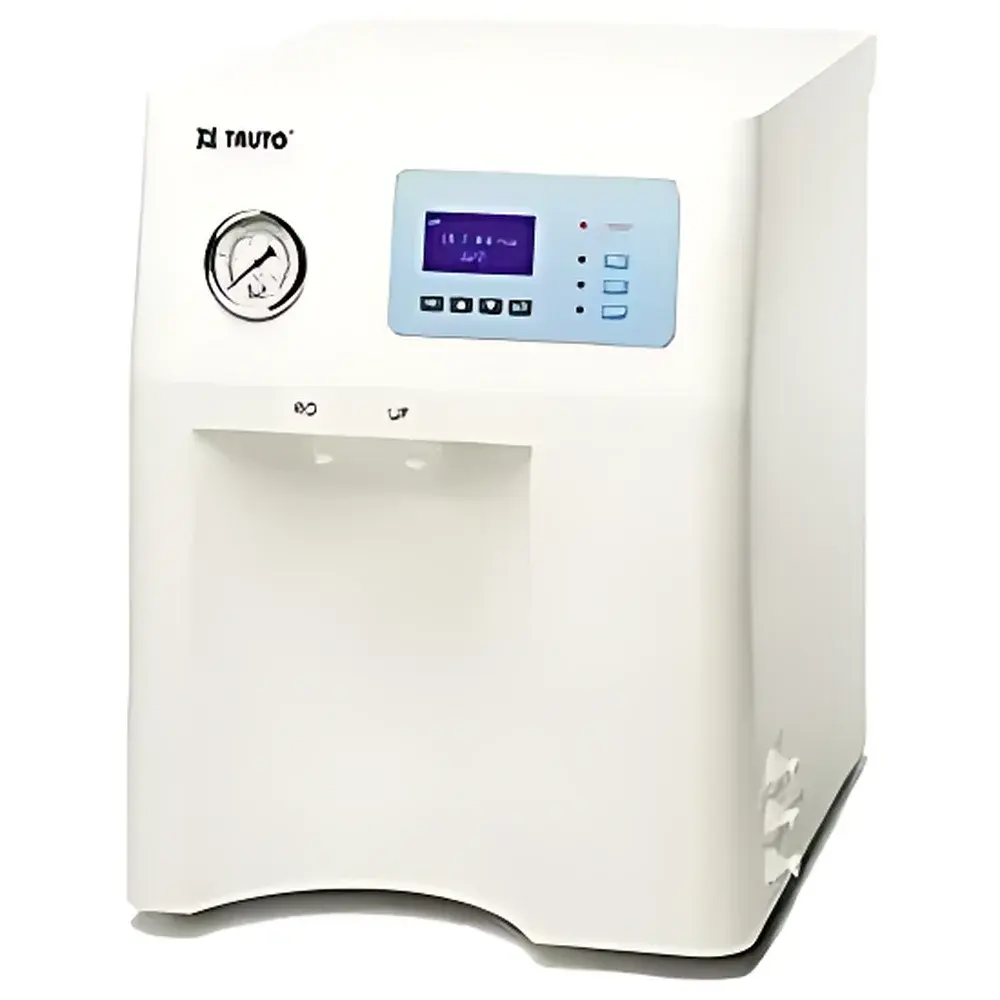
Chu Ding Technology RU-N-25 Ultra Pure Water System
| Brand | Chu Ding Technology |
|---|---|
| Origin | Shanghai, China |
| Manufacturer Type | Authorized Distributor |
| Country of Origin | China |
| Model | RU-N-25 |
| Pricing | Available Upon Request |
| Feed Water | Municipal Tap Water (0.5–4.0 bar) |
| Power Supply | AC 220 V / 50 Hz |
| Pure Water Flow Rate (25 °C) | 25 L/h |
| Instant Dispense Rate | ≥2.0 L/min |
| RO Pure Water Conductivity | 1–5 µS/cm |
| UP Ultra-Pure Water Resistivity | 18.2 MΩ·cm |
| TOC | <10 ppb |
| Total Silica | <1.0 µg/L |
| Microbial Count | <1 CFU/mL |
| Endotoxin | <0.001 EU/mL |
| Particles (>0.22 µm) | <1 particle/mL |
| Recovery Rate | Up to 70% |
| Operating Temperature | 0–45 °C |
| Relative Humidity | ≤85% RH |
| Dimensions (L×W×H) | 400 × 460 × 500 mm |
| Acoustic Noise Level | ≤40 dB (at 1 m) |
| Compliance | GB/T 6682–1992 (Grade III & Grade I) |
Overview
The Chu Ding Technology RU-N-25 Ultra Pure Water System is a dual-output, integrated laboratory water purification platform engineered for precision and reliability in analytical and life science applications. It employs a multi-stage purification architecture—comprising pre-filtration, reverse osmosis (RO), ion exchange, ultrafiltration, and optional UV photooxidation—to convert municipal tap water directly into both Type III pure water and Type I ultra-pure water per GB/T 6682–1992. The system operates on the principle of sequential contaminant removal: RO membranes reject >99.5% of monovalent and multivalent ions, >99% of soluble organic compounds, particulates, and microorganisms; subsequent polishing stages—including mixed-bed ion exchange resin and 0.22 µm final filtration—achieve resistivity up to 18.2 MΩ·cm at 25 °C, total organic carbon (TOC) <10 ppb, and endotoxin levels below 0.001 EU/mL. Designed for continuous, unattended operation in ISO Class 5–7 clean environments, the RU-N-25 delivers consistent water quality under variable feed conditions while maintaining high recovery efficiency (up to 70%) and low operational noise (<40 dB at 1 m).
Key Features
- Microprocessor-controlled automation with real-time monitoring of RO and UP water quality parameters via backlit LCD interface
- Dual independent output streams: RO-grade water (1–5 µS/cm) and UP-grade water (18.2 MΩ·cm, TOC <10 ppb)
- Programmable RO membrane auto-flush cycle to mitigate fouling and extend membrane service life
- Integrated recirculation loop with UV germicidal irradiation (254 nm) and 0.22 µm sterile filtration to suppress microbial regrowth
- Intelligent consumables management system with visual and audible alerts for cartridge replacement
- Comprehensive safety interlocks: automatic shutdown on low inlet pressure, feed water interruption, or reservoir overfill
- Low-energy design with power consumption optimized for 24/7 operation; operating cost ≈ 1/15 that of conventional distillation units
- Compact footprint (400 × 460 × 500 mm) suitable for benchtop integration in QC labs, R&D facilities, and core instrumentation suites
Sample Compatibility & Compliance
The RU-N-25 is validated for use with high-sensitivity analytical instruments requiring ultrapure water input, including HPLC, GC, IC, AAS, ICP-MS, and LC-MS systems. Its output meets and exceeds national standards for laboratory water quality: RO water conforms to GB/T 6682–1992 Grade III specifications; UP water satisfies GB/T 6682–1992 Grade I requirements—and aligns with ASTM D1193–2020 Type I, ISO 3696:1987 Grade 1, and USP Purified Water and Water for Injection (WFI) purity benchmarks where applicable. All wetted components are constructed from pharmaceutical-grade polypropylene, PTFE, and 316L stainless steel to prevent leaching. The system supports GLP/GMP documentation workflows through configurable alarm thresholds, audit-ready event logging, and timestamped water quality records.
Software & Data Management
While the RU-N-25 operates via embedded firmware without external PC dependency, its internal controller stores up to 30 days of time-stamped water quality logs—including conductivity/resistivity trends, TOC excursions, flow rate history, and maintenance events. Data export is supported via USB port for CSV-formatted reports compatible with LIMS integration. Alarm parameters (e.g., resistivity lower limit, TOC upper threshold) are user-adjustable within defined engineering bounds. The system complies with data integrity principles outlined in FDA 21 CFR Part 11 when paired with validated third-party electronic lab notebook (ELN) platforms, supporting audit trails, electronic signatures, and role-based access control in regulated environments.
Applications
- HPLC mobile phase preparation and column equilibration
- ICP-MS and trace metal analysis where blank contamination must be minimized
- Cell culture media formulation and reagent dilution in molecular biology workflows
- Calibration standard preparation for atomic absorption spectroscopy (AAS) and atomic fluorescence (AFS)
- Buffer and solvent preparation for electrophoresis and protein purification
- Final rinse water for semiconductor wafer cleaning validation studies
- Feed water for steam generators in autoclave and sterilizer support systems
FAQ
What is the maximum allowable inlet water pressure for the RU-N-25?
The system accepts municipal feed water within 0.5–4.0 bar; pressure-reducing valves are recommended if inlet pressure exceeds 4.0 bar.
Can the RU-N-25 be connected to a central water distribution loop?
Yes—it supports loop circulation mode with optional booster pump and temperature-controlled delivery piping for multi-point dispensing.
How often must the RO membrane be replaced under typical lab usage?
RO membrane service life averages 24–36 months depending on feed water TDS and hardness; the system tracks cumulative runtime and alerts at 2,000 hours.
Is the UP water outlet suitable for preparing standards for EPA Method 1631 (mercury analysis)?
Yes—the <10 ppb TOC and <1 CFU/mL microbial specification meet the stringent matrix requirements for ultratrace mercury speciation protocols.
Does the system include validation documentation for IQ/OQ/PQ protocols?
Factory-supplied test certificates (including resistivity, TOC, and microbial challenge reports) are provided; full qualification kits with protocol templates are available upon request.



