
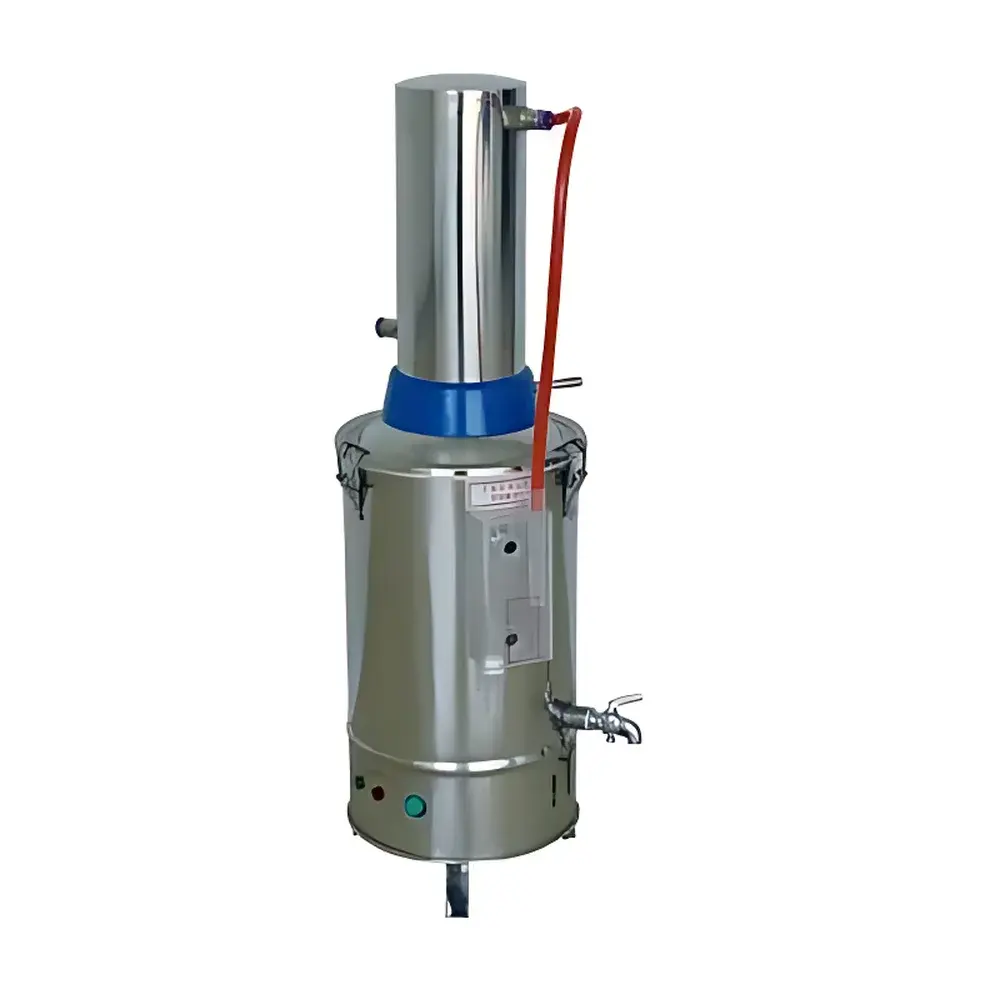
Chu Ding Technology YN-ZD-Z-5 / YN-ZD-Z-10 / YN-ZD-Z-20 Automatic Dry-Run Protection Stainless Steel Distillation Apparatus
| Brand | Chu Ding Technology |
|---|---|
| Origin | Shanghai, China |
| Manufacturer Type | Authorized Distributor |
| Country of Origin | China |
| Model | YN-ZD-Z-5 / YN-ZD-Z-10 / YN-ZD-Z-20 |
| Output Capacity | 5 L/h / 10 L/h / 20 L/h |
| Input Voltage | 220 V AC (all models) |
| Heating Power | 4.5 kW (all models) |
| Construction Material | AISI 304 stainless steel |
| Safety Certification | Compliant with GB/T 14710–2009 (Chinese National Standard for Environmental Adaptability of Medical Electrical Equipment) |
| Cooling Method | Recirculating tap water |
| Protection Mechanism | Imported dry-run sensor with automatic power cutoff |
Overview
The Chu Ding Technology YN-ZD-Z series represents a line of laboratory-grade, electrically heated stainless steel distillation apparatuses engineered for reliable, continuous production of purified distilled water in compliance with basic pharmaceutical and analytical laboratory requirements. These units operate on the principle of single-stage thermal distillation: feed water—typically municipal tap water—is heated to boiling within a sealed stainless steel evaporation chamber; steam rises through a vapor pathway into a vertically oriented condenser coil, where it is cooled by recirculating ambient water and condensed back into liquid phase. The resulting distillate meets general-purpose purity specifications for applications where Type III or ASTM D1193 Grade IV water suffices—such as buffer preparation, glassware rinsing, media formulation, and non-critical instrument feed water. Unlike multi-stage or deionization-based systems, this apparatus relies solely on phase-change separation, effectively removing non-volatile ions, particulates, microorganisms, and organic contaminants with boiling points significantly higher than water.
Key Features
- Automatic dry-run protection system incorporating an imported high-sensitivity level detection sensor that monitors water level in real time and interrupts heating power within <1 second upon detection of low-water or no-water conditions—preventing heater tube burnout and ensuring long-term operational safety.
- Monolithic construction from AISI 304 stainless steel throughout all wetted surfaces—including evaporator chamber, condenser jacket, collection vessel, and piping—to ensure corrosion resistance against chlorinated municipal water and extended service life under daily laboratory use.
- Optimized thermal design featuring a vertical condenser geometry and uniform heating element distribution, minimizing carryover and maximizing condensation efficiency across all three capacity variants (5 L/h, 10 L/h, and 20 L/h).
- Sealed vapor path with precision-machined gasket interfaces and welded joints, eliminating steam leakage and maintaining consistent internal pressure for stable distillation kinetics and reproducible output quality.
- Front-accessible control panel with dual LED indicators (power-on and heating-active), manual reset switch, and integrated overtemperature limiter compliant with IEC 61000-4-5 surge immunity standards.
Sample Compatibility & Compliance
These distillers accept standard potable tap water as both feedstock and coolant, requiring no pretreatment unless local supply contains excessive hardness (>200 ppm CaCO₃) or free chlorine (>2 mg/L), which may accelerate scaling or degrade elastomeric seals over time. Units are designed and tested per GB/T 14710–2009 for environmental adaptability (operating temperature range: 10–35°C; relative humidity ≤80%; atmospheric pressure: 86–106 kPa). While not certified to ISO 9001 or ISO 13485 out-of-the-box, the mechanical architecture supports integration into GLP-compliant workflows when paired with documented maintenance logs, periodic conductivity verification (target: ≤5 µS/cm at 25°C), and user-defined calibration intervals. No regulatory claim is made for USP Purified Water or EP Water for Injection (WFI); however, output may serve as feedstock for secondary purification stages such as reverse osmosis or electrodeionization.
Software & Data Management
The YN-ZD-Z series operates via hardwired electromechanical controls without embedded firmware or digital connectivity. All operational parameters—including runtime, batch volume estimation, and fault event history—are tracked manually using external lab notebooks or LIMS-integrated logging protocols. For audit readiness, users are advised to implement standardized operating procedures (SOPs) covering startup sequence, daily visual inspection (seal integrity, coolant flow, condensate clarity), and monthly descaling using food-grade citric acid solution. Optional accessories include calibrated conductivity meters (e.g., Mettler Toledo SevenCompact S220) and traceable NIST-certified reference standards for routine performance verification.
Applications
- Preparation of reagent-grade water for spectrophotometry, titration, and pH calibration solutions in academic and industrial QC labs.
- Supply of rinse water for Class 10,000 cleanroom components and sterilization autoclave humidification reservoirs.
- Feed water for ultrapure water (UPW) systems requiring pre-distilled input to reduce fouling of downstream RO membranes and ion-exchange resins.
- Distillate generation for histology tissue processing, hematology analyzers, and clinical chemistry instruments where bacterial endotoxin levels are not critical.
- Teaching laboratories demonstrating fundamental separation principles, energy transfer, and phase equilibrium concepts in physical chemistry and biomedical engineering curricula.
FAQ
What is the expected service life of the heating element under normal operation?
With regular descaling and uninterrupted coolant flow, the Incoloy-sheathed heating tubes typically exceed 5,000 operational hours before performance degradation becomes measurable.
Can these units be operated continuously for 24/7 duty cycles?
Yes—provided ambient temperature remains below 35°C, coolant supply is uninterrupted, and scheduled maintenance (e.g., seal replacement every 18 months) is performed per manufacturer guidelines.
Is post-distillation conductivity testing required for routine use?
While not mandatory for general lab use, conductivity monitoring at the outlet port is strongly recommended as a process control indicator; values >5 µS/cm suggest scaling, seal leakage, or coolant contamination.
Do these distillers comply with FDA 21 CFR Part 11 for electronic records?
No—this model lacks electronic data capture or audit trail functionality; compliance must be achieved externally via procedural controls and manual documentation.
What maintenance intervals are recommended for optimal performance?
Daily: visual check of coolant flow and condensate clarity; Weekly: wipe-down of exterior surfaces; Monthly: descaling and gasket inspection; Annually: full system leak test and sensor calibration verification.



