
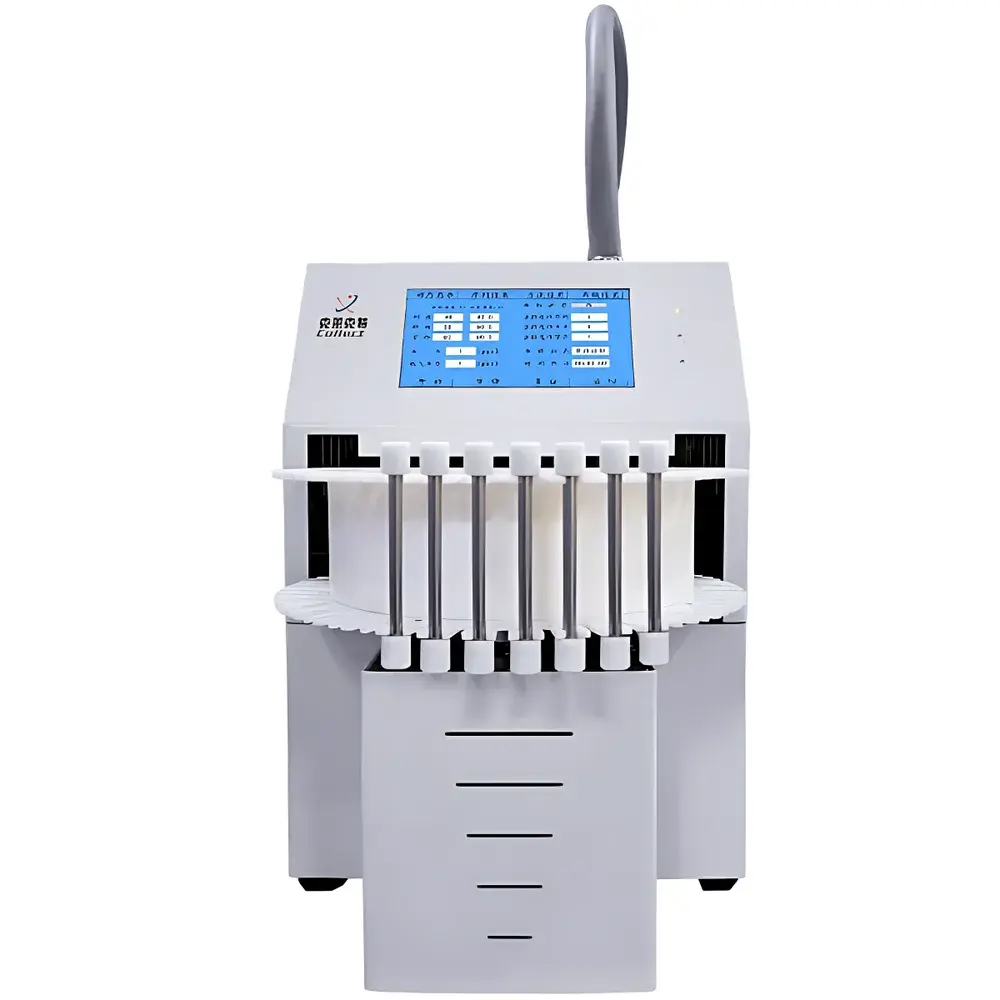
Clarete ASTD-50 Fully Automated Two-Stage Thermal Desorber
| Brand | Clarete |
|---|---|
| Origin | Henan, China |
| Manufacturer Type | Direct Manufacturer |
| Instrument Type | Two-Stage (Cryo-Focusing) Thermal Desorber |
| Automation Level | Fully Automated |
| Sample Capacity | 50 Positions |
| Primary Desorption Temp Range | 40–380 °C, ±1 °C accuracy |
| Secondary Desorption Temp Range | −35–400 °C |
| Valve & Transfer Line Temp Range | 50–240 °C (optional up to 330 °C), ±1 °C accuracy |
| Cryo-Focusing Capability | Yes |
| Flash Heating Rate | >50 °C/s |
| Enrichment Time | 0–60 min |
| Injection Time | 0–10 min |
| Simulated Sampling Time | 0–60 min |
| Simulated Flow Rate | 0–200 mL/min |
| RSD | ≤2.5% (benzene in 0.05 μg methanol) |
Overview
The Clarete ASTD-50 Fully Automated Two-Stage Thermal Desorber is an engineered solution for quantitative trace volatile organic compound (VOC) and semi-volatile organic compound (SVOC) analysis in environmental, occupational hygiene, and materials testing laboratories. It operates on the principle of two-stage thermal desorption—first releasing analytes from sorbent tubes under controlled heating (primary desorption), then cryogenically refocusing them onto a narrow cold trap (secondary desorption), followed by rapid flash-heating and transfer into a gas chromatograph (GC). This architecture ensures high sensitivity, minimal band broadening, and exceptional reproducibility—critical for compliance with EPA TO-17, ISO 16017-1, and ASTM D6196 methodologies. Designed for unattended operation over extended sequences, the ASTD-50 integrates precision temperature control, inert flow path design, and synchronized GC triggering to support regulatory-grade data integrity.
Key Features
- Fully automated sample handling via programmable robotic gripper system accommodating 50 standard 6 mm OD × 89 mm sorbent tubes (e.g., Tenax TA, Carbopack B/C, Carboxen variants)
- Independent, PID-controlled heating zones for primary desorption oven, secondary cold trap (Peltier-cooled to −35 °C), injection valve, and transfer lines—all maintained within ±1 °C stability
- Electrically actuated 6-port switching valve combined with solenoid valves enables precise sequence control of desorption, carrier gas purge, backflush, and trap reconditioning
- Entire sample pathway—including valve-to-GC interface—resides within a thermally insulated heated enclosure to eliminate cold spots and prevent analyte condensation or loss
- High-inertness transfer lines fabricated from silonized fused silica or deactivated stainless steel; all wetted surfaces undergo rigorous deactivation treatment to minimize adsorption and carryover
- Time-based method programming supports full automation of enrichment duration, desorption dwell time, flash ramp rate (>50 °C/s), injection duration, and post-run trap bake-out
- Integrated GC trigger output (TTL/relay) synchronizes desorption start with GC oven ramp initiation and data acquisition software start signal
Sample Compatibility & Compliance
The ASTD-50 accommodates industry-standard sorbent tubes per ISO 16017-1 and EPA Method TO-17 specifications, including single- and multi-bed configurations (e.g., Tenax GR/Carbopack X/Carboxen 1000). Its validated performance meets RSD ≤2.5% for benzene at 0.05 μg loading—demonstrating suitability for low-level VOC quantification in ambient air, indoor air, and polymer emission testing. The instrument’s firmware supports audit-trail-enabled method storage and user-access logging, aligning with GLP and GMP documentation requirements. While not certified to IEC 61000-4 electromagnetic compatibility standards out-of-box, its electrical architecture complies with CE marking directives for laboratory equipment (2014/30/EU EMC Directive and 2014/35/EU LVD Directive). Full validation documentation—including IQ/OQ templates—is provided for laboratory implementation under FDA 21 CFR Part 11-compliant workflows when paired with compliant chromatography data systems.
Software & Data Management
The ASTD-50 operates via embedded microcontroller with intuitive Chinese-language LCD interface; English-language configuration and method export are supported via USB-hosted CSV parameter files compatible with common GC vendor software (Agilent OpenLab, Thermo Chromeleon, Shimadzu GCsolution). All temperature setpoints, timing parameters, and valve actuation sequences are stored as named methods with version timestamps. System logs record runtime events—including temperature deviations exceeding ±1.5 °C, valve actuation failures, or pressure fault conditions—with automatic timestamping and retention for ≥30 days. Raw method files may be imported/exported without proprietary encryption, enabling third-party script integration for LIMS interfacing or automated report generation.
Applications
- Regulatory monitoring of ambient and workplace air per EPA TO-17, EN 16705, and ISO 16017-1
- VOC emission profiling from building materials, automotive interiors, and packaging films
- Odorant identification and quantification in consumer products and food contact materials
- Method development for emerging contaminants including halogenated VOCs, oxygenates, and C10–C20 SVOCs
- Quality control of activated carbon and polymer-based sorbents via breakthrough testing
- Automated batch processing of field-collected samples in high-throughput environmental labs
FAQ
What sorbent tube formats are supported?
Standard 6 mm OD × 89 mm tubes (e.g., Markes UNITY, PerkinElmer, or generic TO-17 tubes); custom adapters available upon request for alternative dimensions.
Does the ASTD-50 support splitless or split injection modes?
It delivers 100% transfer to the GC column; split functionality must be implemented at the GC inlet using appropriate liners or splitter modules.
Can the secondary cold trap temperature be set below −35 °C?
No—the Peltier cooling module is rated for −35 °C minimum; liquid nitrogen trapping is not supported on this platform.
Is remote monitoring or network connectivity available?
No Ethernet or Wi-Fi interface is built-in; status monitoring is limited to local display and USB log export.
What maintenance intervals are recommended for the valve and trap assemblies?
Valve seals should be inspected every 500 runs; cold trap frits require cleaning every 200 runs or after high-particulate samples; full calibration verification is advised quarterly.





