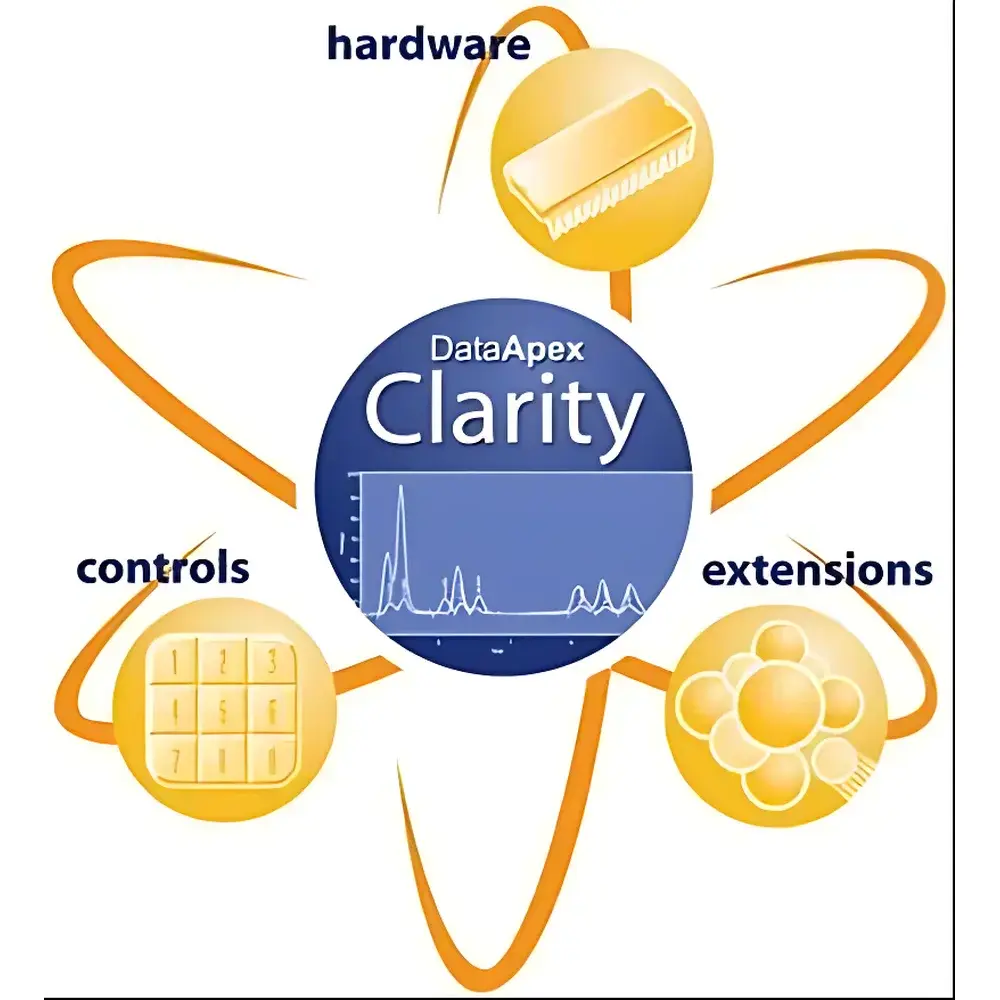
Clarity Chromatography Data System (CDS) by DataApex
| Brand | DataApex |
|---|---|
| Origin | Czech Republic |
| Model | Clarity |
| Software Platform | Windows Vista and later (64-bit compatible) |
| Regulatory Compliance | Supports 21 CFR Part 11 compliant configurations (audit trail, electronic signatures, user access control) |
| Deployment | Standalone workstation software with local or networked database options |
| Instrument Control | Native drivers for Agilent, Shimadzu, Sykam/KNAUER, Bischoff HPLC/GC systems |
| Data Format | Proprietary .CLD binary + export to ASCII, CSV, PDF, PNG, SVG |
Overview
Clarity Chromatography Data System (CDS) is a validated, enterprise-grade chromatographic data acquisition and processing platform developed by DataApex s.r.o., a Czech software engineering firm specializing in analytical instrument control and regulatory-compliant laboratory informatics. Built on a modular architecture, Clarity implements real-time analog-to-digital conversion, closed-loop instrument control, and ISO/IEC 17025-aligned data integrity workflows. It operates as a full-featured chromatography workstation—acquiring, visualizing, integrating, quantifying, and reporting raw detector signals from high-performance liquid chromatography (HPLC), ultra-high-performance liquid chromatography (UHPLC), gas chromatography (GC), and capillary electrophoresis (CE) systems. Unlike generic data viewers, Clarity embeds domain-specific algorithms for peak detection (e.g., second-derivative thresholding, valley-to-valley baseline correction), retention time alignment, and multi-component calibration curve fitting (linear, quadratic, weighted least-squares). Its deterministic timing engine ensures sub-millisecond synchronization between valve actuation, gradient programming, and detector sampling—critical for method reproducibility under GLP and GMP environments.
Key Features
- Multi-vendor hardware integration: Native communication protocols for Agilent ChemStation/OpenLab CDS, Shimadzu LabSolutions, Sykam/Spectra Physics, KNAUER AZURA, Bischoff LC systems, and select Thermo Fisher and Waters modules via vendor-supplied SDKs or direct RS-232/USB/Ethernet interfaces.
- Modular functional expansion: Optional add-on modules include Clarity Quant (for pharmacopeial-compliant assay validation), Clarity Security (role-based permissions, 21 CFR Part 11 audit trail logging), Clarity Network (centralized method & result repository with SQL Server backend), and Clarity AutoQC (automated system suitability testing with configurable pass/fail criteria).
- Intuitive graphical workflow design: Drag-and-drop method builder with context-sensitive tooltips (“balloon help”), real-time preview of gradient profiles and detector response simulations, and one-click template cloning for rapid SOP deployment.
- Regulatory-ready data governance: Immutable raw data storage (.CLD format with SHA-256 hash), electronic signature capture with biometric or PKI certificate support, and full audit trail export in XML or PDF/A-2b format compliant with FDA, EMA, and PMDA inspection expectations.
- Cross-platform interoperability: Export of processed results to LIMS (via ASTM E1384 or HL7 ADT messages), ELN (using ISA-Tab metadata standards), and statistical analysis tools (R, Python pandas via CSV/TSV with embedded metadata headers).
Sample Compatibility & Compliance
Clarity supports all standard chromatographic detection modalities—including UV-Vis diode array (DAD), fluorescence (FLD), refractive index (RID), conductivity, mass spectrometry (MS) signal channels (TIC, EIC, SIM), and electrochemical detection—without requiring proprietary detector firmware modifications. It natively interprets manufacturer-specific calibration files (e.g., Agilent .CAL, Shimadzu .CALIB) and maintains traceable unit conversions (mAU → ng/mL via response factor propagation). The software conforms to ISO/IEC 17025:2017 Clause 7.7 (result reporting), USP Analytical Instrument Qualification, and EU Annex 11 principles for computerized system validation. Installation Qualification (IQ), Operational Qualification (OQ), and Performance Qualification (PQ) documentation packages are available upon request for regulated laboratories undergoing MHRA, ANVISA, or TGA audits.
Software & Data Management
Clarity employs a dual-layer database architecture: transient acquisition buffers reside in RAM for low-latency signal processing, while finalized runs are archived in a transactional SQL Server or PostgreSQL instance (local or remote). All user actions—including manual peak editing, integration parameter adjustments, and report generation—are timestamped, attributed to authenticated accounts, and logged in an encrypted audit trail. Data retention policies can be configured per project or instrument group, supporting automated archiving to NAS or object storage (S3-compatible). Backups follow NIST SP 800-88 Rev. 1 guidelines, with incremental daily snapshots and full weekly images verified via checksum comparison. The Clarity API (RESTful JSON endpoints) enables integration with enterprise identity providers (Active Directory, Azure AD) and custom QA dashboards.
Applications
- Pharmaceutical QC release testing per USP , EP 2.2.46, and JP 6.03 methods
- Biologics purity assessment using SEC-HPLC and IEX chromatograms
- Environmental contaminant screening (PAHs, PCBs, pesticides) via GC-MS/MS
- Food safety analytics including mycotoxin quantification and adulterant profiling
- Academic research requiring reproducible method transfer across HPLC platforms
- Contract research organizations (CROs) managing multi-client, multi-instrument study data
FAQ
Does Clarity support 64-bit Windows operating systems?
Yes—Clarity 2.6 and later versions are fully compiled for x64 architecture and certified for Windows 10/11 LTSB editions.
Can Clarity be validated for use in FDA-regulated environments?
Yes—DataApex provides IQ/OQ/PQ protocol templates, risk assessments per ICH Q9, and a complete validation support package aligned with FDA Guidance for Industry: Computerized Systems Used in Clinical Trials (2023).
Is raw data portable outside the Clarity ecosystem?
Yes—raw .CLD files include embedded metadata (instrument parameters, user ID, timestamps) and can be exported losslessly to open formats (ASCII, mzML for MS data) without compromising auditability.
How does Clarity handle method transfer between different HPLC vendors?
Clarity’s method translation engine maps vendor-specific gradient tables, dwell volume corrections, and detector sampling rates into a unified internal representation, enabling consistent integration and quantitation across Agilent, Shimadzu, and KNAUER systems.
What training and technical support options are available?
DataApex offers instructor-led virtual workshops (GxP-focused), on-site installation support, and SLA-backed remote assistance with guaranteed 4-hour response for critical issues affecting production runs.
Related Products