
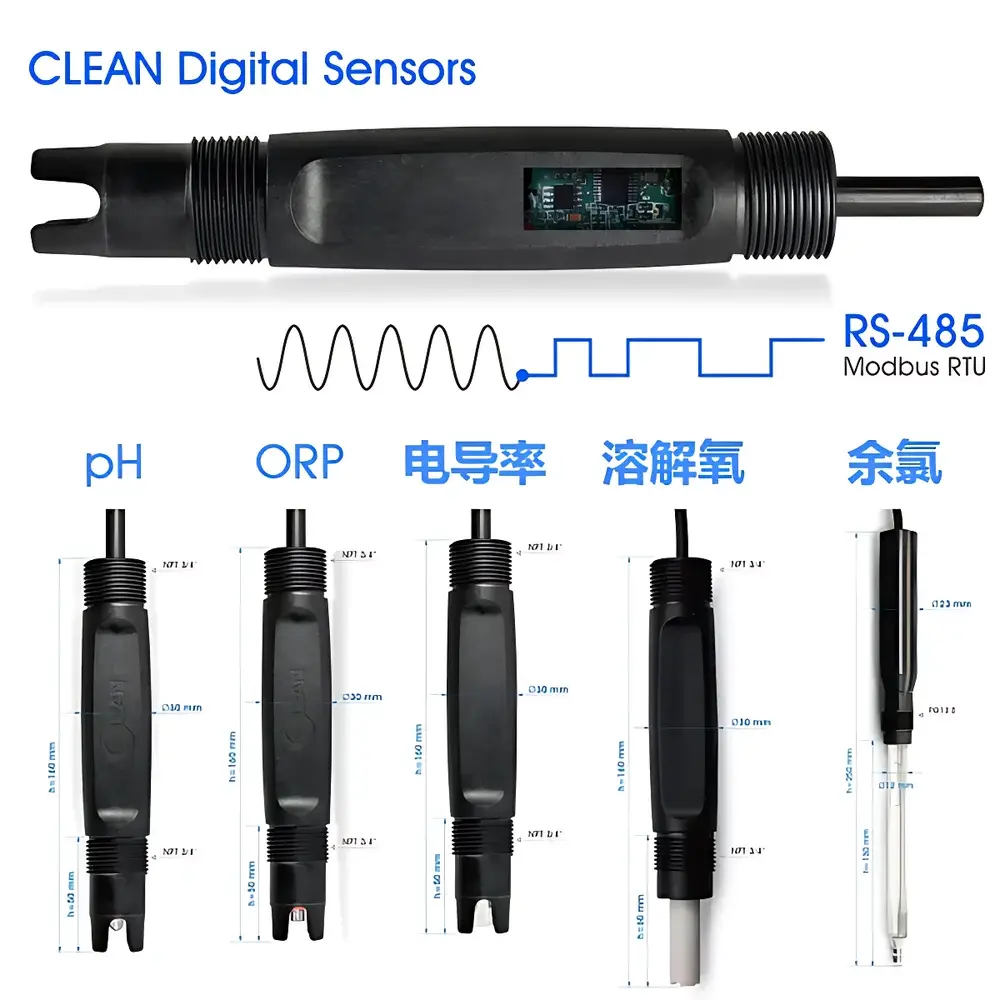
CLEAN CS5530D Digital Residual Chlorine Electrode with RS-485 Output
| Brand | CLEAN |
|---|---|
| Origin | Taiwan |
| Model | CS5530D |
| Instrument Type | Online |
| Measurement Principle | Amperometric Electrochemical Sensor |
| Measured Parameter | Free Chlorine (Residual Cl₂) |
| Range | 0–2.000 mg/L and 0–20.00 mg/L |
| Accuracy | ≤3% of reading |
| Repeatability | ±0.02 mg/L |
| Resolution | 0.001 mg/L (low range), 0.01 mg/L (high range) |
| LOD | 0.035 mg/L |
| Temperature Compensation | Integrated Pt1000 RTD |
| pH Compensation | Built-in pH input interface for external pH electrode integration |
| Operating Temperature | 0–80 °C |
| Max Pressure | 10 bar |
| Housing Material | Glass sensing element + PP + POM |
| Reference System | Dual-salt-bridge Ag/AgCl |
| Junction Type | Annular ceramic liquid junction |
| Cap Material | PP |
| Connector | PG13.5 |
| Handle Material | POM |
| Cable Length | 5 m |
| Communication | RS-485 Modbus RTU |
| Power Supply | DC 12 V |
| Output Signals | Residual chlorine concentration (mg/L), temperature (°C) |
| Enclosure Rating | IP68 |
| Compatible Flow Cell | A580 hermetically sealed flow-through cell |
Overview
The CLEAN CS5530D is a high-stability, digital amperometric residual chlorine electrode engineered for continuous, in-line monitoring of free chlorine in potable water, distribution systems, swimming pools, cooling towers, and wastewater disinfection processes. Unlike colorimetric or DPD-based methods, the CS5530D employs a three-electrode amperometric cell (working, counter, and reference) operating at a fixed polarizing voltage to selectively oxidize hypochlorous acid (HOCl) and hypochlorite ion (OCl⁻) at the platinum working electrode surface. The resulting diffusion-limited current is linearly proportional to the active chlorine species concentration. Critically, the sensor integrates real-time temperature measurement via an embedded Pt1000 RTD and supports external pH electrode input—enabling dynamic speciation correction based on the HOCl/OCl⁻ equilibrium (pKa = 7.54 at 25 °C). This electrochemical architecture eliminates reagent consumption, avoids optical interference from turbidity or color, and delivers stable output under variable flow conditions when paired with the A580 pressurized flow cell.
Key Features
- Dual-range digital output: selectable 0–2.000 mg/L (high-resolution mode) and 0–20.00 mg/L (wide-range mode), both with programmable resolution (0.001 or 0.01 mg/L)
- Integrated dual-salt-bridge Ag/AgCl reference system with annular ceramic junction—minimizes clogging and extends service intervals in suspended-solids-rich matrices
- IP68-rated housing constructed from chemically inert materials: borosilicate glass sensing tip, polypropylene (PP) cap, and polyoxymethylene (POM) handle—suitable for submersion or pressurized inline installation
- RS-485 Modbus RTU interface enables direct integration into SCADA, PLC, or DCS platforms without analog signal degradation or grounding complications
- DC 12 V power supply simplifies field deployment in existing low-voltage infrastructure; no isolated loop power required
- Rated for continuous operation up to 10 bar pressure and 80 °C—compatible with hot water disinfection validation protocols and high-pressure distribution networks
Sample Compatibility & Compliance
The CS5530D is validated for use in drinking water (compliant with EPA Method 334.0 and ISO 7393-2), municipal wastewater effluent, and industrial process water where residual chlorine control is mandated by regulatory frameworks. Its amperometric design ensures immunity to common interferents including bromide, nitrite (below 1 mg/L), and low-molecular-weight organics—provided oxidant demand is stabilized upstream. The dual-salt-bridge reference system maintains potential stability in chloride-rich environments (>5000 mg/L Cl⁻), supporting applications in desalination plant post-chlorination streams. For GLP/GMP environments, data integrity is preserved through time-stamped Modbus registers compliant with FDA 21 CFR Part 11 when interfaced with audit-trail-enabled controllers.
Software & Data Management
The electrode transmits calibrated residual chlorine and temperature values as discrete 16-bit holding registers over Modbus RTU (slave ID configurable, baud rates 9600–115200 bps). No proprietary software is required; standard Modbus polling tools (e.g., ModScan, Ignition SCADA) can log, trend, and alarm on raw or compensated outputs. When integrated with CLEAN’s A580 flow cell, automatic flow-rate compensation algorithms (optional firmware upgrade) adjust for residence-time-dependent response lag. All calibration coefficients—including slope, zero offset, temperature coefficient (β), and pH correction factor—are stored non-volatile memory and survive power cycles.
Applications
- Real-time monitoring of chlorine residual at water treatment plant clearwells and booster station outlets
- Automated dose control loops for sodium hypochlorite or chlorine gas feed systems
- Validation of contact time (CT) calculations per US EPA Guidance for Disinfectants
- Swimming pool and spa water quality management per WHO Guidelines for Safe Recreational Water Environments
- Pharmaceutical purified water (PW) and water-for-injection (WFI) distribution loop surveillance (USP )
- Monitoring of chlorine decay kinetics during pipe network aging studies
FAQ
Does the CS5530D measure total chlorine or only free chlorine?
The CS5530D is optimized for free chlorine (HOCl + OCl⁻) detection. It does not respond significantly to chloramines under standard operating conditions due to their lower oxidation kinetics at the applied polarization potential.
Is pH compensation mandatory for accurate measurement?
Yes. Since the ratio of HOCl to OCl⁻ is pH-dependent—and only HOCl exhibits strong biocidal activity and electrochemical activity—the integrated pH input is required for traceable, regulatory-grade reporting.
What maintenance schedule is recommended for long-term stability?
Electrolyte refill every 6 months (for dual-salt-bridge chamber), membrane cleaning with 0.1 M HCl weekly in high-fouling applications, and zero/slope verification against NIST-traceable DPD standards quarterly.
Can the CS5530D be installed directly in open-channel flow?
No. It must be used with a pressurized flow cell (e.g., A580) to maintain laminar, bubble-free sample presentation and consistent diffusion boundary layer thickness.
Is temperature compensation performed internally or externally?
Temperature measurement is performed internally via the integrated Pt1000 RTD; the sensor firmware applies the Arrhenius-based temperature correction algorithm before outputting the final mg/L value.
Related Products







