
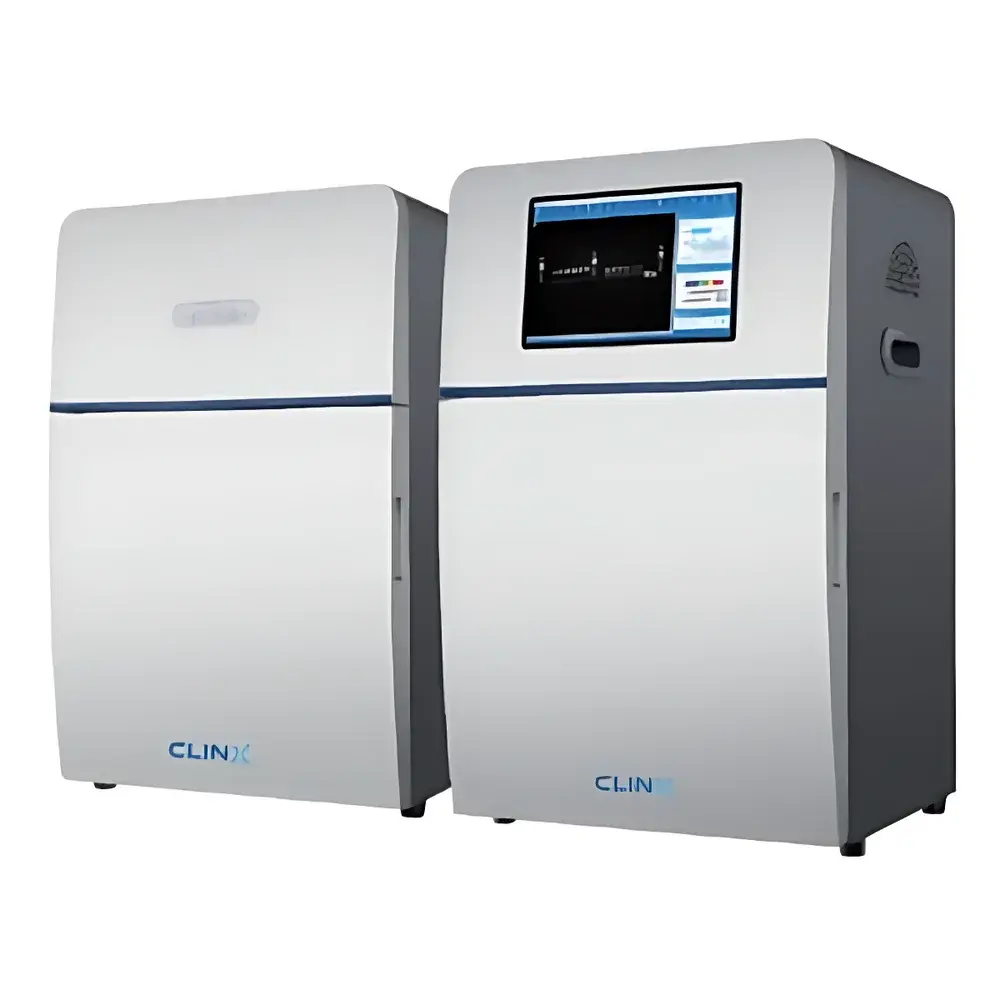
CLINX GenoSens 2150 Gel Imaging System
| Brand | CLINX |
|---|---|
| Origin | Shanghai, China |
| Model | GenoSens 2150 |
| Camera Resolution | 5.2 MP (2540 × 2048) |
| Bit Depth | 16-bit |
| Dynamic Range | 4.0 OD |
| Imaging Modes | UV (302/365 nm), Blue Light (470 nm), White Light, Reflected Fluorescence |
| Transilluminator Area | 211 mm × 260 mm |
| Lens | Motorized Autofocus Lens |
| Image Capture Area | 195 mm × 245 mm |
| Software | GenoSens Image Acquisition & Analysis Suite |
| Compliance | Designed for GLP-compliant workflows with audit trail-capable user account management |
Overview
The CLINX GenoSens 2150 Gel Imaging System is an integrated, digitally controlled platform engineered for high-fidelity visualization and quantitative analysis of nucleic acid and protein electrophoresis gels. It operates on a solid-state LED-based illumination architecture—eliminating mercury-vapor lamps—and employs a scientific-grade 16-bit monochrome CCD sensor with 5.2 megapixel resolution to capture gel images across UV (302 nm / 365 nm), blue light (470 nm), white light, and reflected fluorescence excitation wavelengths. The system’s optical design ensures uniform photon delivery (>90% uniformity across the transilluminator surface), minimizing intensity gradients that compromise densitometric accuracy. Its modular excitation/emission filter configuration supports multi-dye compatibility without mechanical reconfiguration, enabling reproducible detection of ethidium bromide, SYBR dyes, GelSignal™ variants, Coomassie-stained proteins, silver-stained bands, and fluorescent tags including SYPRO Ruby and SYPRO Orange. Built for routine laboratory environments, the GenoSens 2150 delivers consistent performance under ambient lighting conditions and integrates seamlessly into regulated workflows requiring traceability and data integrity.
Key Features
- 16-bit CCD sensor with true 65,536 gray-level resolution and 4.0 optical density (OD) dynamic range—enabling accurate quantification across low- and high-intensity bands in a single exposure.
- Motorized autofocus lens with real-time preview and programmable focus presets—reducing operator variability and ensuring pixel-level sharpness across variable gel thicknesses and staining intensities.
- Dual-wavelength UV LED transilluminator (302 nm / 365 nm) and dedicated 470 nm blue-light module—designed for safe, long-life (>30,000 h) excitation of modern nucleic acid dyes with minimal photobleaching or DNA damage.
- White-light LED transilluminator optimized for visible-stain detection (Coomassie, silver, and stain-free gels), delivering stable, flicker-free illumination with >90% spatial uniformity.
- Reflected fluorescence capability with selectable excitation (365, 470, 530, 630, 660, 730 nm) and emission filters (460, 525, 585, 690, 715, 810 nm)—supporting multiplexed fluorescent protein or nucleic acid labeling strategies.
- Embedded industrial 10.1-inch touchscreen interface (GenoSens 2150Touch variant) or external PC control via dual USB 2.0 ports—providing flexible deployment in shared core facilities or individual labs.
Sample Compatibility & Compliance
The GenoSens 2150 accommodates standard vertical and horizontal electrophoresis gels up to 24.5 cm × 19.5 cm, including agarose, polyacrylamide (PAGE), SDS-PAGE, and native gels. It supports all major nucleic acid dyes—including EtBr, SYBR Green I/II, SYBR Gold, SYBR Safe, GelSignal Red/Green, and GelStar—as well as protein-compatible stains such as Coomassie Brilliant Blue R-250, silver nitrate, SYPRO Ruby, SYPRO Orange, and commercial stain-free chemistries. The system adheres to instrumentation design principles aligned with ISO/IEC 17025 and FDA 21 CFR Part 11 requirements: its GenoSens software implements role-based multi-tier user accounts, electronic signature support, full audit trail logging (including image acquisition parameters, user actions, and timestamped metadata), and PDF report generation embedding raw image hashes and acquisition settings. All LED sources meet IEC 62471 photobiological safety classification for UV and blue-light exposure.
Software & Data Management
The GenoSens Image Acquisition & Analysis Software provides a unified interface for hardware control, image processing, and quantitative densitometry. Core modules include real-time live preview with histogram feedback, automated exposure optimization, pixel binning (1×1 to 4×4), and non-linear contrast enhancement (gamma correction, pseudo-color mapping, inversion, cropping, and rotation). Quantitative analysis features automatic lane and band detection with manual override; background subtraction per lane; integrated molecular weight calibration using reference ladders; calculation of relative mobility (Rf), band intensity (integrated optical density), % volume, and normalized concentration estimates. All results—including annotated images, measurement tables, and calibration curves—are exportable to CSV or Excel formats. Audit logs record user login/logout events, parameter changes, image saves, and analysis exports—supporting GLP/GMP documentation requirements and internal quality assurance protocols.
Applications
The GenoSens 2150 serves as a primary imaging tool in molecular biology, biochemistry, and biopharmaceutical QC laboratories. Typical use cases include verification of PCR product size and yield; assessment of restriction digest efficiency; quantification of plasmid DNA purity and concentration; validation of siRNA/shRNA knockdown efficiency; comparative analysis of protein expression levels across treatment groups; evaluation of post-translational modifications via 2D electrophoresis; and documentation of CRISPR editing outcomes (e.g., T7E1 or Surveyor assays). Its broad spectral flexibility also enables applications beyond electrophoresis—such as algal colony imaging under white light, fluorescence-based viability assays, and documentation of chemiluminescent western blots when paired with optional high-sensitivity acquisition modes.
FAQ
Does the GenoSens 2150 support chemiluminescence imaging?
No—the GenoSens 2150 is optimized for fluorescence and absorbance-based gel detection. Chemiluminescent signal capture requires longer exposures and cooled CCD/CMOS sensors not included in this model. For chemiluminescence, CLINX recommends the GenoSens 2250 series with thermoelectric cooling.
Can the system be validated for regulated environments (e.g., pharmaceutical QC)?
Yes—the software includes configurable user roles, electronic signatures, and immutable audit trails compliant with FDA 21 CFR Part 11 and ISO 13485 documentation standards. IQ/OQ documentation templates are available upon request.
What is the maximum gel thickness supported by the autofocus system?
The motorized lens accommodates gels up to 8 mm thick, including comb-inserted wells and embedded markers, without manual refocusing.
Is third-party software integration possible?
Raw TIFF image output is fully compatible with ImageJ/Fiji, Quantity One (Bio-Rad), and other open- or commercial-analysis platforms. API access is not provided; however, batch export scripts can be configured via Windows command-line tools.
How is UV exposure safety managed during operation?
The cabinet incorporates interlocked door switches that automatically deactivate UV LEDs upon opening. Optional UV-blocking acrylic shields (≥99.5% attenuation at 302 nm) are available as accessories for enhanced operator protection.



