
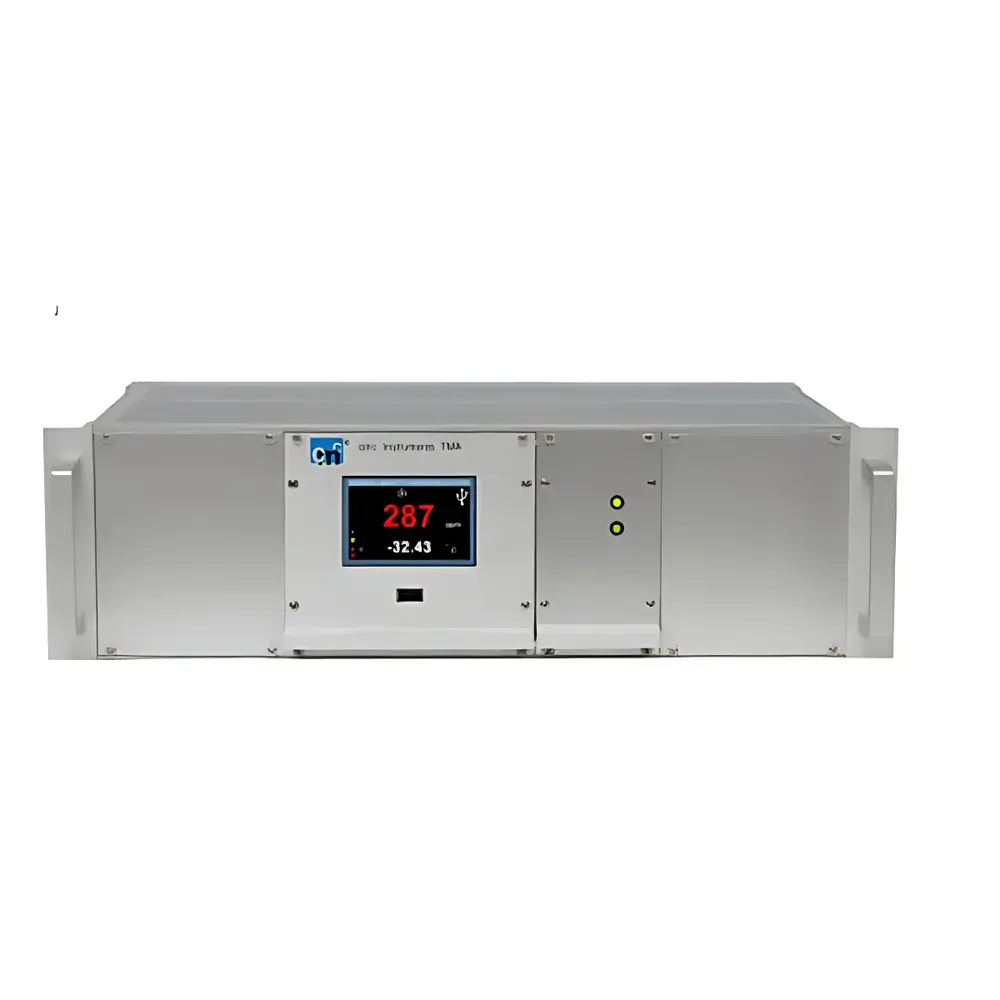
CMC iTMA-202-19″ Electrolytic Dew Point Analyzer for Chlorine and Corrosive Gases
| Brand | CMC (Schimse) |
|---|---|
| Origin | Germany |
| Model | iTMA-202-19" |
| Type | Online Dew Point Analyzer |
| Principle | Phosphorus Pentoxide (P₂O₅) Electrolytic Method |
| Operating Temperature | 5–50 °C |
| Accuracy | ±1% of full scale |
| Repeatability | ±0.1% of full scale |
| Measurement Ranges | 0–10 / 100 / 1,000 / 2,500 ppm H₂O (auto/manual switching) |
| Response Time (T₉₀) | <1 s |
| T₅₀ Response | <8 s |
| Sample Flow Rate | 20 NL/h |
| Recommended Sample Pressure | 0.1–0.5 barg |
| Display | Touchscreen with multilingual support (including Chinese) |
| Analog Output | 0/4–20 mA (configurable) |
| Alarm Outputs | 2 relay outputs |
| Enclosure Dimensions | 483 mm (W) × 135 mm (H) × 345 mm (D) |
| Standard Cable Length | 3 m (up to 300 m optional) |
Overview
The CMC iTMA-202-19″ is a high-stability, online electrolytic dew point analyzer engineered specifically for continuous moisture monitoring in aggressive and reactive gas streams—including chlorine (Cl₂), hydrogen chloride (HCl), sulfur dioxide (SO₂), hydrogen sulfide (H₂S), and other high-purity acid gases. It employs the well-established phosphorus pentoxide (P₂O₅) electrolytic measurement principle: water vapor in the sample gas is quantitatively decomposed at a P₂O₅-coated sensor cell via controlled electrolysis into hydrogen and oxygen. The resulting current is stoichiometrically proportional to the water concentration—enabling absolute, calibration-free trace moisture quantification down to sub-ppm levels. Unlike optical or capacitive methods, this technique delivers inherent zero drift stability and eliminates the need for periodic recalibration under stable operating conditions. The sensor architecture features a fused-silica cylindrical cell with parallel platinum or rhodium electrodes and a sub-micron hygroscopic phosphoric acid (H₃PO₄) film, regenerated in situ when required—ensuring long-term reliability in chemically demanding environments.
Key Features
- True absolute measurement: No reliance on reference standards or external calibration gases
- Dedicated sensor design for Cl₂ and other corrosive process gases—resistant to chemical passivation and electrode poisoning
- Microprocessor-controlled auto-ranging with four selectable full-scale ranges (0–10, 100, 1,000, 2,500 ppm H₂O)
- Ultra-fast response: T₉₀ < 1 second; T₅₀ < 8 seconds—critical for real-time process control and safety interlocks
- Integrated self-diagnostic routine at power-on and during operation per NAMUR NE 43 guidelines
- Robust 19-inch rack-mount enclosure (483 × 135 × 345 mm) rated for industrial ambient temperatures (5–65 °C)
- Configurable 4–20 mA analog output with linear or square-root scaling; two programmable relay outputs for alarm or shutdown signaling
Sample Compatibility & Compliance
The iTMA-202-19″ is validated for use with inert gases (He, Ne, Ar, Kr, Xe), diatomic gases (H₂, N₂, O₂, F₂), oxidizing species (O₃), hydrocarbons (CH₄, C₂H₂), halocarbons (Freons, SF₆), and highly reactive acid gases—including Cl₂, HCl, SO₂, and H₂S—provided they do not chemically reduce or hydrolyze the P₂O₅ sensing layer. Gases such as ammonia (NH₃) or amines are incompatible due to irreversible reaction with phosphoric acid. The analyzer meets NAMUR-compliant electrical interface specifications and supports integration into SIL-2-capable safety instrumented systems (SIS) when configured with appropriate redundancy. Its design adheres to IEC 61000-6-2/6-4 for electromagnetic compatibility and carries CE marking for EMC and LVD directives. While not intrinsically safe by default, it may be deployed in Zone 2 classified areas with appropriate barrier configurations.
Software & Data Management
The embedded touchscreen HMI provides local configuration, real-time trend visualization, and event logging without external software dependency. All operational parameters—including range selection, alarm thresholds, output scaling, and sensor regeneration triggers—are configurable via intuitive menu navigation. Data logging records timestamped moisture values, sensor status flags, and diagnostic events at user-defined intervals (1 s to 1 h). Optional Modbus RTU (RS-485) or Ethernet/IP interfaces enable seamless integration with DCS, SCADA, or MES platforms. Audit trails comply with GLP/GMP data integrity expectations: all parameter changes are time-stamped and attributed to operator ID (if network-authenticated). While not FDA 21 CFR Part 11-certified out-of-the-box, the system supports electronic signature workflows and secure user role management when deployed with validated IT infrastructure.
Applications
- Chlor-alkali production: Continuous monitoring of Cl₂ drying efficiency prior to liquefaction or compression
- Electronics-grade gas supply: Verification of moisture purity in bulk Cl₂, HCl, and SF₆ used in semiconductor etching and chamber cleaning
- Chemical synthesis: Moisture control in SO₂-based sulfonation reactors and H₂S scavenging loops
- Pharmaceutical excipient manufacturing: Validation of dry air or nitrogen purge lines for moisture-sensitive API handling
- Power transformer gas analysis: Trace H₂O detection in SF₆-insulated switchgear to prevent dielectric breakdown
- Calibration lab traceability: Use as a primary transfer standard for verifying chilled mirror or tunable diode laser analyzers
FAQ
Is the P₂O₅ sensor compatible with wet chlorine gas containing residual hypochlorous acid (HOCl)?
Yes—the sensor’s electrode materials and acid film chemistry are selected to tolerate transient HOCl exposure typical of industrially dried Cl₂ streams. Long-term exposure to >10 ppm HOCl may accelerate membrane degradation and necessitate more frequent regeneration cycles.
Can the analyzer operate at sample pressures above 0.5 barg?
It is rated for 0.1–0.5 barg. Operation outside this range requires an external pressure regulator and flow controller to maintain specified sample velocity (20 NL/h) and avoid mechanical stress on the sensor cell.
Does the instrument require periodic zero/span calibration?
No—its electrolytic principle is fundamentally absolute. However, annual verification using NIST-traceable moisture standards is recommended for quality assurance and audit readiness.
What maintenance is required beyond sensor regeneration?
Routine tasks include inlet filter replacement (every 3–6 months depending on particulate load), leak-checking of sample lines, and validation of analog output linearity using a certified multimeter.
Is remote firmware update supported?
Firmware updates are performed via USB memory stick or Ethernet connection using CMC’s proprietary configuration utility; no cloud connectivity or over-the-air updates are implemented to ensure cybersecurity compliance in regulated environments.





