
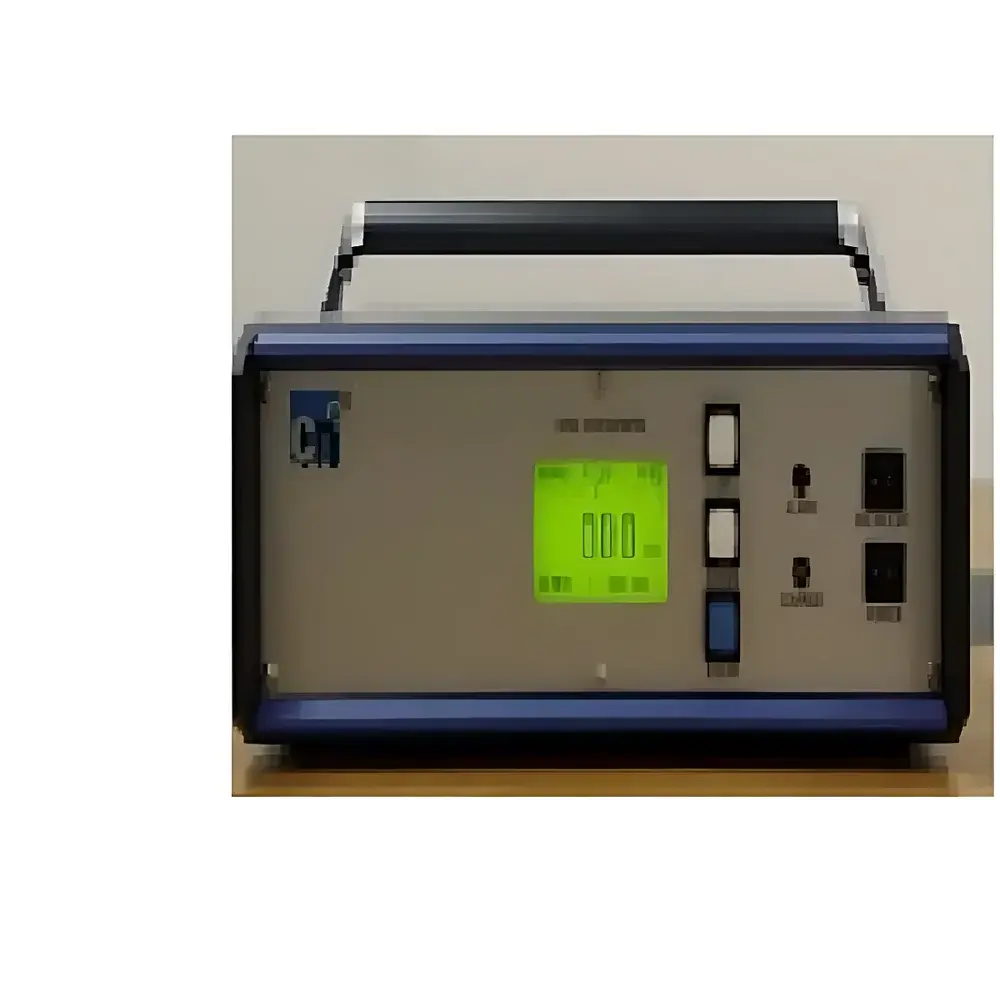
CMC TMA-210-D Portable Electrolytic Moisture Analyzer with Display
| Brand | CMC |
|---|---|
| Origin | Germany |
| Model | TMA-210-D |
| Principle | Phosphorus Pentoxide (P₂O₅) Electrolytic Method |
| Operating Temperature Range | -20 °C to +80 °C |
| Accuracy | ±0.2 °C dew point equivalent |
| Repeatability | ±0.1 °C dew point equivalent |
| Measurement Range | 0–10 / 100 / 1000 / 2500 ppmᵥ (auto-ranging) |
| Sensitivity | 0.1% of full scale |
| Response Time | <1 s (t₉₀) |
| Sample Flow Rate | 100 NL/h |
| Recommended Sample Pressure | 0.1–0.5 barg |
| Sample Temperature | 5–150 °C |
| Ambient Temperature | 5–65 °C |
| Display | Backlit LCD |
| Analog Output | 4–20 mA or 0–10 V |
| Alarm Outputs | 2 relay outputs |
| Enclosure Type | Benchtop (257 × 160 × 316 mm) |
Overview
The CMC TMA-210-D is a benchtop portable electrolytic moisture analyzer engineered for trace-level water vapor quantification in industrial process gases and high-purity carrier streams. It employs the internationally recognized phosphorus pentoxide (P₂O₅) electrolytic detection principle: moisture in the sample gas is absorbed by a thin film of phosphoric acid (H₃PO₄) coated between two parallel electrodes (typically platinum or rhodium), then electrolyzed into hydrogen and oxygen. The resulting P₂O₅ layer continuously rehydrates from incoming moisture, sustaining an equilibrium where the electrolysis current is directly proportional to the water concentration—enabling linear, zero-based measurement across four auto-switching ranges (0–10, 0–100, 0–1000, and 0–2500 ppmᵥ). This method delivers exceptional specificity for H₂O without cross-sensitivity to CO₂, hydrocarbons, or most acidic gases—making it suitable for demanding applications including chlorine (Cl₂), hydrogen chloride (HCl), sulfur dioxide (SO₂), hydrogen sulfide (H₂S), and ultra-high-purity inert gases (He, Ar, Kr, Xe, N₂, O₂). Unlike chilled-mirror or capacitance-based dew point meters, the TMA-210-D provides true ppmᵥ quantification—not inferred dew point—and maintains stability under variable pressure and flow conditions typical in gas cylinder validation, semiconductor purge lines, and specialty chemical synthesis.
Key Features
- True electrolytic P₂O₅ sensor with platinum/rhodium electrode configuration for long-term stability and resistance to corrosive and reactive gases
- Microprocessor-controlled auto-ranging with seamless switching between four measurement spans—no manual range selection required
- Sub-second response time (t₉₀ < 1 s), enabling real-time monitoring of moisture transients during gas purging or system commissioning
- Integrated self-diagnostic routine at power-up, verifying sensor hydration status, amplifier integrity, and relay functionality
- NAMUR-compliant output interface (NE 43) with dual programmable alarm relays for process interlock integration
- Backlit LCD display with simultaneous readout of moisture concentration (ppmᵥ), dew point (°C), and operating status indicators
- Benchtop enclosure (257 × 160 × 316 mm) designed for lab verification, field calibration checks, and mobile QA/QC deployment
Sample Compatibility & Compliance
The TMA-210-D is validated for continuous analysis of non-reactive and moderately aggressive gas matrices, including but not limited to: He, Ar, Kr, Xe, N₂, H₂, O₂, O₃, D₂, F₂, SF₆, C₂H₂, CO₂, CH₄, natural gas, Freon variants, and high-purity acid gases (Cl₂, HCl, SO₂, H₂S). It excludes gases that chemically degrade phosphoric acid or form stable oxides with the electrode surface (e.g., strong oxidizers like NO₂ or ozone above 10 ppm). All configurations comply with IEC 61000-6-2 (immunity) and IEC 61000-6-4 (emissions), and support GLP/GMP-aligned data integrity when paired with external logging systems. While not intrinsically safe, the analyzer may be deployed in Zone 2/Class I Div 2 environments when installed per local hazardous area regulations.
Software & Data Management
The TMA-210-D operates as a standalone instrument with no embedded PC or proprietary software dependency. Analog outputs (4–20 mA or 0–10 V) are fully scalable and linear over the active range, supporting direct integration into DCS, PLC, or SCADA platforms. Relay alarms are configurable for high/low limit, latching/non-latching, and hysteresis settings via front-panel menu navigation. For audit-ready documentation, users may connect the analog output to a validated data acquisition system compliant with FDA 21 CFR Part 11—enabling electronic signature, user access control, and immutable audit trails. Internal firmware supports firmware version reporting and diagnostic event logging (e.g., sensor dry-out, over-range, power interruption), accessible via serial query (RS-232 optional).
Applications
- Verification of moisture content in high-purity bulk gases prior to delivery to semiconductor fab tools
- In-line monitoring of Cl₂ and HCl supply lines in chlor-alkali and PVC production
- QA release testing of SF₆ insulating gas in high-voltage switchgear maintenance
- Residual moisture validation in cryogenic liquid nitrogen and argon dewars
- Trace moisture profiling during hydrogen fuel cell feed gas conditioning
- Calibration transfer standard for field-deployed chilled-mirror hygrometers and tunable diode laser analyzers
FAQ
Does the TMA-210-D require periodic sensor replacement or regeneration?
Yes—the P₂O₅ sensor requires scheduled replacement every 12–24 months depending on cumulative exposure to moisture and gas matrix aggressiveness. Sensor regeneration is not supported; replacement kits include pre-calibrated assemblies traceable to NIST standards.
Can the instrument measure dew point directly, or only ppmᵥ?
It calculates and displays dew point (°C) in real time using built-in pressure and temperature compensation algorithms—but its primary metrological output is absolute water concentration (ppmᵥ), which remains invariant across pressure changes.
Is the TMA-210-D compatible with ISO 8573-3 or ASTM D6673 for compressed air testing?
No—it is not certified for ISO 8573-3 Class 0–5 classification, as those standards mandate chilled-mirror or spectroscopic methods. However, its ppmᵥ output can be used for internal process control exceeding ISO 8573-3 Class 1 requirements (≤0.1 ppmᵥ) when validated per internal SOP.
What maintenance intervals are recommended for routine operation?
Daily visual inspection of inlet filter and desiccant trap; quarterly verification of zero and span using certified moisture standards (e.g., NIST-traceable permeation tubes); annual full sensor replacement and calibration certificate renewal.
Can the analog output be configured for different engineering units?
Yes—the 4–20 mA output is programmable for any linear span within the selected measurement range (e.g., 0–100 ppmᵥ = 4–20 mA), with offset and scaling retained through power cycles.
Related Products







