
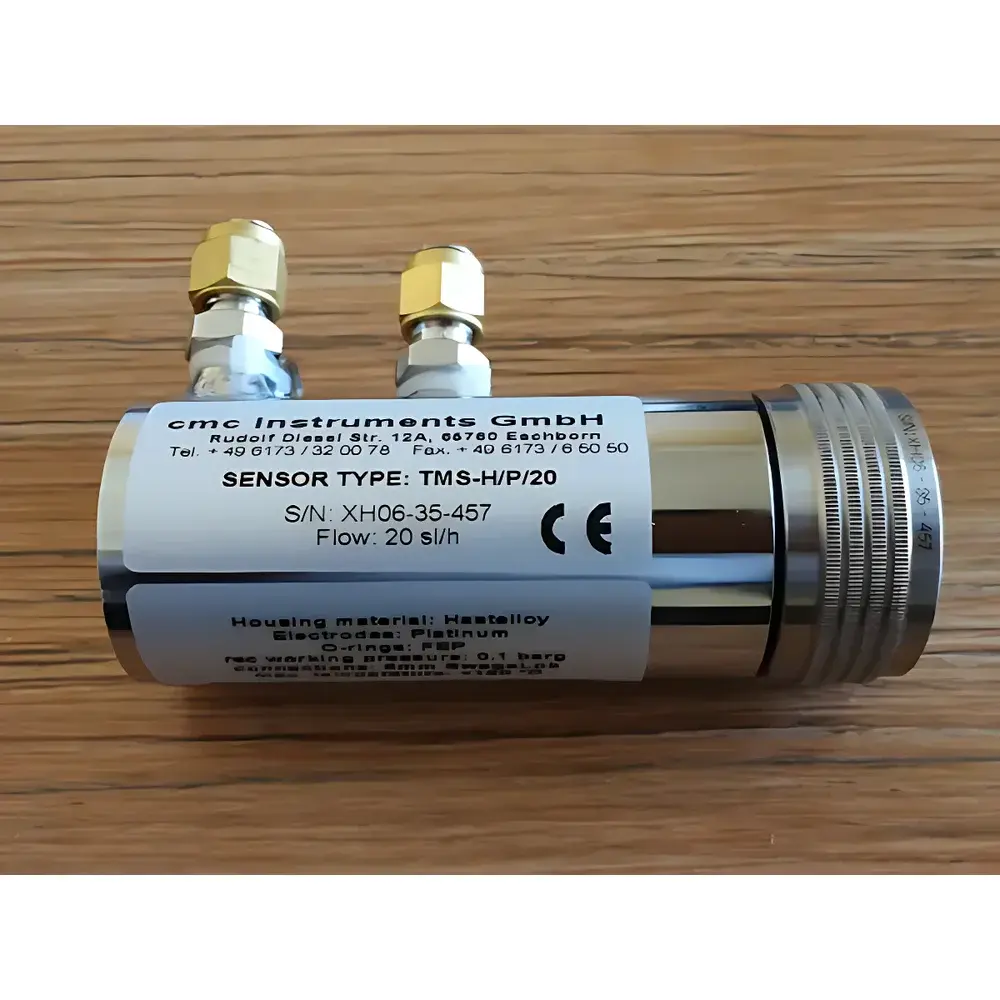
CMC TMS-H-P-20 Portable Electrolytic Dew Point Analyzer
| Brand | CMC |
|---|---|
| Origin | Germany |
| Model | TMS-H-P-20 |
| Type | Portable Dew Point Analyzer |
| Principle | Electrolytic (P2O5 Sensor) |
| Operating Temperature | +5 °C to +50 °C |
| Accuracy | ±1% of reading |
| Measuring Cell Material | Hastelloy |
| Electrode Material | Platinum |
| Substrate | Glass |
| Seal Material | FEP |
| Sample Gas Flow Rate | 20 NL/h |
| Operating Pressure Range | 0.1–0.5 barg |
| Gas Inlet/Outlet Fitting | 6 mm Swagelok®-style compression fitting, Hastelloy |
Overview
The CMC TMS-H-P-20 is a portable, high-stability electrolytic dew point analyzer engineered for trace moisture measurement in industrial gas streams where reliability, low maintenance, and field-deployable precision are critical. Utilizing the well-established phosphorus pentoxide (P2O5) electrolytic sensing principle, the instrument quantifies water vapor concentration by electrolyzing H2O molecules captured on a hygroscopic P2O5 film deposited between dual platinum electrodes. The resulting electrolysis current is directly proportional to the partial pressure of water vapor—enabling continuous, real-time dew point determination with high reproducibility across demanding process environments. Designed and manufactured in Germany, the TMS-H-P-20 meets stringent requirements for use in compressed air systems, natural gas transmission, SF6 insulation gas monitoring, semiconductor purge lines, and hydrogen fuel cell feed gas qualification.
Key Features
- Electrolytic P2O5 sensor with platinum electrodes and Hastelloy measuring cell—ensuring chemical resistance to aggressive or corrosive gas matrices including H2S, CO2, and halogenated compounds.
- FEP-sealed glass substrate assembly provides long-term sensor stability and minimizes drift under variable thermal and pressure conditions.
- Compact, battery-operated portable design optimized for on-site verification, commissioning support, and periodic audit measurements without requiring external power or gas conditioning infrastructure.
- Integrated flow control system maintains precise 20 NL/h sample gas throughput—critical for maintaining sensor response time and measurement linearity.
- Wide operating pressure range (0.1–0.5 barg) accommodates both low-pressure sampling and regulated process line tapping without external pressure regulation.
- Robust 6 mm Swagelok®-compatible Hastelloy fittings ensure leak-tight connections and compatibility with standard industrial gas handling hardware.
Sample Compatibility & Compliance
The TMS-H-P-20 is validated for use with non-condensing, non-reactive gas streams—including nitrogen, argon, helium, hydrogen, oxygen, compressed air, SF6, and natural gas (with appropriate pre-filtration). It is not suitable for gases containing condensable hydrocarbons, silicone vapors, or high concentrations of acidic or oxidizing species that may degrade the P2O5 film. The analyzer complies with IEC 61294 (dew point measurement methods), EN 12021 (compressed breathing air specifications), and supports adherence to ISO 8573-1 Class 1–4 moisture purity grading when deployed per standardized sampling protocols. Its construction and calibration traceability align with GLP documentation practices for laboratory and field-based QA/QC workflows.
Software & Data Management
The TMS-H-P-20 operates as a standalone analog/digital hybrid instrument with local LCD display and configurable 4–20 mA output. While it does not include embedded data logging or wireless connectivity, its analog output is compatible with third-party SCADA, DCS, or LIMS platforms supporting HART or Modbus RTU integration via optional interface modules. Calibration certificates are supplied with NIST-traceable reference standards, and full audit trails—including calibration date, operator ID, and environmental conditions at time of verification—are maintained per internal lab SOPs. The device supports 21 CFR Part 11-compliant data integrity when integrated into validated electronic record systems using qualified acquisition software.
Applications
- Verification of desiccant dryer performance and regeneration cycles in compressed air systems (ISO 8573-1 Class 2–4).
- Moisture monitoring in SF6 switchgear to prevent dielectric breakdown and arc flash hazards.
- Pre-commissioning checks of pipeline purging in petrochemical and LNG facilities.
- In-line verification of hydrogen purity per ISO 14687 Grade A/B specifications for fuel cell applications.
- Field validation of membrane or refrigerant dryer efficiency in pharmaceutical nitrogen generation skids.
- Supporting ASTM D6680 (standard test method for trace moisture in gaseous fuels) and ISO 8573-3 (moisture measurement procedures).
FAQ
What is the recommended calibration interval for the TMS-H-P-20?
CMC recommends annual calibration using certified zero and span standards; however, frequency should be adjusted based on usage intensity, exposure history, and quality system requirements (e.g., every 6 months in GMP-regulated environments).
Can the sensor be exposed to liquid water or condensation?
No. Direct contact with liquid water or sustained condensation will permanently damage the P2O5 film and invalidate measurement integrity. Sample gas must remain fully gaseous throughout analysis.
Is the TMS-H-P-20 suitable for measuring moisture in natural gas with H2S content?
Yes—provided total H2S remains below 50 ppmv and particulate filtration (≤1 µm) is implemented upstream. Higher concentrations require application-specific risk assessment and potential sensor protection strategies.
Does the instrument require carrier gas or zero-air supply?
No. The TMS-H-P-20 operates exclusively on the measured sample gas stream and does not require auxiliary purge or zero-gas sources.
How does pressure variation affect dew point readings?
Dew point is a thermodynamic property independent of pressure; however, the instrument’s specified 0.1–0.5 barg range ensures stable sensor hydration kinetics and accurate current-to-concentration conversion. Outside this range, measurement uncertainty increases due to altered diffusion dynamics across the P2O5 layer.




