
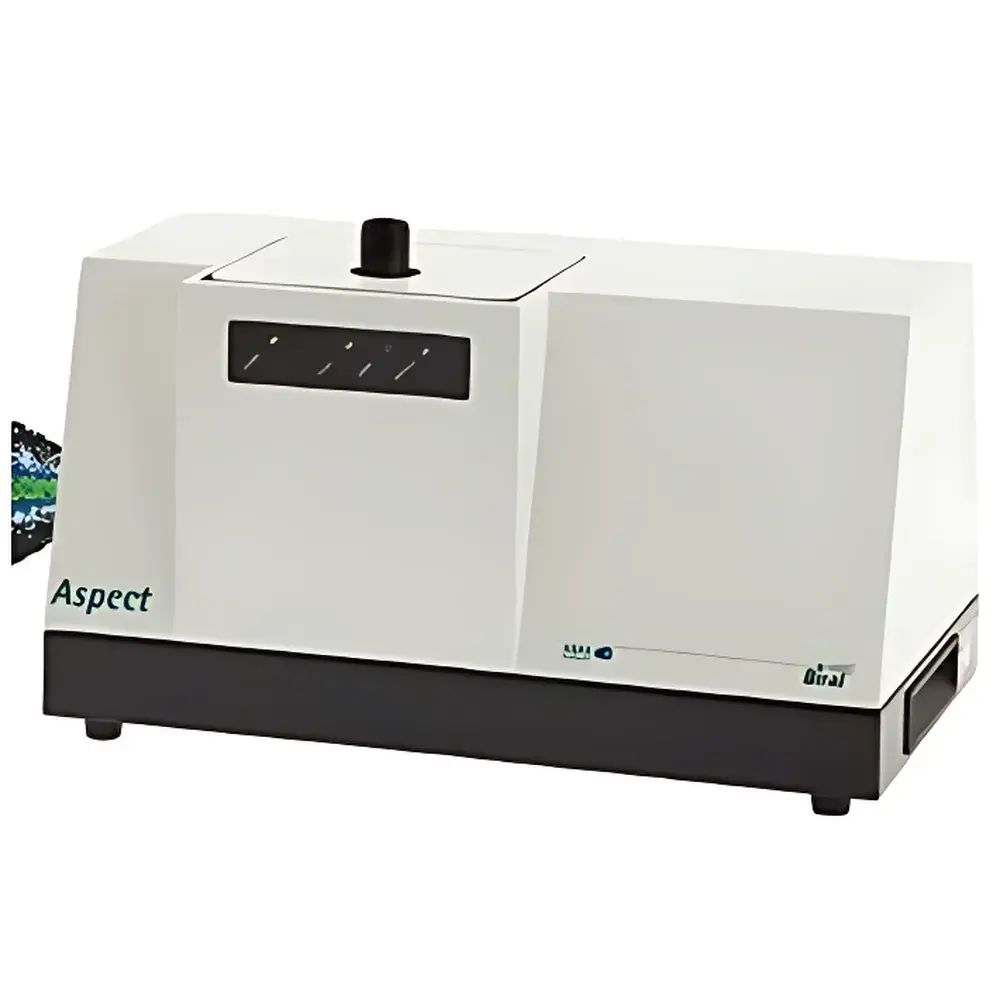
CMI ASPECT Aerosol Size and Shape Analyzer
| Brand | CMI (California Measurements, Inc.) |
|---|---|
| Origin | USA |
| Manufacturer Type | Authorized Distributor |
| Import Status | Imported |
| Model | ASPECT |
| Pricing | Available Upon Request |
| Communication Interface | USB |
| Particle Throughput | 20,000 particles/sec |
| Asymmetry Factor (Af) | 0–100 |
| Asymmetry Channel Count | 20 (Resolution: 5) |
| Flow Rate | 1.0 LPM (±10%) |
| Particle Size Range | 0.5–20 µm |
| Size Resolution | 0.5 µm |
| Particle Counting Capacity | <20,000/sec |
| Dimensions | 47 cm (L) × 27 cm (W) × 26 cm (H) |
| Weight | 20 kg |
Overview
The CMI ASPECT Aerosol Size and Shape Analyzer is the first commercially available instrument engineered to simultaneously quantify both aerodynamic size and morphological shape of individual airborne particles in real time. It implements the proprietary Aerosol Size and Shape (ASAS) measurement principle—a dual-mode optical detection methodology grounded in laser extinction and angular light scattering analysis. As polydisperse aerosol flows through a precisely collimated 635 nm laser beam at 1.0 LPM, each particle induces a unique signature comprising forward-scattered intensity distribution and beam attenuation depth. These signals are captured by a high-speed photodiode array and processed using inverse Mie-based inversion algorithms coupled with empirical shape calibration curves. Unlike conventional optical particle counters that assume spherical morphology, ASPECT resolves non-sphericity via the asymmetry factor (Af), a dimensionless parameter derived from the ratio of scattered light intensity in forward vs. side-scatter quadrants. This enables unambiguous discrimination of bioaerosol surrogates—including fungal spores, pollen grains, bacterial aggregates, and synthetic fibers—from inert mineral or combustion-derived particles—critical for exposure assessment, source apportionment, and atmospheric process modeling.
Key Features
- Real-time, single-particle resolution for simultaneous size (0.5–20 µm) and shape (Af = 0–100) characterization
- 20-channel asymmetry binning with 5-unit resolution, enabling statistically robust shape distribution profiling
- High-throughput capability: up to 20,000 particles per second without coincidence error under nominal flow conditions
- Integrated USB 2.0 interface for direct connection to Windows-based acquisition and analysis workstations
- Compact benchtop form factor (47 × 27 × 26 cm; 20 kg) suitable for field-deployable environmental monitoring stations or controlled laboratory environments
- Optically stable cavity design with temperature-compensated laser diode and calibrated photodetector array to ensure long-term measurement reproducibility
Sample Compatibility & Compliance
ASPECT is validated for use with ambient air, filtered chamber effluents, and controlled aerosol generation systems (e.g., Collison nebulizers, rotating drum generators). It accepts dry, non-condensing aerosols with relative humidity below 60% RH to prevent hygroscopic growth artifacts. The system complies with ISO 21501-4:2018 for optical particle counter performance verification and supports traceable calibration using NIST-traceable PSL and silica sphere standards. Data output formats adhere to ASTM D6609-22 for aerosol size distribution reporting. While not intrinsically certified for GMP or FDA-regulated environments, its audit-ready data structure—including timestamped raw signal logs, operator ID fields, and version-stamped analysis parameters—facilitates integration into GLP-compliant workflows requiring full data lineage.
Software & Data Management
The ASPECT Control & Analysis Suite (v4.x) runs on Windows 10/11 and provides real-time visualization of particle number concentration (cm⁻³), volume concentration (µm³/cm³), surface area concentration (µm²/cm³), and binned distributions (% of total count/volume/surface area). All primary outputs are exportable as CSV or HDF5 files. The software implements automated background subtraction, coincidence correction, and Af-dependent refractive index compensation. Raw waveform data (extinction + 20-channel scatter traces per particle) is retained for retrospective reanalysis. Audit trail functionality records user login events, parameter changes, and report generation timestamps—supporting alignment with FDA 21 CFR Part 11 requirements when deployed with appropriate IT infrastructure controls.
Applications
- Atmospheric science: quantifying ice-nucleating particle (INP) abundance and morphology in cloud condensation nuclei (CCN) studies
- Environmental health: differentiating respirable bioaerosol loadings (e.g., Aspergillus conidia vs. fiberglass fragments) in occupational settings
- Pharmaceutical development: monitoring morphology evolution during spray-dried inhaler formulation processing
- Climate modeling: constraining aerosol radiative forcing estimates via shape-resolved optical property databases
- Biosecurity: rapid screening of airborne biological threat simulants in HVAC duct monitoring networks
- Material science: characterizing aspect ratio and surface roughness of engineered nanomaterials post-aerosolization
FAQ
What particle types can ASPECT reliably distinguish based on shape alone?
ASPECT resolves morphological differences between spheres (Af ≈ 0), rods (Af ≈ 30–60), and irregular aggregates (Af > 70), enabling classification of pollen, diatom frustules, fungal hyphae fragments, and synthetic fibers—provided refractive index contrast permits sufficient scatter signal separation.
Does ASPECT require periodic recalibration with reference standards?
Yes. CMI recommends annual factory recalibration using monodisperse PSL spheres and certified asymmetric reference particles (e.g., titanium dioxide whiskers). Field-level verification with 3.0 µm and 10.0 µm PSL is advised before critical measurement campaigns.
Can ASPECT operate continuously for unattended long-term monitoring?
Yes. With stable power supply and ambient temperature control (15–30 °C), ASPECT supports 72-hour continuous operation. Internal thermal management maintains laser wavelength stability within ±0.2 nm over this interval.
Is the asymmetry factor (Af) correlated with aerodynamic diameter?
No. Af is orthogonal to aerodynamic size—it reflects projected area deviation from circularity and is independent of particle density or settling velocity. Combined Af + size data enables multi-dimensional aerosol fingerprinting beyond traditional PM₂.₅/PM₁₀ metrics.
How does ASPECT handle high-concentration aerosols where coincidence errors may occur?
The system applies real-time coincidence rejection using pulse width discrimination and inter-pulse timing thresholds. At concentrations exceeding 10⁴ particles/cm³, users may reduce flow rate or dilute sample stream to maintain <5% coincidence probability per measurement cycle.







