
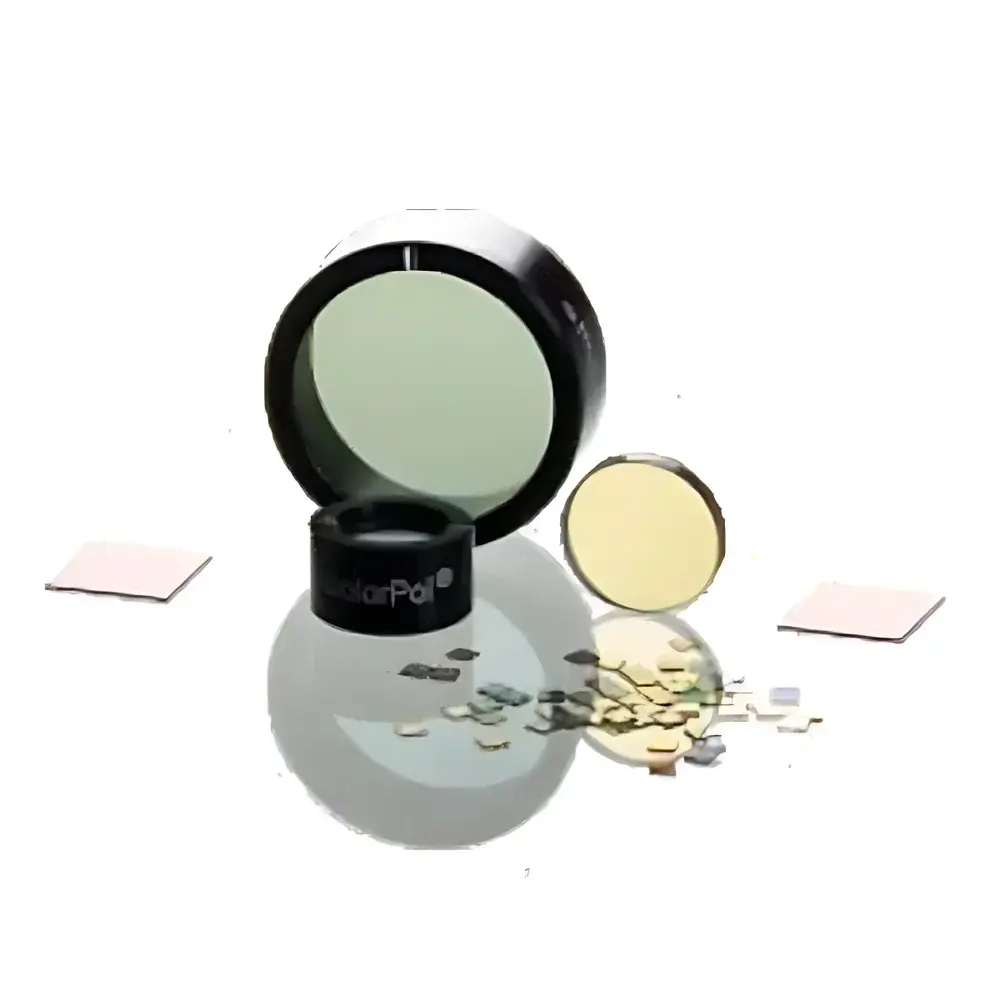
CODIXX colorPol® Standard Series High-Extinction-Ratio Polarizers
| Brand | CODIXX |
|---|---|
| Origin | Germany |
| Product Line | colorPol® Standard Series |
| Substrate Material | High-Strength Soda-Lime Glass with Embedded Silver Nanoparticles |
| Transmission Range | 250 nm – 5000 nm (UV to MWIR) |
| Max. Transmission (UV) | ~60% @ 350 nm |
| Max. Transmission (VIS) | >90% @ 550 nm |
| Max. Transmission (IR) | up to 94% @ 3000 nm |
| Extinction Ratio | ≥10⁴:1 (typical, dependent on wavelength and incidence angle) |
| Operating Temperature Range | −40 °C to +120 °C |
| Damage Threshold | 500 MW/cm² (ns pulsed, 1064 nm), 10 kW/cm² (CW, 1064 nm) |
| Surface Quality | 40–20 scratch-dig |
| Parallelism | <1 arcmin |
| Thickness Tolerance | ±0.05 mm |
Overview
The CODIXX colorPol® Standard Series High-Extinction-Ratio Polarizers are precision-engineered dichroic glass polarizers designed for demanding optical systems requiring stable, broadband polarization control from the deep ultraviolet (250 nm) through the visible spectrum and into the mid-wave infrared (up to 5000 nm). Unlike polymer-based or thin-film interference polarizers, the colorPol® series utilizes a proprietary bulk-glass manufacturing process in which silver nanoparticles are uniformly embedded within high-strength soda-lime glass via controlled thermal diffusion. This results in intrinsic, non-surface-dependent dichroism—eliminating coating delamination risks and enabling high laser damage resistance. The polarizers operate on the principle of selective absorption: incident light with electric field vectors aligned parallel to the nanoparticle alignment axis is strongly absorbed, while orthogonal components transmit with minimal loss. This anisotropic absorption yields extinction ratios exceeding 10⁴:1 across key spectral bands, making them suitable for applications where polarization purity directly impacts measurement fidelity—such as ellipsometry, polarimetric imaging, cavity-dumped laser systems, and spectroscopic instrumentation.
Key Features
- Broadband spectral coverage: 250 nm – 5000 nm, verified per ISO 9050 for transmission uniformity and polarization performance
- High transmission efficiency: >90% peak transmission in the visible (550 nm), up to 94% in the MWIR (3000 nm), and ~60% in the UV (350 nm)
- Exceptional extinction ratio: ≥10⁴:1 (typical) at design wavelengths; validated using NIST-traceable polarimetry setups
- Laser-compatible architecture: CW damage threshold of 10 kW/cm² at 1064 nm; pulsed threshold of 500 MW/cm² (10 ns, 10 Hz)
- Thermally robust substrate: Operating range from −40 °C to +120 °C without performance drift or birefringence induction
- Mechanically stable form factor: 40–20 scratch-dig surface quality, <1 arcmin parallelism, ±0.05 mm thickness tolerance—ensuring compatibility with kinematic mounts and automated alignment stages
Sample Compatibility & Compliance
The colorPol® Standard Series is compatible with collimated or low-convergence beams (NA ≤ 0.1) and exhibits minimal angular sensitivity up to ±5° incidence. It is certified RoHS-compliant and manufactured under ISO 9001-certified processes in Germany. While not classified as medical or aerospace-grade hardware, its performance stability meets requirements for ISO/IEC 17025-accredited calibration labs performing polarization-sensitive measurements. For regulated environments (e.g., pharmaceutical QC labs using polarimetric assays), documentation packages—including batch-specific transmission/extinction data sheets and material traceability reports—are available upon request. The polarizers do not require recalibration over time and show no measurable degradation after 10⁷ thermal cycles (−40 °C ↔ +85 °C).
Software & Data Management
No embedded firmware or software is associated with this passive optical component. However, CODIXX provides downloadable spectral transmission and extinction ratio datasets (CSV and MATLAB .mat formats) for integration into optical simulation workflows (e.g., Zemax OpticStudio, FRED, or Python-based ray-tracing pipelines). Each shipped unit includes a unique serial number linked to its measured performance curve in CODIXX’s secure, audit-ready database—supporting GLP-compliant record retention for up to 15 years. Raw measurement data adheres to ASTM E275 and ISO 15389 standards for spectrophotometric characterization.
Applications
- Polarization-sensitive spectroscopy (e.g., Raman, FTIR, CD spectroscopy)
- Ellipsometric metrology for thin-film thickness and refractive index determination
- High-power laser beam conditioning in Nd:YAG, Ti:sapphire, and OPO systems
- Polarimetric imaging for biomedical tissue analysis and stress-induced birefringence mapping
- Reference standards in national metrology institutes for polarization calibrator validation
- Environmental monitoring sensors operating in solar-blind UV or industrial MWIR bands
FAQ
What is the typical extinction ratio at 633 nm?
Typical extinction ratio is ≥1.2 × 10⁴:1 when measured with a HeNe laser at normal incidence and collimated illumination.
Can these polarizers be used in vacuum environments?
Yes—they are outgassing-free (per ASTM E595) and have been qualified for UHV use (<10⁻⁹ mbar) in synchrotron beamline applications.
Is custom cut size or AR coating available?
Standard sizes include Ø25.4 mm, Ø50.8 mm, and 25 × 25 mm square; anti-reflection coatings (single-layer MgF₂ or broadband BBAR) are offered as optional configurations.
How does temperature affect extinction ratio?
Extinction ratio remains stable within ±5% over the full −40 °C to +120 °C range, as confirmed by differential polarimetry under thermal ramp testing.
Are calibration certificates included?
A factory test report with spectral transmission and extinction curves is supplied with every unit; ISO/IEC 17025-accredited calibration is available as a value-added service.




