
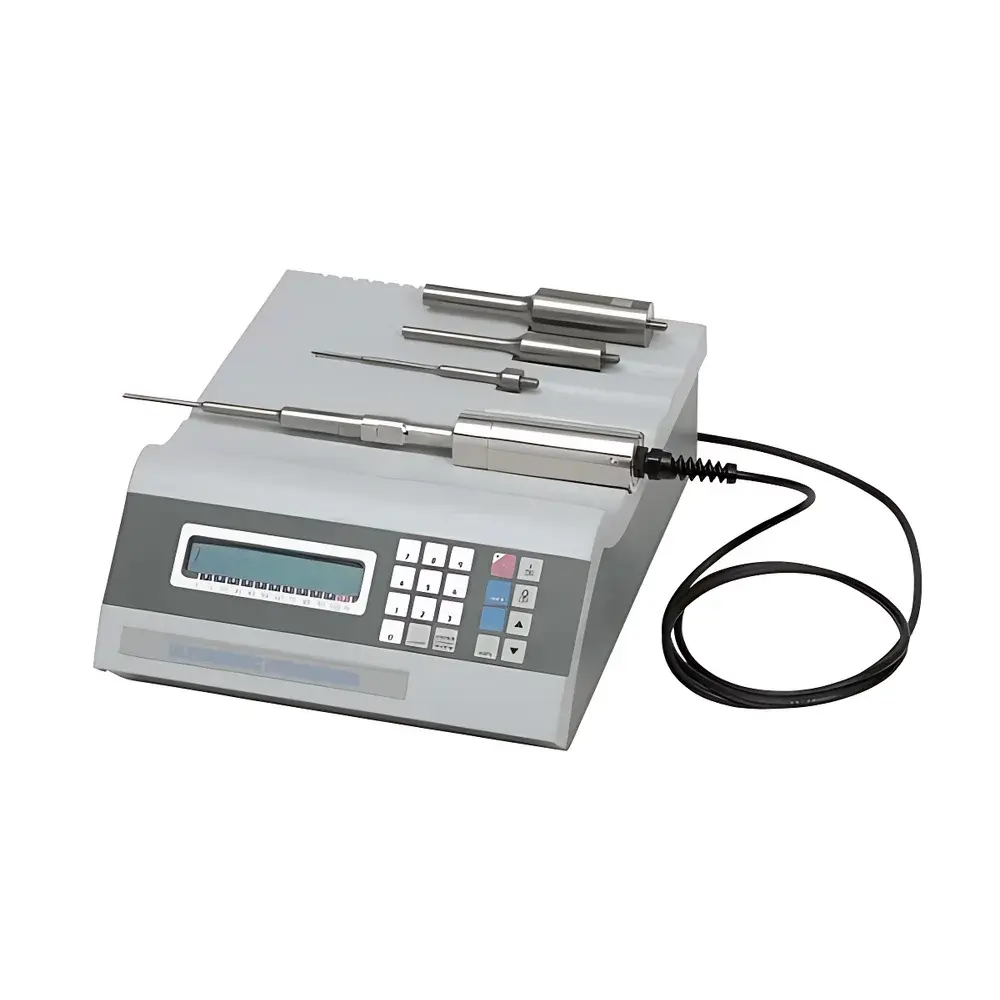
Cole-Parmer 04714-51 130W Ultrasonic Cell Disruptor
| Brand | Cole-Parmer |
|---|---|
| Origin | USA |
| Model | 04714-51 |
| Output Power | 130 W |
| Frequency | 20 kHz |
| Probe Tip Diameter | 6 mm |
| Sample Volume Range | 10–50 mL |
| Dimensions (L×W×H) | 115 × 250 × 320 mm |
| Net Weight | 3 kg |
| Timer Range | 1 s – 10 min (digital) |
| Pulse Mode | On/Off cycles adjustable from 0.1 s to 10 s each |
| Transducer Type | CV18 PZT piezoelectric converter (Ø32 mm × 146 mm, 340 g) |
| Probe Material | Ti-6Al-4V titanium alloy |
| Input Voltage | 220 V / 50 Hz |
| Display | 3-digit LCD wattmeter |
| Remote Control | Footswitch interface provided |
Overview
The Cole-Parmer 04714-51 is a precision-engineered 130 W ultrasonic cell disruptor designed for reproducible, controlled lysis of microbial, mammalian, and plant cells in research and process development laboratories. Operating at a fixed frequency of 20 kHz, the instrument utilizes piezoelectric transduction to convert high-frequency electrical energy into mechanical vibrations transmitted through a titanium alloy probe. These vibrations generate intense cavitation in liquid media—forming, growing, and collapsing microbubbles that produce localized shear forces, hydrodynamic shockwaves, and transient hotspots sufficient to disrupt cellular membranes and subcellular structures without significant thermal denaturation when used with appropriate pulsing protocols. The system is optimized for benchtop applications requiring consistent energy delivery across variable sample viscosities and volumes (10–50 mL), making it suitable for nucleic acid extraction, protein solubilization, organelle isolation, and nanoparticle dispersion.
Key Features
- Adaptive amplitude control: Real-time feedback from the probe continuously monitors mechanical load; the generator automatically adjusts drive current to maintain user-defined amplitude—ensuring stable cavitation intensity despite changes in sample density, temperature, or viscosity.
- Digital power monitoring: Integrated 3-digit LCD wattmeter displays instantaneous power delivered to the probe (in watts), enabling quantitative process documentation and method transfer.
- Programmable dual-timer architecture: A primary process timer (1 second to 10 minutes) governs total sonication duration, while an independent pulse controller allows precise definition of on/off intervals—from 0.1 s to 10 s per phase—critical for thermally sensitive samples.
- Robust CV18 transducer: Hermetically sealed PZT (lead zirconate titanate) ceramic stack housed in corrosion-resistant housing; engineered for continuous-duty operation and resistant to moisture, dust, and chemical exposure.
- Ti-6Al-4V probe construction: High-strength, non-reactive titanium alloy probe (6 mm tip diameter, 138 mm length) ensures durability, acoustic efficiency, and compatibility with aqueous and mildly aggressive buffers.
- Remote footswitch interface: Enables hands-free initiation and termination of sonication cycles—enhancing operator safety and workflow integration in biosafety cabinets or gloveboxes.
- Overload protection circuitry: Monitors transducer current draw and thermal rise; automatically interrupts output if threshold limits are exceeded, preventing component damage during extended or high-load operation.
Sample Compatibility & Compliance
The 04714-51 is validated for use with suspension cultures (E. coli, yeast, CHO cells), tissue homogenates, and viscous lysates. Its closed-system probe design minimizes aerosol generation when operated under appropriate containment. While not certified for GMP manufacturing environments, the instrument supports GLP-aligned workflows through traceable parameter logging (via external data acquisition systems) and adherence to standard operating procedures referenced in ISO 13485 and USP <1043> guidelines for cell disruption validation. All electrical components comply with UL 61010-1 and IEC 61010-1 safety standards for laboratory equipment.
Software & Data Management
This stand-alone analog/digital hybrid instrument does not include embedded software or network connectivity. However, its real-time wattmeter output and TTL-compatible remote trigger port enable integration with third-party data loggers (e.g., National Instruments DAQ systems) or LIMS platforms via analog voltage scaling (0–10 V = 0–130 W). Timestamped power logs can be correlated with sample metadata for audit-ready documentation. For regulated environments, users may implement 21 CFR Part 11-compliant electronic records using validated external acquisition software—provided the instrument’s physical controls remain accessible for manual override and calibration verification.
Applications
- Preparative-scale bacterial lysis for recombinant protein purification
- Chromatin shearing in ChIP-seq library preparation
- Disruption of Gram-positive bacteria and fungal spores
- Emulsification of lipid nanoparticles and polymeric micelles
- Exosome isolation from conditioned cell culture media
- Homogenization of frozen tissue sections prior to RNA extraction
FAQ
What is the maximum recommended continuous duty cycle for this unit?
For optimal transducer longevity and thermal stability, continuous operation beyond 5 minutes per cycle is discouraged. Use pulse mode (e.g., 5 s on / 5 s off) for sessions exceeding 3 minutes.
Can the probe be autoclaved?
Yes—the Ti-6Al-4V probe is autoclavable at 121°C for 20 minutes; however, the transducer assembly and generator must never be sterilized by steam or immersion.
Is amplitude calibration traceable to NIST standards?
Amplitude is controlled electronically via voltage-to-displacement mapping; while no factory NIST-traceable calibration certificate is supplied, users may validate displacement using laser vibrometry per ASTM E1876.
Does this model support multiple probe sizes?
The 04714-51 is configured for the standard 6 mm tip probe. Other tip diameters (e.g., 3 mm or 13 mm) require compatible transducers and are not cross-interchangeable with the CV18 unit.
How often should the probe tip be inspected for erosion?
Visual inspection is recommended after every 10 hours of cumulative use; replace the probe if tip pitting exceeds 0.1 mm depth or if sonication efficiency declines despite amplitude compensation.




