
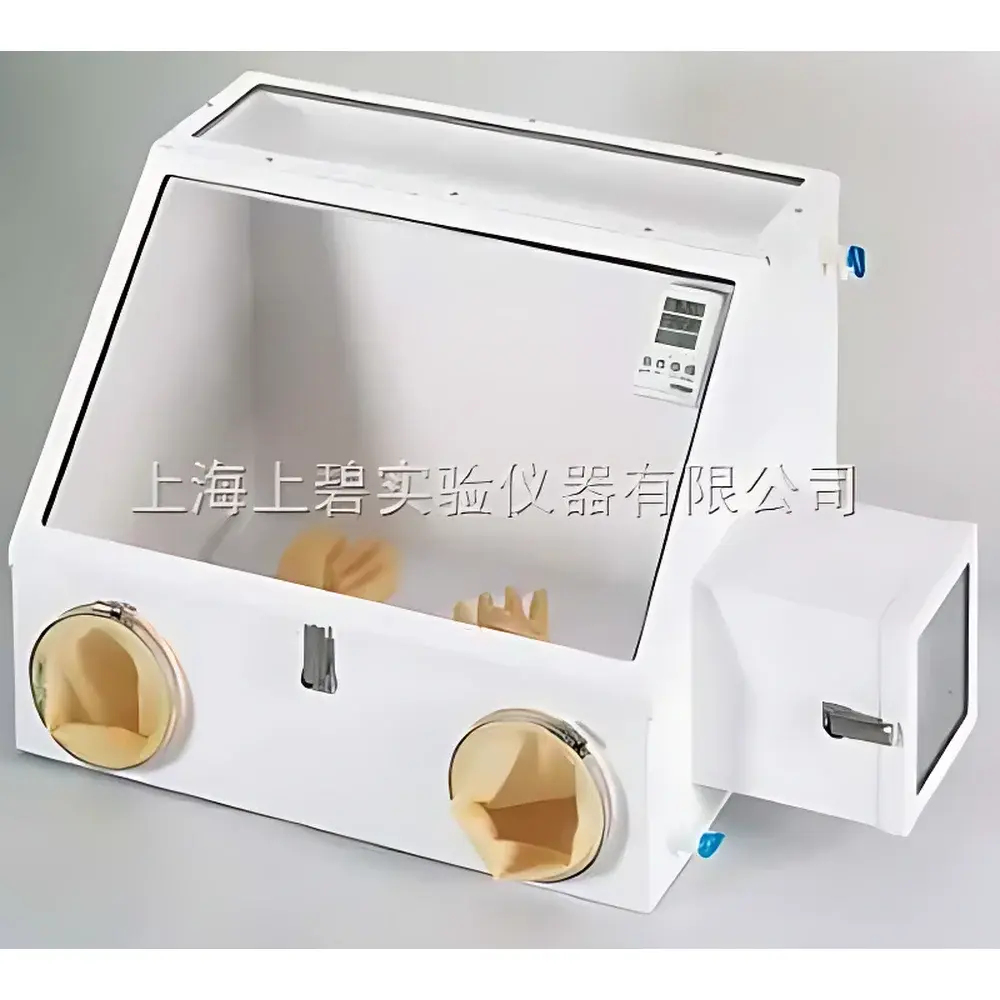
Cole-Parmer 34788-00 Stainless Steel Glove Box with Acrylic Viewing Window
| Origin | USA |
|---|---|
| Manufacturer Type | Authorized Distributor |
| Origin Category | Imported |
| Model | 34788-00 |
| Pricing | Upon Request |
| Humidity Range | 20–95% RH |
| Viewing Window | 6.35 mm (1/4″) thick acrylic, angled design |
| Glove Port Diameter | 15 cm |
| Glove Length | 61 cm |
| Right-Side Antechamber External Dimensions | 22 × 21 × 21 cm (L×W×H) |
| Main Chamber External Dimensions | 69 × 51 × 51 cm (L×W×H) |
| Weight | 65 kg |
| Gas Inlet/Outlet | Dual ball valves |
Overview
The Cole-Parmer 34788-00 Glove Box is a rigorously engineered inert-atmosphere workstation designed for containment, exclusion, or controlled-environment manipulation of air-sensitive, moisture-sensitive, or hazardous materials in research laboratories and quality control settings. Constructed with electropolished 304 stainless steel housing, the unit provides structural integrity, corrosion resistance, and compatibility with standard laboratory cleaning and decontamination protocols. Its primary operational principle relies on positive-pressure inert gas purging (e.g., N₂ or Ar) to maintain an oxygen- and moisture-controlled environment—typically <100 ppm O₂ and <100 ppm H₂O when properly conditioned and maintained. The 6.35 mm-thick acrylic viewing window is precisely angled to minimize optical distortion and ensure accurate visual assessment during sample handling, while maintaining mechanical robustness and chemical resistance to common solvents.
Key Features
- Electropolished 304 stainless steel main chamber with welded seams and smooth internal surfaces for ease of cleaning and reduced particle retention.
- Optically corrected 1/4″ (6.35 mm) thick acrylic front viewing window mounted at an ergonomic angle to eliminate parallax and image warping during extended operation.
- Dual precision brass ball valves integrated into the rear panel for independent control of inert gas inlet and exhaust flow—enabling fine-tuned pressure regulation and purge cycle optimization.
- Integrated analog hygrometer located at the upper right corner of the front panel, calibrated to display relative humidity from 20% to 95% RH—providing real-time environmental feedback without requiring external sensors or software.
- Right-side antechamber (22 × 21 × 21 cm external) with interlocked door mechanism to permit safe transfer of tools, samples, or consumables without compromising main chamber integrity.
- Pre-installed medium-size latex gloves (15 cm cuff diameter, 61 cm length) with reinforced wrist seals; compatible with optional glove replacements including nitrile, chloroprene, or butyl variants for enhanced chemical resistance.
Sample Compatibility & Compliance
This glove box supports a broad range of sample types—including pyrophoric organometallics, lithium battery electrode materials, pharmaceutical intermediates, and biological reagents requiring low-oxygen handling. It conforms to general laboratory safety standards for containment equipment (ANSI Z9.7, ISO 14644-1 Class 8 background compatibility) and is routinely deployed in environments adhering to GLP and GMP frameworks. While not certified as explosion-proof, its design facilitates integration with external spark-proof ventilation systems and optional O₂/H₂O analyzers for continuous monitoring—supporting compliance with ASTM D6866 (for isotopic analysis workflows), USP (for sterile compounding support), and ISO 8573-1 (compressed air purity class alignment). All metallic components meet RoHS Directive 2011/65/EU requirements.
Software & Data Management
The 34788-00 operates as a standalone mechanical system with no embedded microcontroller or digital interface. Environmental parameters—including humidity—are monitored via analog instrumentation only. For labs requiring audit-ready documentation, third-party data loggers (e.g., Vaisala HMT337 or Omega OM-EL-USB-TC) may be externally mounted to record hygrometer output or integrate with building management systems. No proprietary firmware or cloud connectivity is included; this architecture ensures long-term operational stability, eliminates cybersecurity exposure, and aligns with FDA 21 CFR Part 11 requirements for manual recordkeeping environments where electronic signatures are not mandated.
Applications
- Handling of air-sensitive catalysts and Grignard reagents in synthetic organic chemistry.
- Electrode fabrication and testing for solid-state batteries under argon atmosphere.
- Preparation of anaerobic microbiological cultures or oxygen-sensitive enzymatic assays.
- Stabilization and packaging of hygroscopic reference standards in analytical chemistry labs.
- Safe manipulation of low-toxicity radioactive tracers or nanomaterial powders under negative-pressure auxiliary ventilation.
- Supporting ISO/IEC 17025-accredited testing procedures where environmental consistency must be manually verified and logged.
FAQ
Is the glove box pre-purged or ready for immediate use upon installation?
No—initial inert gas conditioning requires user-performed purge cycles (typically 5–10 volume exchanges) using an external N₂ or Ar supply regulated to ≤0.5 bar gauge pressure. A residual O₂ analyzer is recommended for validation.
Can the hygrometer be recalibrated in-house?
Yes—the analog hygrometer includes a calibration screw accessible via the rear panel; calibration should be performed using saturated salt solutions per ISO 4677-2 guidelines.
Are replacement gloves available in non-latex materials?
Yes—Cole-Parmer offers nitrile, butyl rubber, and Viton-compatible glove kits (part numbers 34788-GN, 34788-GB, 34788-GV) with identical 15 cm cuff dimensions and enhanced solvent resistance.
Does the unit include a pressure relief valve?
No—pressure regulation is achieved solely via manual adjustment of the dual ball valves; users integrating automated pressure controllers must install an external relief valve compliant with ASME B31.3 process piping standards.
What maintenance intervals are recommended for long-term reliability?
Inspect glove integrity weekly; replace every 6–12 months depending on usage frequency and chemical exposure. Clean stainless surfaces with 70% isopropyl alcohol biweekly; verify ball valve sealing performance quarterly using soap-bubble leak testing.



