
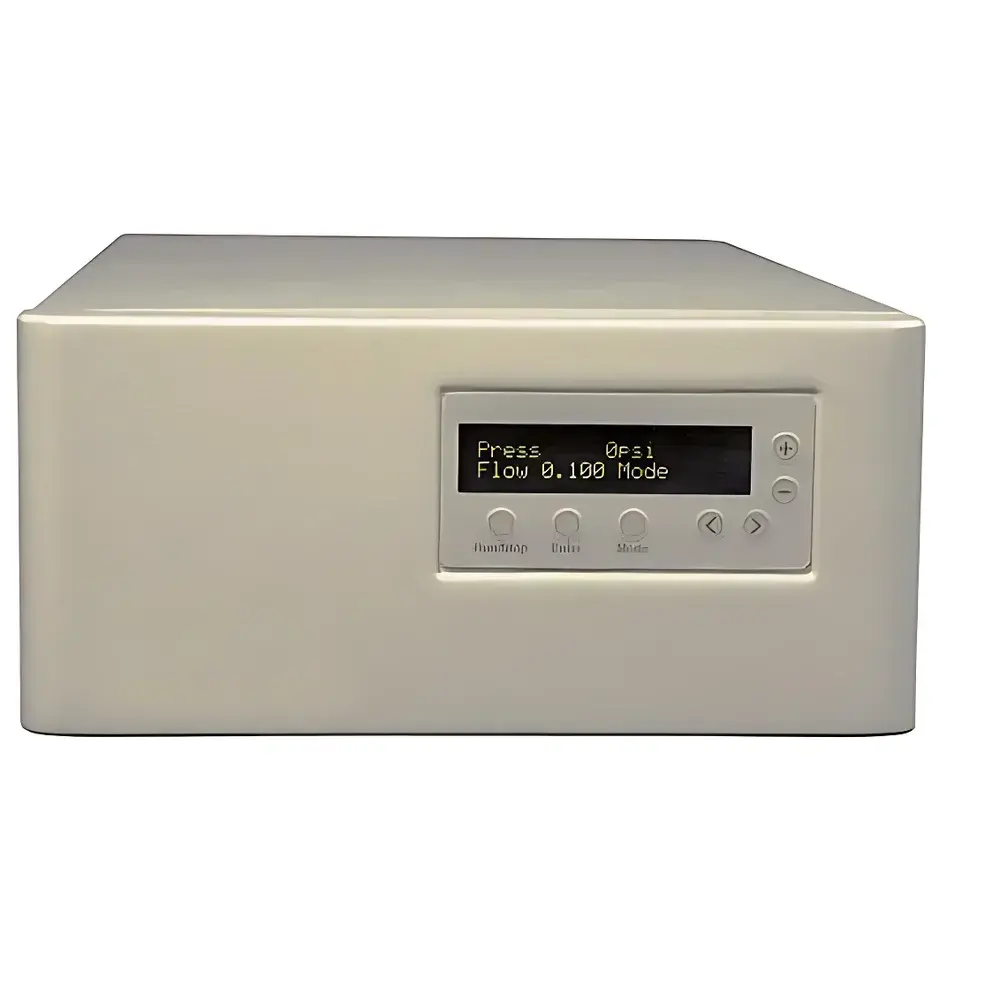
Cole-Parmer 74930-60 High-Pressure, Low-Flow Precision Plunger Pump
| Brand | Cole-Parmer |
|---|---|
| Origin | USA |
| Model | 74930-60 |
| Flow Range | 0.001–5.000 mL/min |
| Max Pressure | 18,000 psi (1241 bar) |
| Flow Increment | 1 µL |
| Accuracy | ±2% at max pressure |
| Repeatability | ±0.5% RSD |
| Operating Temp. | Up to 100°C |
| Ambient | 0–80°C, ≤98% RH |
| Materials | 316 stainless steel housing, sapphire valves, PTFE fluid path tubing, UHMW-PE seals, integrated pressure transducer |
| Power | 100–220 VAC, 50/60 Hz |
| Dimensions (W×H×D) | 14×27×45 cm |
| Weight | 15 kg |
| Interface | RS-232 |
Overview
The Cole-Parmer 74930-60 is a high-precision, high-pressure positive displacement plunger pump engineered for demanding analytical and process applications requiring stable, low-flow delivery under extreme pressure conditions. Designed specifically for ultra-high-performance liquid chromatography (UHPLC), microfluidic synthesis, high-pressure reaction monitoring, and precision solvent delivery in catalytic or polymerization systems, this pump operates on the principle of reciprocating plunger displacement with real-time pressure-compensated flow control. Its advanced solvent recompression algorithm minimizes pulsation—critical for maintaining column integrity with sub-10 µm particle-packed LC columns—and ensures consistent volumetric delivery even at maximum rated pressure (1241 bar / 18,000 psi). Unlike peristaltic or diaphragm pumps, the rigid plunger architecture delivers superior long-term stability, minimal compressibility error, and compatibility with aggressive organic solvents and aqueous buffers.
Key Features
- Ultra-low flow capability: Programmable range from 0.001 to 5.000 mL/min with 1 µL resolution across full pressure range
- High-pressure operation: Rated to 18,000 psi (1241 bar) with integrated pressure transducer and real-time feedback loop
- Low-pulsation design: Achieves <0.5% RSD repeatability and <1% flow accuracy over 30-second intervals (linear mode), validated per ISO 5725-2 for precision assessment
- Chemically inert wetted path: Sapphire check valves, PTFE-lined fluidic channels, UHMW-PE seals, and 316 stainless steel housing ensure compatibility with HPLC-grade acetonitrile, methanol, THF, and acidic/basic mobile phases
- Onboard LCD interface: Enables local configuration of flow rate, pressure limit, purge cycles, and fault diagnostics without external software
- RS-232 serial interface: Supports integration into automated lab systems, SCADA platforms, or custom LabVIEW/Python control environments with ASCII command protocol
- Thermal management: Internal thermal cutoff and ambient-rated electronics (0–80°C, ≤98% RH) enable reliable operation in controlled laboratory or pilot-scale chemical hood environments
Sample Compatibility & Compliance
The 74930-60 is suitable for use with low-viscosity to moderately viscous Newtonian fluids (e.g., water, ethanol, DMSO, dichloromethane) up to ~20 cP at 25°C. Non-Newtonian or particulate-laden samples require pre-filtration through ≥0.45 µm membranes to prevent valve clogging. The pump meets CE marking requirements for electromagnetic compatibility (EN 61326-1) and low-voltage directive (2014/35/EU). While not certified as intrinsically safe, its non-sparking construction and sealed electronics make it appropriate for Class I, Division 2 environments when installed per NEC Article 500 guidelines. It supports GLP/GMP workflows via audit-trail-capable host software (when paired with compatible controllers) and complies with data integrity expectations aligned with FDA 21 CFR Part 11 when used in validated instrument configurations.
Software & Data Management
The pump operates autonomously via front-panel controls but supports remote operation through standard RS-232 communication using Cole-Parmer’s optional PumpControl™ software (v3.2+), which provides waveform visualization, method storage, event logging, and export to CSV/TXT formats. All flow and pressure setpoints, runtime hours, and error codes are timestamped and retained in non-volatile memory. When integrated into larger analytical platforms (e.g., coupled with Agilent or Waters LC systems), it accepts TTL-triggered start/stop commands and reports status flags (e.g., “flow stable”, “pressure limit reached”, “valve fault”) for synchronized sequence execution. Raw telemetry data—including instantaneous flow deviation and pressure deviation—can be streamed at 10 Hz for post-acquisition pulse analysis.
Applications
- UHPLC and nano-LC gradient delivery where pulse dampening and sub-microliter precision directly impact peak shape and retention time reproducibility
- High-pressure kinetic studies in continuous-flow reactors operating above 1000 bar, including supercritical CO₂-assisted synthesis
- Calibration of mass flow meters and pressure sensors requiring traceable, stable volumetric reference flows
- Delivery of reagents in automated peptide synthesizers and oligonucleotide array printers
- Long-duration stability testing of novel stationary phases under accelerated backpressure conditions
- Microreactor feed control in academic and industrial flow chemistry labs adhering to ASTM E2500-07 (Guide for Specification, Design, and Verification of Pharmaceutical and Biopharmaceutical Manufacturing Systems)
FAQ
What is the minimum programmable flow increment?
The pump supports 1 µL increments across its entire 0.001–5.000 mL/min range, independent of pressure setting.
Can this pump handle viscous solvents like glycerol or ethylene glycol?
It is not recommended for fluids exceeding 20 cP at operating temperature due to increased plunger load and potential seal wear; consult engineering support for viscosity derating curves.
Is the RS-232 interface optically isolated?
No—the interface is electrically isolated per EN 61000-6-2, but optical isolation requires an external USB-to-RS232 converter with galvanic separation.
Does the pump include automatic leak detection or dry-run protection?
It features pressure-based stall detection and will halt operation if target pressure is not achieved within user-defined timeout, but lacks direct fluid-level sensing.
How often does the sapphire valve assembly require maintenance?
Under typical UHPLC usage (≤12 hrs/day, filtered solvents), valve service interval is ≥12 months; Cole-Parmer recommends quarterly visual inspection and annual calibration verification per ISO/IEC 17025 guidelines.



