
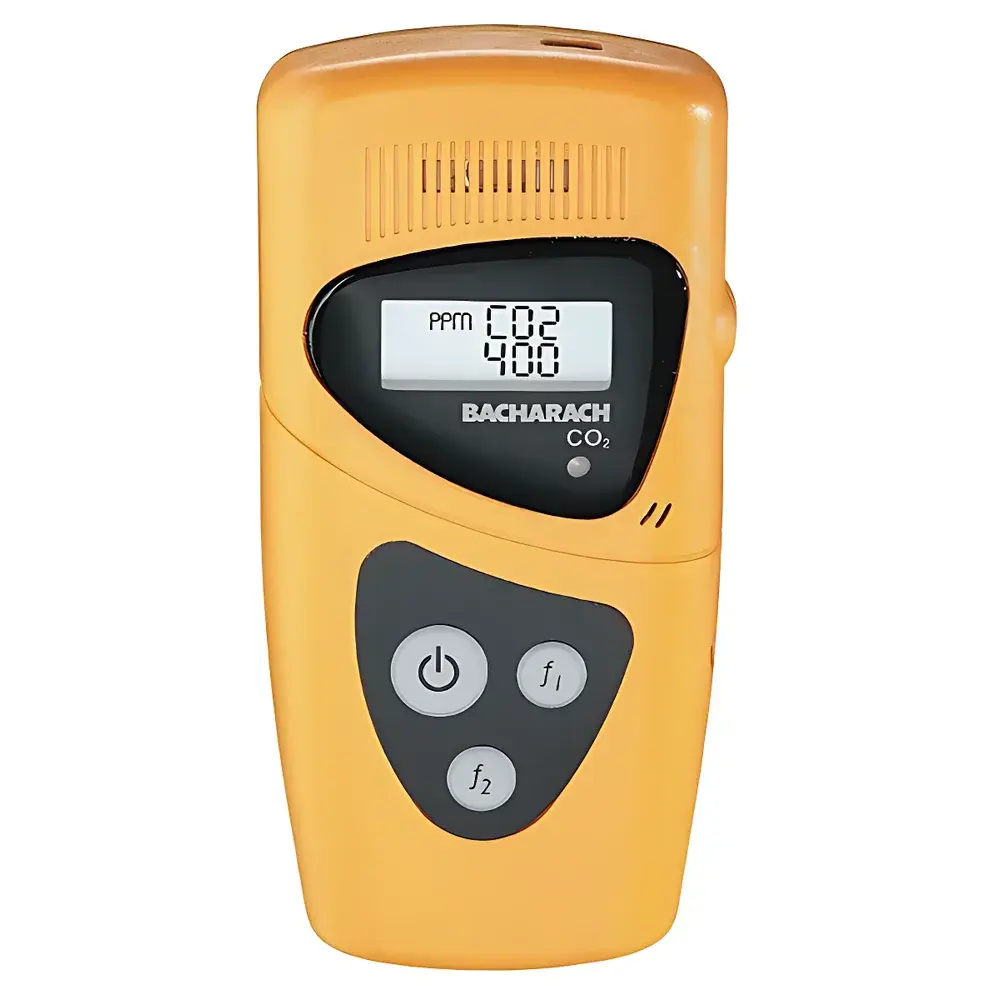
Cole-Parmer 81973-20 Portable Dual-Wavelength NDIR Carbon Dioxide Analyzer
| Brand | Cole-Parmer |
|---|---|
| Origin | USA |
| Model | 81973-20 |
| Instrument Type | Portable |
| Detection Target | CO₂ (multi-component capable) |
| Range | 0–50,000 ppm (0–5% v/v) |
| Resolution | 100 ppm (0.01%) |
| Accuracy | ±5% of reading or ±50 ppm, whichever is greater |
| Response Time | < 60 s (T₉₀) |
| Zero Drift | < ±20 ppm/week |
| Span Drift | < ±2% of full scale/month |
| Operating Temperature | 0–50 °C |
| Battery Life | 8 h (NiCd rechargeable) |
| Weight | 0.7 kg |
| Dimensions | 66.7 × 139.7 × 20.6 mm (L × H × W) |
| Data Storage | 850 records (non-volatile memory) |
| Communication | IR interface + RS232 (optional cable 81973-60) |
| Alarm | Visual (LED) and audible (variable-tone) at user-configurable thresholds (e.g., 5,000 ppm intermittent / 10,000 ppm continuous) |
| Sensor Type | Dual-wavelength non-dispersive infrared (NDIR) with integrated pressure & temperature compensation |
Overview
The Cole-Parmer 81973-20 is a handheld, battery-powered carbon dioxide (CO₂) analyzer engineered for field-deployable, real-time gas concentration measurement in ambient air and controlled environments. It employs dual-wavelength non-dispersive infrared (NDIR) spectroscopy — a principle based on the selective absorption of infrared radiation at characteristic wavelengths (e.g., 4.26 µm for CO₂) — to deliver stable, interference-resistant quantification. Unlike single-beam NDIR systems, its dual-wavelength architecture actively compensates for optical path degradation, dust accumulation, and source intensity drift by referencing a secondary non-absorbing wavelength. Integrated pressure and temperature sensors enable real-time compensation of gas density effects, ensuring metrological consistency across variable environmental conditions (e.g., altitude changes or HVAC ducts). Designed for compliance with indoor air quality (IAQ) assessment protocols and laboratory biosafety workflows, the instrument meets functional requirements aligned with ASHRAE Standard 62.1 (Ventilation for Acceptable Indoor Air Quality) and ISO 16000-23 (Indoor air — Determination of carbon dioxide).
Key Features
- Dual-wavelength NDIR sensor with embedded pressure and temperature compensation for high long-term stability and minimal calibration dependency
- Rechargeable NiCd battery providing 8 hours of continuous operation; includes universal 110/240 VAC charger
- Backlit LCD display with intuitive menu navigation and real-time CO₂ concentration readout (ppm and % v/v)
- Configurable visual and audible alarms with variable tone modulation proportional to CO₂ concentration (e.g., escalating pitch above threshold)
- Two sampling modes: diffusion-based passive intake and active sampling via built-in micro-diaphragm pump (optional probe 81973-10 included)
- Non-volatile internal memory storing up to 850 data points: 800 time-stamped continuous logs + 100 manually triggered snapshots
- Infrared (IR) wireless data transfer and optional RS232 interface (cable 81973-60) for PC download and post-processing using Windows-compatible software
Sample Compatibility & Compliance
The 81973-20 is validated for direct measurement of CO₂ in dry or humidified air matrices within the range of 0–50,000 ppm. Its NDIR optical path is inherently insensitive to common interferents such as CO, CH₄, and water vapor (within typical indoor RH ranges), though condensation must be avoided. The instrument supports applications requiring adherence to regulatory frameworks including OSHA PEL (5,000 ppm TWA), NIOSH REL (40,000 ppm ceiling), and CDC/NIOSH guidelines for CO₂ monitoring in occupied spaces. While not certified for intrinsic safety (e.g., ATEX or IECEx), it complies with FCC Part 15 Class B and CE electromagnetic compatibility directives. Data integrity is supported through timestamped logging and exportable CSV files suitable for GLP-aligned recordkeeping.
Software & Data Management
Data retrieval is facilitated via IR link or RS232 serial connection using included Windows 98–Windows 10 compatible software. Exported datasets contain UTC timestamps, CO₂ concentration values, ambient temperature, and pressure readings — enabling correlation with HVAC performance or occupancy patterns. The software supports basic trend visualization, threshold annotation, and batch export for integration into LIMS or Excel-based QA/QC workflows. All stored measurements reside in non-volatile memory; power loss does not erase historical records. Audit trail functionality is limited to file creation/modification timestamps; for 21 CFR Part 11 compliance, external validation and electronic signature protocols must be implemented at the system level.
Applications
- Indoor air quality (IAQ) audits in offices, schools, and healthcare facilities per ASHRAE 62.1 ventilation rate procedures
- Verification of CO₂ setpoints and alarm response in CO₂ incubators used in cell culture laboratories
- Post-occupancy evaluation (POE) studies assessing ventilation effectiveness and occupant density correlations
- Food packaging headspace analysis (qualitative screening of modified atmosphere packaging integrity)
- Educational demonstrations of gas exchange kinetics and respiration physiology
- Field verification of demand-controlled ventilation (DCV) system performance
FAQ
What is the recommended calibration frequency?
Cole-Parmer recommends zero calibration every 30 days using certified zero air (N₂ ≥99.999%), and span calibration annually with traceable 10,000 ppm CO₂ standard gas.
Can the instrument measure CO₂ in high-humidity environments?
Yes, but prolonged exposure to condensing humidity may affect optical window clarity; use of desiccant filters or sample drying is advised for sustained operation above 85% RH.
Is the built-in pump sufficient for duct sampling?
The integrated micro-pump delivers ~150 mL/min flow — adequate for short-probe sampling in low-velocity ducts (<2 m/s); for high-velocity or particulate-laden streams, an external aspiration system is recommended.
Does the device support external power during operation?
No — operation is battery-only; the AC adapter is for charging only and cannot power the unit live.
How is data traceability ensured for regulated environments?
Raw data exports include timestamps and sensor metadata; however, full 21 CFR Part 11 compliance requires third-party software validation, user access controls, and electronic audit trails beyond the device’s native capabilities.
Related Products







