
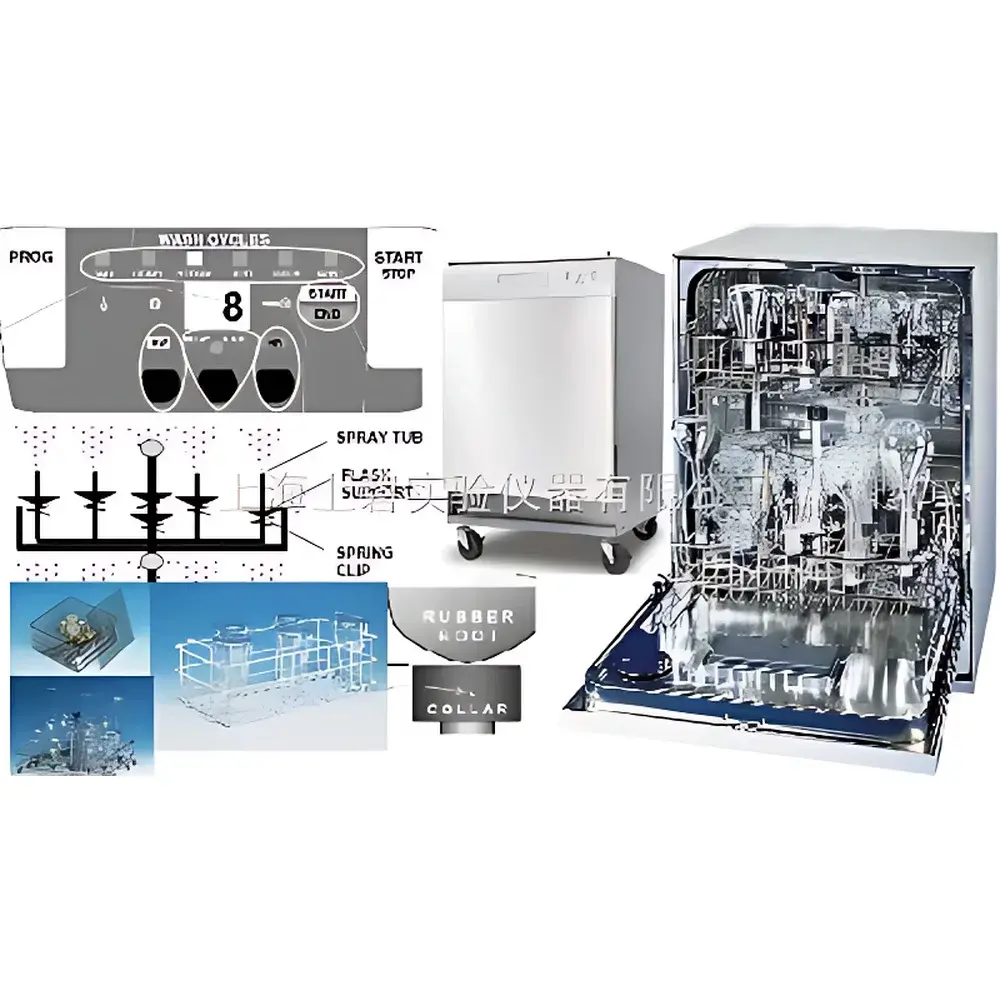
Cole-Parmer 98951-70 Benchtop Bottle Washer
| Brand | Cole-Parmer |
|---|---|
| Origin | USA |
| Model | 98951-70 |
| Chamber Dimensions (L×H×W) | 55 × 64 × 48 cm |
| External Dimensions (L×H×W) | 61 × (98–102) × 63 cm |
| Power Supply | 230 V, 50 Hz, 10 A, 1400 W |
| Weight | 80 kg |
| Heating Range | 29–77 °C |
| Water Inlet | 11 L/min at 18–60 psi, 1/4″ ID |
| Drain Outlet | 3/4″ ID |
| Safety Certification | ETL Listed |
| Cycle Programs | 6 pre-programmed wash cycles with adjustable temperature |
| Filtration System | Triple-stage filter + electrically actuated drain pump |
| Spray System | Dual rotating spray arms (upper & lower), 22 nozzle spindle rack for narrow-neck bottles |
| Insulation | Triple-layer side wall and door insulation |
| Door Safety | Dual-hand operated interlocked latch with steam containment |
| Overflow Protection | Float-activated automatic drain valve |
| Compliance | Designed to support GLP/GMP-aligned cleaning validation workflows |
Overview
The Cole-Parmer 98951-70 Benchtop Bottle Washer is an engineered solution for reproducible, traceable, and validated cleaning of laboratory glassware and plastic containers in regulated and research-intensive environments. Operating on a closed-loop thermally assisted spray-wash principle, it delivers consistent mechanical action via dual rotating spray arms and high-velocity targeted nozzles—optimized for challenging geometries including volumetric flasks, culture tubes, BOD bottles, and narrow-neck reagent bottles up to 2 L capacity. Its stainless-steel 304 construction (chamber interior, door liner, spray arms, and filtration housing) ensures corrosion resistance against alkaline detergents and repeated thermal cycling. The triple-insulated chamber walls and door minimize heat loss and acoustic emission, enabling operation in shared lab spaces without compromising energy efficiency or ambient noise levels. Designed and assembled in the United States, the unit complies with ETL safety standards and supports integration into quality management systems requiring documented cleaning processes.
Key Features
- Stainless-steel 304 wetted components—including chamber, door liner, spray arms, and filter housings—for long-term chemical and thermal durability
- Dual independent rotating spray arms (upper and lower) delivering full 360° coverage across all rack positions
- Spindle-style rack with 22 precision-aligned nozzles that insert directly into narrow-neck vessels for bottom-up冲洗 (rinse/clean), ensuring removal of particulate and residue from critical internal surfaces
- Triple-stage filtration system (coarse screen, fine mesh, and secondary retention filter) paired with an electrically actuated drain pump to protect the recirculation loop from glass shards or debris
- Six programmable wash cycles with user-defined temperature setpoints (29–77 °C), dwell times, and rinse phases—enabling method development for specific soil types (e.g., proteinaceous, oily, or crystalline residues)
- Integrated float-activated overflow sensor that triggers immediate drain activation upon liquid level exceedance—preventing chamber flooding and electrical hazard
- Interlocked safety door with dual-hand engagement mechanism; halts cycle immediately upon opening and resumes automatically after closure, preventing steam exposure and maintaining process integrity
- Adjustable leveling feet (±4 cm height range) accommodate uneven floor surfaces while maintaining stable operation and drainage alignment
Sample Compatibility & Compliance
The 98951-70 accommodates a broad range of container formats through interchangeable racks (sold separately), including BOD bottles (18-position), standard bottles ≤500 mL (20-position), large-capacity bottles ≤2000 mL (9-position), test tubes (150-position, three height variants), Petri dish carriers, and graduated cylinder racks (32-position). All racks are designed to maintain uniform spacing and orientation during rotation, minimizing nesting and shadowing effects. The washer supports cleaning validation protocols aligned with ISO 15883-1 (washer-disinfectors for healthcare), ASTM E2578 (standard guide for cleaning validation in pharmaceutical manufacturing), and FDA expectations for equipment qualification (IQ/OQ/PQ). While not a medical device sterilizer, its thermal profiles and repeatability meet requirements for cleaning prior to autoclaving or aseptic filling operations under cGMP conditions.
Software & Data Management
This model operates via an embedded microcontroller-based interface with LED display and tactile membrane keypad—designed for reliability and minimal maintenance in non-networked lab environments. Though it lacks Ethernet or USB data export, all cycle parameters (start time, selected program, final temperature, total duration) are logged internally with timestamping. Audit-trail functionality is enabled via optional external data loggers compatible with 4–20 mA or relay outputs (e.g., for temperature and cycle status). For laboratories implementing 21 CFR Part 11 compliance, the washer can be integrated into broader electronic batch record (EBR) systems using discrete I/O signals for start/stop confirmation and fault indication. Cleaning records—including rack configuration, detergent lot number, and operator ID—must be manually entered into laboratory information management systems (LIMS) or paper-based logs per institutional SOPs.
Applications
- Routine cleaning of volumetric glassware (pipettes, burettes, flasks) in analytical chemistry and QC labs
- Pre-sterilization preparation of cell culture flasks, serum bottles, and bioreactor accessories in life science facilities
- Removal of biofilm and organic residue from BOD bottles used in environmental water testing (EPA Method 5210B)
- High-reproducibility cleaning of HPLC vials and autosampler trays to prevent carryover in trace-level analysis
- Validation-supporting cleaning of reusable sampling containers in pharmaceutical stability studies
- Decontamination of glassware exposed to low-to-moderate risk biological agents (BSL-1/2), when used with appropriate enzymatic or alkaline detergents
FAQ
What types of detergents are compatible with this washer?
The unit is compatible with low-foaming alkaline or enzymatic cleaners rated for laboratory glassware washing, such as Cole-Parmer’s LF2100 Low-Foam Liquid Cleaner (dilutable up to 1:100). Non-ionic surfactants and phosphate-free formulations are recommended to avoid residue formation and ensure complete rinsability.
Can the washer be connected to a central hot water supply?
Yes—it accepts inlet water at temperatures up to 77 °C. Using pre-heated water reduces cycle time and energy consumption, particularly for high-soil loads. Ensure inlet pressure remains within 18–60 psi and flow rate ≥11 L/min.
Is validation documentation available from Cole-Parmer?
Cole-Parmer provides factory calibration certificates and component traceability data. Full IQ/OQ documentation kits—including test protocols, acceptance criteria, and blank execution forms—are available upon request through authorized distributors or qualified third-party validation service providers.
How often should the filters be cleaned or replaced?
The coarse and fine filters should be inspected and rinsed after each use. Under typical lab usage (≤10 cycles/day), the secondary retention filter requires replacement every 3–6 months. Filter replacement intervals must be adjusted based on soil load and detergent type, and recorded in equipment maintenance logs.
Does the unit require a dedicated drain line with air gap?
Yes. Installation must comply with local plumbing codes. A gravity-fed drain line with minimum 3/4″ ID and proper air gap (≥2× pipe diameter) is required to prevent back-siphonage and ensure safe discharge of heated effluent.



