
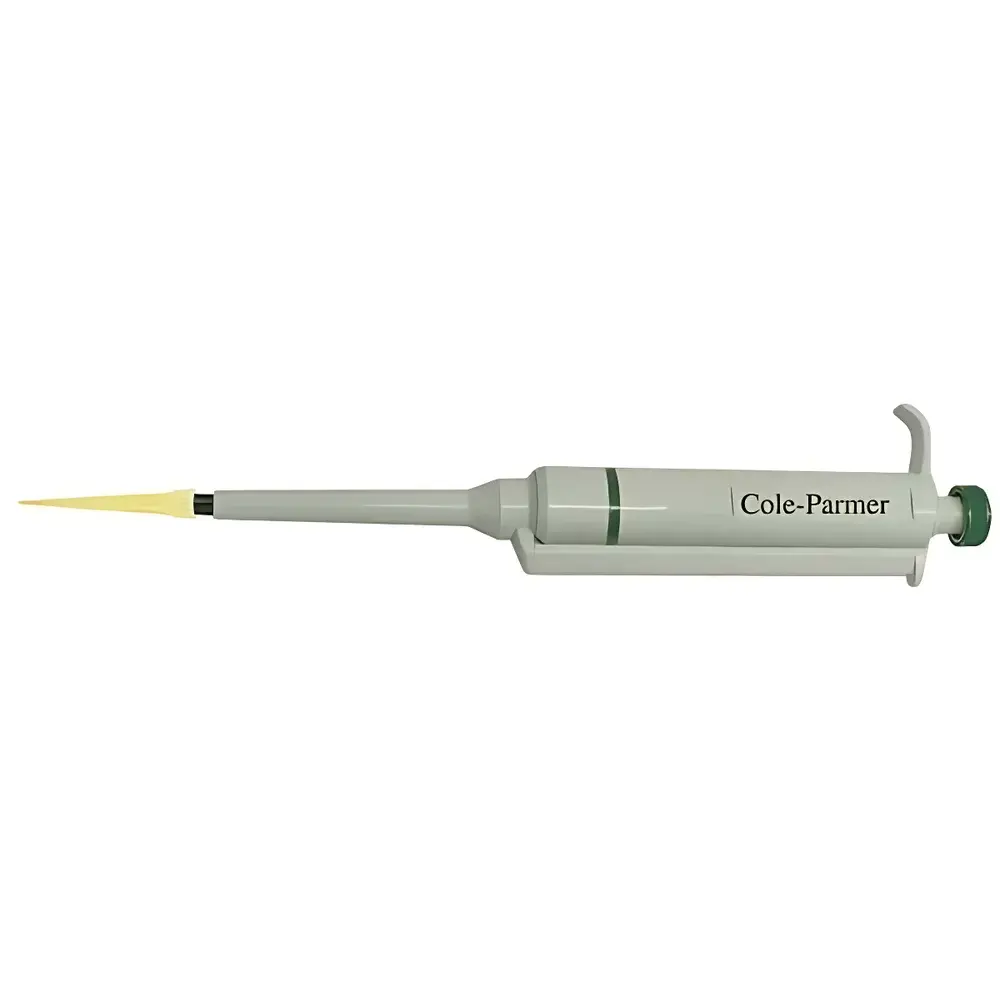
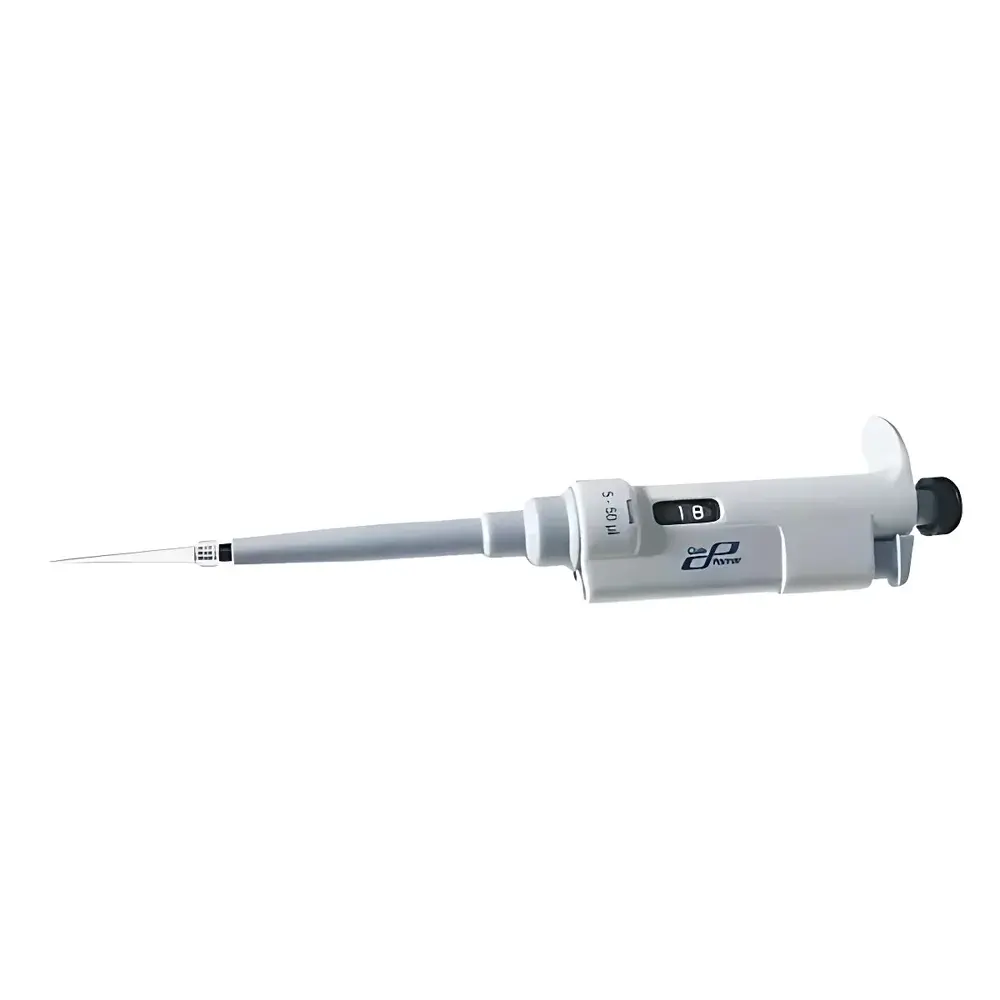
Cole-Parmer Autoclavable Ergonomic Pipette, Model 21600
| Brand | Cole-Parmer |
|---|---|
| Origin | USA |
| Manufacturer Type | Authorized Distributor |
| Product Origin | Imported |
| Model | 21600 |
| Instrument Type | Single-Channel Manual Pipette |
| Channel Count | Single |
| Volume Range | 0.1–10,000 µL (Note: “ml” in source is erroneous |
| Maximum Capacity | 10,000 µL |
| Accuracy | ±0.3% (for fixed-volume variants) |
| Precision (Repeatability) | ≤0.2–≤2.8% (volume-dependent) |
| Calibration Standard | DIN 12650 |
| Sterilization Method | Full-unit autoclaving at 121 °C, 15 psi, 20 min |
| Wetted Materials | Polypropylene |
| Piston Material | Stainless Steel |
| Tip Ejection Mechanism | Dedicated streamlined tip ejector |
| Tip Compatibility | Cole-Parmer universal pipette tips and ISO-standard conical tips |
Overview
The Cole-Parmer Autoclavable Ergonomic Pipette, Model 21600, is a precision-engineered manual single-channel liquid handling instrument designed for laboratories requiring stringent sterility, long-term reliability, and operator comfort. Unlike conventional pipettes that necessitate disassembly prior to sterilization, the Model 21600 is constructed as a fully autoclavable unit—every component, including the piston assembly, shaft, and housing, withstands standard steam sterilization cycles (121 °C, 15 psi, 20 minutes) without degradation or calibration drift. Its core measurement principle relies on air displacement with a stainless steel piston and precision-machined barrel, ensuring consistent volumetric delivery across repeated use. The ergonomic design reduces thumb force by up to 40% compared to legacy manual pipettes, mitigating repetitive strain injury (RSI) risk during high-throughput workflows. This pipette serves as a critical tool in applications governed by GLP, GMP, and clinical laboratory standards where traceability, sterility assurance, and inter-operator reproducibility are non-negotiable.
Key Features
- Full-unit autoclavability: No disassembly required—validated for ≥100 sterilization cycles per DIN 12650 Annex B.
- Stainless steel piston assembly: Enhances mechanical stability, minimizes hysteresis, and delivers superior accuracy (±0.3% for fixed-volume units) and repeatability (≤0.2% CV).
- Dual-stage plunger mechanism: Enables controlled blow-out for complete sample dispensing and supports reverse pipetting for viscous or foaming liquids.
- Ergonomic tip ejection system: Streamlined, low-force ejector optimized for narrow-neck vessels and microcentrifuge tubes—reduces lateral wrist torque by 35% versus conventional levers.
- DIN 12650-certified calibration: Each unit ships with a traceable, computer-generated calibration certificate and includes an onboard calibration tool for user-performed adjustments.
- Universal tip compatibility: Accepts both Cole-Parmer proprietary tips and ISO 8655-compliant conical tips (e.g., 10–1000 µL, 1000–10,000 µL formats).
Sample Compatibility & Compliance
The Model 21600 accommodates aqueous solutions, buffers, cell suspensions, serum, and low-viscosity reagents (up to 50 cP). Its polypropylene wetted surfaces resist hydrolysis and common disinfectants (e.g., 70% ethanol, 0.5% sodium hypochlorite), supporting routine decontamination between uses. All fixed- and variable-volume variants comply with ISO 8655-2 (volumetric performance) and ISO 8655-5 (calibration procedures). The included calibration report satisfies audit requirements under FDA 21 CFR Part 11 (when used with validated electronic recordkeeping), EU Annex 11, and CLIA-certified laboratory protocols. Sterility validation data are available upon request per ISO 17665-1.
Software & Data Management
While the Model 21600 is a manual pipette and does not incorporate embedded electronics or firmware, its calibration documentation integrates seamlessly into laboratory quality management systems (QMS). The provided calibration certificate includes unique serial number, date of certification, uncertainty values (k=2), and technician signature—structured for direct import into LIMS or ELN platforms such as LabWare, Veeva Vault, or Thermo Fisher SampleManager. Optional digital calibration logs can be generated using Cole-Parmer’s free PipetteIQ desktop utility (Windows/macOS), enabling version-controlled records, expiry alerts, and export to CSV/PDF for internal audits.
Applications
- Cell culture workflows requiring sterile, endotoxin-free liquid transfer (e.g., passaging, media supplementation).
- QC/QA testing in pharmaceutical manufacturing where equipment qualification (IQ/OQ/PQ) mandates full-unit sterilization and documented calibration.
- Molecular diagnostics labs performing RNA/DNA extraction, PCR setup, and NGS library preparation under ISO 15189-accredited conditions.
- Academic core facilities supporting shared instrumentation with multi-user traceability and minimal maintenance downtime.
- Biobanking operations involving aliquoting of primary human samples under strict biosafety level 2 (BSL-2) containment protocols.
FAQ
Can the entire pipette be autoclaved without disassembly?
Yes. All components—including piston, seal, barrel, and housing—are rated for repeated autoclaving at 121 °C, 15 psi, 20 minutes. No tools or disassembly are required.
Does the pipette meet ISO 8655 standards?
Yes. Performance specifications and calibration methodology conform to ISO 8655-2 (accuracy/repeatability) and ISO 8655-5 (calibration procedures).
What is the maximum viscosity the pipette can handle reliably?
Optimal performance is maintained for liquids up to 50 cP at ambient temperature. For higher viscosities, reverse pipetting mode is recommended.
Is the calibration certificate compliant with FDA 21 CFR Part 11?
The certificate itself is a static, signed document. When paired with validated electronic recordkeeping systems and appropriate audit trails, it fulfills Part 11 requirements for attributable, legible, contemporaneous, original, and accurate (ALCOA+) data.
Are replacement parts available for long-term serviceability?
Yes. Cole-Parmer supplies certified replacement seals, pistons, and tip ejector assemblies with lot-specific traceability and shelf-life documentation.



