
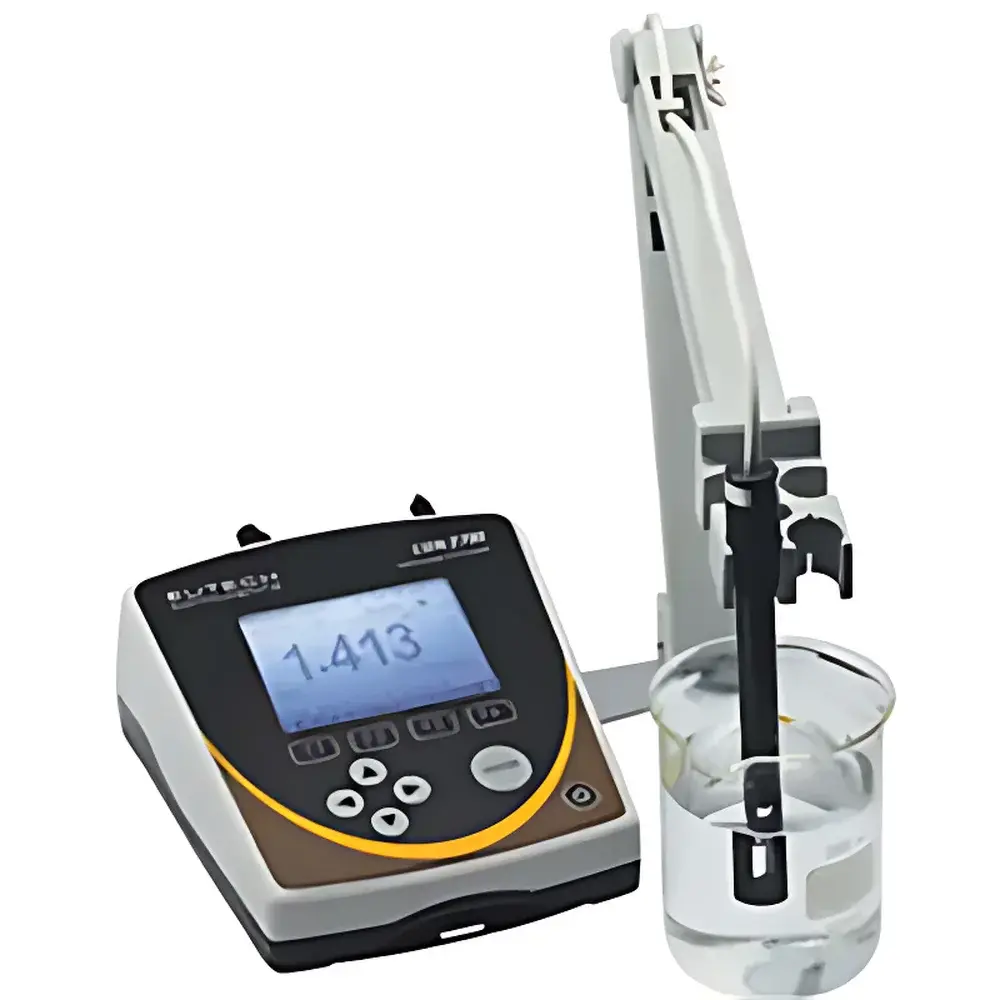
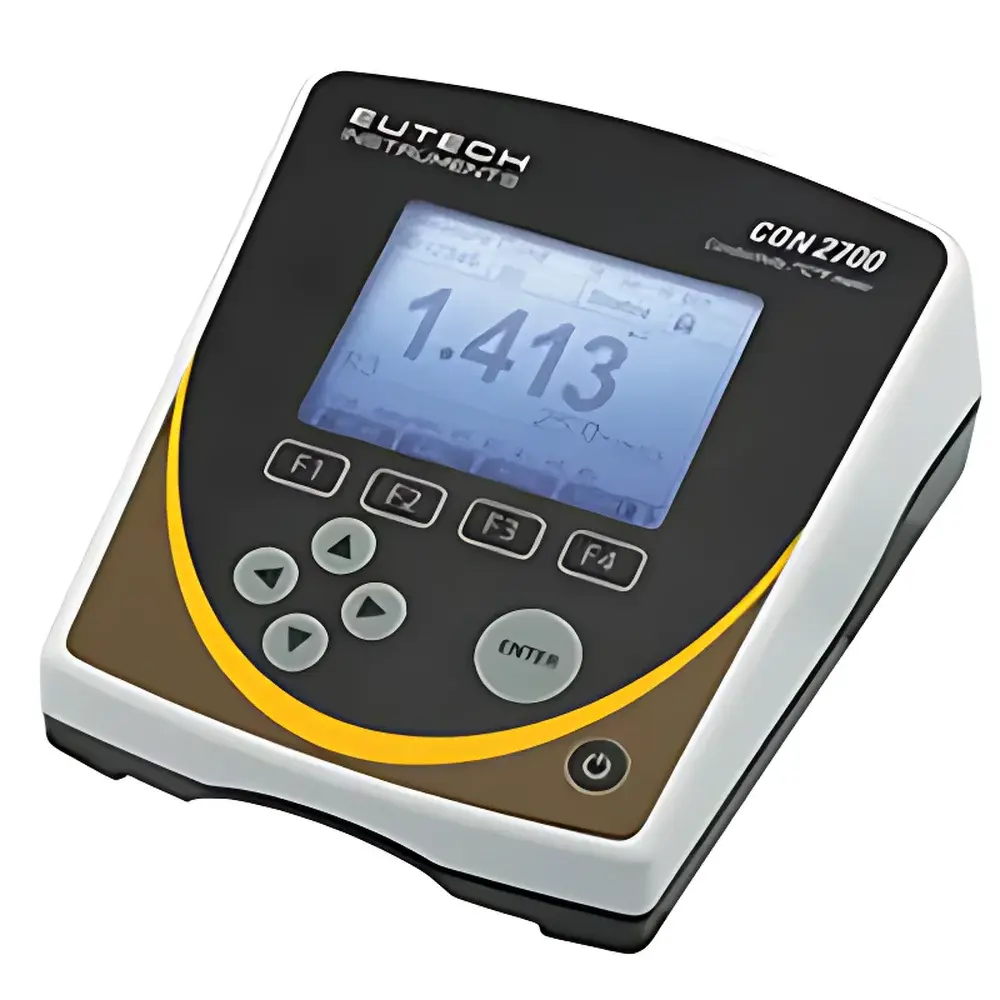
Thermo Scientific Eutech CON2700 Benchtop Conductivity Meter
| Brand | Eutech |
|---|---|
| Origin | USA |
| Model | CON2700 |
| Instrument Type | Benchtop Laboratory Meter |
| Temperature Range | 0.0–100.0 °C |
| Conductivity Range | 0.05 μS/cm – 500.0 mS/cm |
| TDS Range | 0.050 ppm – 500 ppt (with TDS factor 0.1) |
| Salinity Range | 0.0–80.0 ppt |
| Resistivity Range | 2.000 Ω – 20.0 MΩ |
| Calibration Points | Up to 5-point |
| Cell Constants | 0.1, 1.0, 10.0 cm⁻¹ (user-selectable) |
| Data Storage | 500 GLP-compliant records with timestamp |
| Interface | Bidirectional RS232 |
| Auto-Calibration | Yes (single-key conductivity calibration with electrode constant calculation) |
| Electrode Replatinization | Built-in circuit, completes in ≤5 min |
| Password Protection | For menu access and calibration settings |
| Alarm Functions | Out-of-range alert, calibration due warning, auto-log expiration notification |
Overview
The Thermo Scientific Eutech CON2700 is a high-precision benchtop conductivity meter engineered for rigorous laboratory-based water quality analysis. It operates on the principle of two- or four-electrode AC conductivity measurement, applying a known alternating current across an immersed conductive cell and measuring the resulting voltage drop to determine solution conductance—corrected for temperature using built-in NIST-traceable Pt1000 thermistor compensation (0.0–100.0 °C). Unlike portable or field-deployable units, the CON2700 is optimized for repeatability and traceability in controlled environments where regulatory compliance, method validation, and long-term instrument stability are critical. Its architecture supports simultaneous measurement and conversion of raw conductance into standardized derived parameters—including total dissolved solids (TDS), salinity (in ppt), and resistivity—using user-definable conversion factors aligned with ASTM D1125, ISO 7888, and USP . Designed for integration into QA/QC workflows, it meets core requirements for GLP (Good Laboratory Practice) and supports audit-ready data integrity through time-stamped storage and calibration event logging.
Key Features
- Automated single-button conductivity calibration with real-time electrode constant calculation and display—enabling immediate assessment of sensor health and fouling status.
- Integrated platinum black re-platinization circuit: restores electrode surface activity in ≤5 minutes without external equipment or chemical baths—critical for maintaining long-term measurement fidelity in high-ionic-strength or organic-laden samples.
- Five-point programmable conductivity calibration across three selectable cell constants (0.1, 1.0, 10.0 cm⁻¹), supporting wide-ranging applications from ultrapure water (≤0.05 μS/cm) to concentrated brines (up to 500 mS/cm).
- GLP-compliant data management: stores 500 measurement records with full metadata (date, time, parameter values, calibration ID, operator ID if configured), accessible via RS232 interface for export to LIMS or validated spreadsheet templates.
- Configurable security layer: password protection for calibration menus, system settings, and data deletion functions—ensuring procedural control in regulated environments subject to FDA 21 CFR Part 11 or ISO/IEC 17025 documentation requirements.
- Intelligent alarm system: configurable thresholds for out-of-range measurements, overdue calibrations, and expired calibration validity periods—reducing risk of nonconforming data generation.
Sample Compatibility & Compliance
The CON2700 is validated for aqueous matrices including drinking water, wastewater effluents, boiler feedwater, pharmaceutical process water (PW, WFI), seawater dilutions, and electroplating baths. It accommodates standard 4-ring conductivity cells (e.g., Eutech CONSEN9203D) and supports manual cell constant entry for custom or third-party sensors. All measurement algorithms adhere to internationally recognized standards: conductivity calculations follow ISO 7888:2012; temperature compensation uses the nonlinear CaCl₂-based algorithm per ASTM D1125-22; TDS conversions apply linear scaling with user-adjustable factors (default 0.1–1.0). The device’s firmware and hardware design support traceable calibration against certified KCl reference standards (e.g., 84 μS/cm, 1413 μS/cm, 12.88 mS/cm) and is compatible with metrology-grade dry-well temperature calibrators for independent verification of thermal accuracy (±0.3 °C).
Software & Data Management
Data exchange occurs exclusively via bidirectional RS232 serial communication—no USB or Bluetooth—to ensure deterministic timing and compatibility with legacy laboratory infrastructure and validated software platforms. Output format is ASCII-delimited (tab or comma), containing all measured and calculated parameters plus timestamps in ISO 8601 format (YYYY-MM-DD HH:MM:SS). No proprietary drivers or cloud dependencies are required. Internal memory retains records even during power interruption, and calibration logs include electrode ID, date/time, standard used, slope, offset, and calculated cell constant—fulfilling minimum ALCOA+ (Attributable, Legible, Contemporaneous, Original, Accurate, Complete, Consistent, Enduring, Available) criteria for regulated labs. Optional PC software (Eutech LogPro, sold separately) enables batch export, trend visualization, and PDF report generation compliant with internal SOPs.
Applications
- Pharmaceutical water system validation per USP and EU Annex 1: continuous monitoring of purified water (PW) and water for injection (WFI) conductivity at 25 °C, with automatic temperature correction to reference conditions.
- Environmental compliance testing: EPA Method 120.1 and ISO 7888-based analysis of surface water, groundwater, and treated effluent for regulatory reporting under NPDES permits.
- Power generation chemistry control: real-time tracking of condensate purity and steam cycle leakage detection via ultra-low conductivity measurement (<1 μS/cm) with sub-microsiemen resolution.
- Academic and industrial research: kinetic studies of electrolyte dissociation, membrane performance evaluation in desalination R&D, and quality control of buffer solutions in bioprocessing.
- Food & beverage QC: verification of rinse water conductivity in CIP validation, salt concentration profiling in brining processes, and sugar solution purity assessment.
FAQ
Does the CON2700 support automatic temperature compensation (ATC) for conductivity measurements?
Yes. It employs a built-in Pt1000 temperature sensor with automatic compensation across 0.0–100.0 °C, applying the nonlinear algorithm specified in ASTM D1125 for accurate conversion to 25 °C equivalent conductivity.
Can I use non-Eutech conductivity probes with this meter?
Yes—provided the probe outputs a standard analog signal compatible with the CON2700’s input impedance and connector type (BNC or DIN), and the user manually enters the correct cell constant and calibration coefficients.
Is the internal data storage encrypted or password-protected?
No. While stored records cannot be altered post-acquisition, access to the data menu and deletion functions requires administrator-level password authentication—consistent with GLP requirement for controlled data handling.
What is the recommended calibration frequency for routine QC use?
Per ISO/IEC 17025:2017 Clause 7.7, calibration should occur before each analytical session or at least daily when in continuous use; the instrument’s “calibration due” reminder supports adherence to this practice.
Does the CON2700 meet FDA 21 CFR Part 11 requirements for electronic records?
It provides foundational elements—audit trail-capable timestamps, operator identification fields, and calibration lockout—but full Part 11 compliance depends on site-specific validation of the entire data workflow, including connected PCs and software used for data review and archiving.
Related Products







