
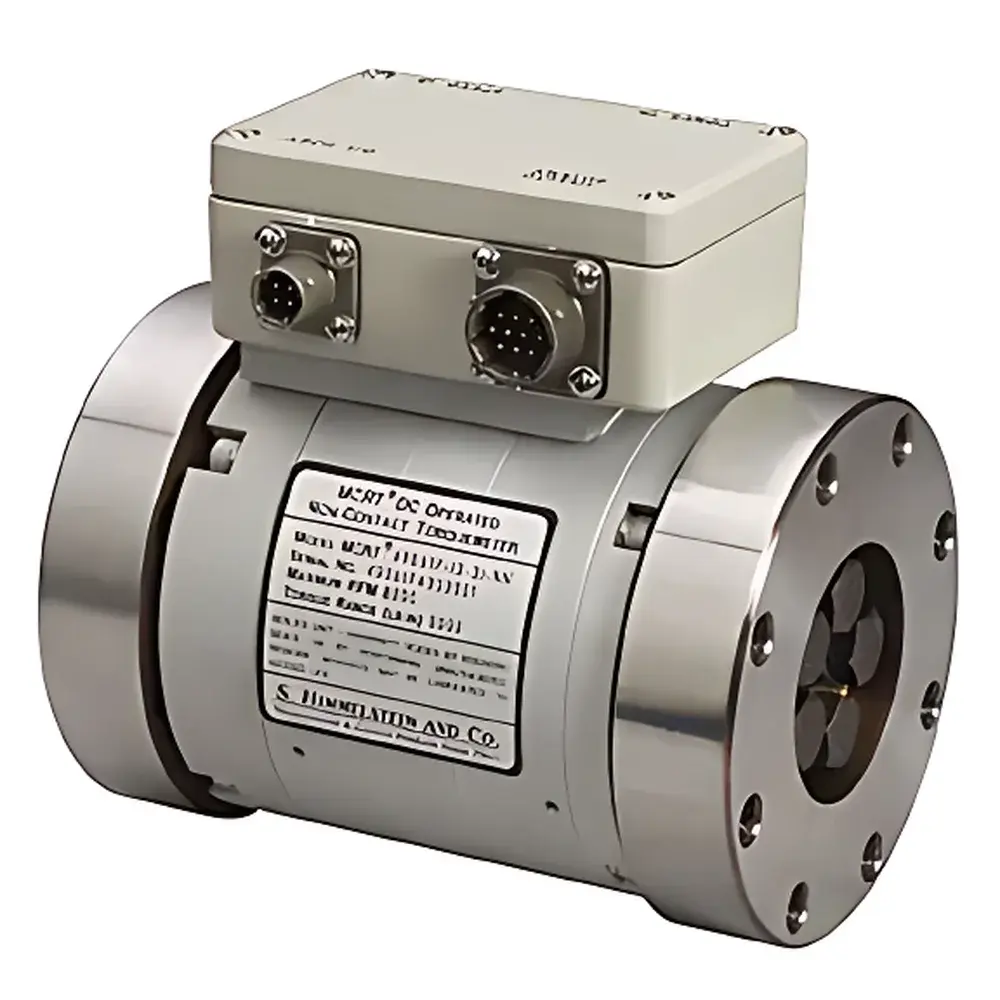
Non-Contact Digital Torque Sensor Series – Model 487 / 497 / 597
| Origin | USA |
|---|---|
| Manufacturer Type | Authorized Distributor |
| Origin Category | Imported |
| Model Numbers | 487, 497, 597 |
| Pricing | Available Upon Request |
| Torque Range | 2.83 N·m to 452,000 N·m (25 to 4,000,000 lb·in) |
| Accuracy | ±0.05% FS (Torque Analog Output) |
| Output | Engineering-Unit Digital via RS-232/RS-485 Serial Port |
| Signal Filtering | 11 Selectable Constant-Delay Low-Pass Filters |
| Overload Capacity | 200%, 400%, and 1,000% of Full Scale |
| Noise & Ripple | ≤0.02% FS |
| EMI Hardening | Optimized for Variable Frequency Drive (VFD) Environments |
| Calibration | Remote, Bidirectional, NIST-Traceable |
| Software | PC-Based Interface with Support for 33 Engineering Units (No Recalibration Required) |
Overview
The Non-Contact Digital Torque Sensor Series (Models 487, 497, and 597) is a high-fidelity, magnetoelastic-based torque measurement platform engineered for precision dynamic and static torque monitoring in industrial powertrain validation, rotating machinery diagnostics, and R&D test benches. Unlike slip-ring or strain-gauge-based transducers, this series employs a non-invasive, torsion-sensitive magnetic field modulation principle—where shaft twist induces a measurable phase shift in harmonic flux distribution—enabling true contactless torque sensing without mechanical coupling, wear, or signal degradation over time. Designed for integration into high-speed rotating systems operating up to 15,000 rpm (model-dependent), the sensor maintains metrological integrity under thermal drift, vibration, and electromagnetic interference commonly induced by adjustable-speed drives (ASDs) and inverters. Its architecture complies with fundamental requirements for traceable mechanical metrology per ISO/IEC 17025 and supports calibration traceability to NIST SRM 2160 (Standard Reference Material for Rotational Torque).
Key Features
- Non-contact magnetoelastic sensing eliminates mechanical wear, backlash, and maintenance intervals associated with slip rings or rotary transformers.
- ±0.05% full-scale accuracy on analog torque output, verified per ASTM E2501-21 (Standard Practice for Verification of Torque Transducers).
- Digital engineering-unit output (N·m, lb·ft, kN·m, etc.) via RS-232/RS-485 serial interface—no external signal conditioning required.
- Eleven programmable constant-delay low-pass filters (0.1 Hz to 10 kHz cutoff) enable application-specific noise suppression without altering gain or offset.
- EMI-hardened design validated per IEC 61000-4-3 (Radiated Immunity) and IEC 61000-4-4 (Electrical Fast Transient/Burst) standards for operation adjacent to VFDs and PWM-driven motors.
- Bidirectional, remote NIST-traceable calibration capability—performed without disassembly or physical access to the sensing zone.
- Overload resilience: rated for 200%, 400%, and 1,000% of full-scale torque depending on model configuration, preserving linearity and hysteresis performance post-overload.
- 0.02% peak-to-peak noise and ripple specification ensures stable baseline integrity for low-torque transient detection (e.g., clutch engagement, bearing drag, or start-up inertia profiling).
Sample Compatibility & Compliance
This sensor series accommodates solid, hollow, and keyed shafts with diameters ranging from 25 mm to 500 mm (model-dependent), supporting both in-line and reaction-mount configurations. It is compatible with ferromagnetic shaft materials (e.g., AISI 4140, 4340, and equivalent alloys) meeting ASTM A370 tensile property requirements. The system meets essential regulatory expectations for test instrumentation used in GLP-compliant laboratories and GMP-aligned manufacturing environments—including audit-ready calibration documentation, electronic signature support, and 21 CFR Part 11–compliant data logging when paired with validated PC interface software. All models are CE-marked per Machinery Directive 2006/42/EC and RoHS 2011/65/EU compliant.
Software & Data Management
Supplied PC interface software provides real-time visualization, acquisition, and export of torque, rotational speed (optional), and calculated power (optional) in user-selected engineering units—including SI, Imperial, and hybrid formats (e.g., kW, HP, N·m, lb·in). The software supports automatic unit conversion across all 33 predefined scales without hardware recalibration—a feature critical for multi-national test facilities operating under dual-unit regulatory frameworks (e.g., ISO 17025 accredited labs serving both EU and US clients). Raw data is stored in timestamped CSV or TDMS format, with optional metadata tagging for test sequence, operator ID, environmental conditions, and calibration certificate reference. Audit trail functionality records all parameter changes, data exports, and calibration events in accordance with ALCOA+ principles (Attributable, Legible, Contemporaneous, Original, Accurate, Complete, Consistent, Enduring, Available).
Applications
- Electric motor and inverter efficiency mapping in EV powertrain development
- Turbomachinery torque verification during endurance testing (gas turbines, compressors, pumps)
- Wind turbine drivetrain load monitoring and condition-based maintenance
- Automotive transmission bench testing under dynamic load cycling
- Industrial conveyor and extruder drive train performance validation
- Academic and government research on rotational dynamics, friction loss quantification, and energy conversion efficiency
FAQ
Does this sensor require shaft modification or keyway alteration for installation?
No—installation is fully non-intrusive; the sensor clamps externally around the shaft and requires no machining, drilling, or surface treatment.
Can the sensor measure torque at zero RPM (static condition)?
Yes—models 487/497/597 support true static torque measurement with no minimum rotational speed requirement.
Is the NIST-traceable calibration performed in-house or by an accredited third party?
Calibration is conducted by the manufacturer’s ISO/IEC 17025-accredited metrology laboratory; certificates include uncertainty budgets per GUM (Guide to the Expression of Uncertainty in Measurement).
What communication protocols does the PC interface support beyond serial?
The base configuration uses RS-232/RS-485; optional OEM modules provide Modbus RTU, EtherNet/IP, and CANopen interfaces upon request.
How often is recalibration recommended under continuous industrial operation?
Annual calibration is recommended per ISO 9001:2015 Clause 7.1.5.2; extended intervals (up to 24 months) may be justified with documented stability studies per ANSI/NCSL Z540.3.



