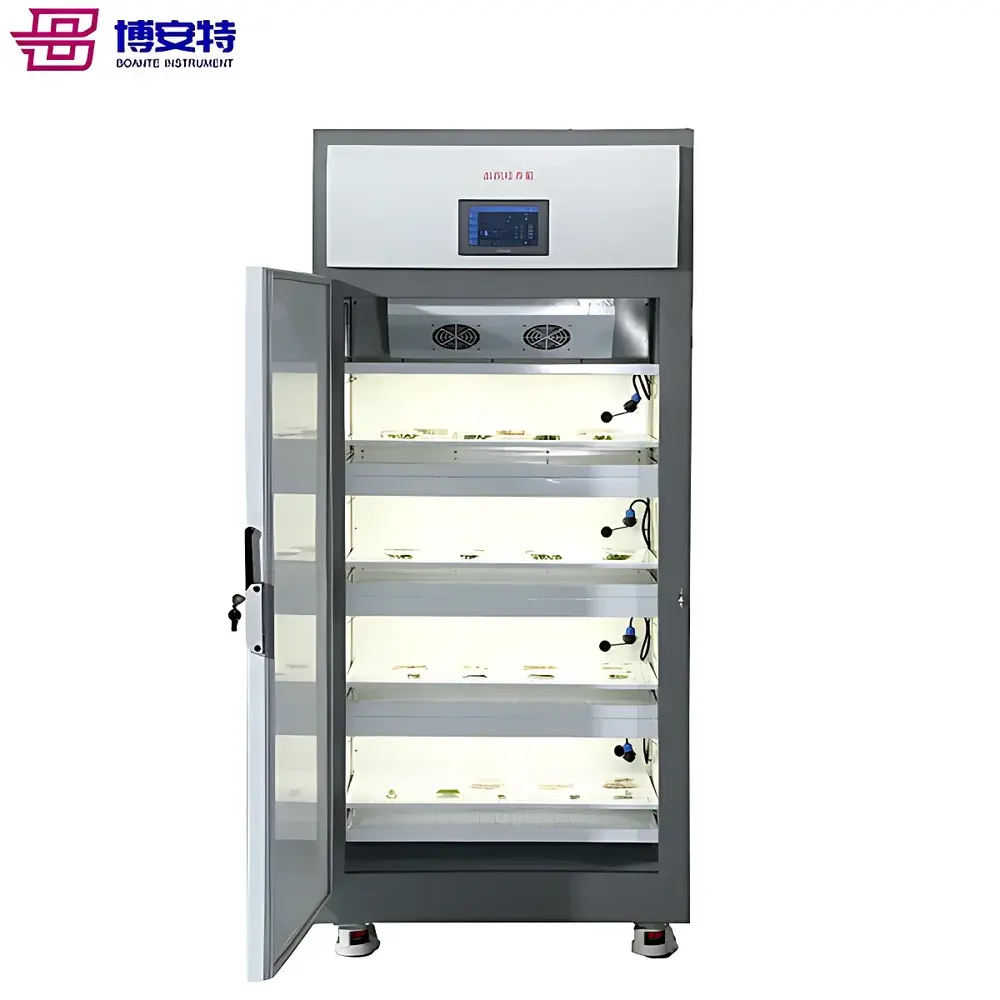
CONVIRON GEN1000 Series Intrusive Plant Growth Chambers
| [Brand | CONVIRON (Canada) |
|---|---|
| Origin | Canada |
| Model | GEN1000 |
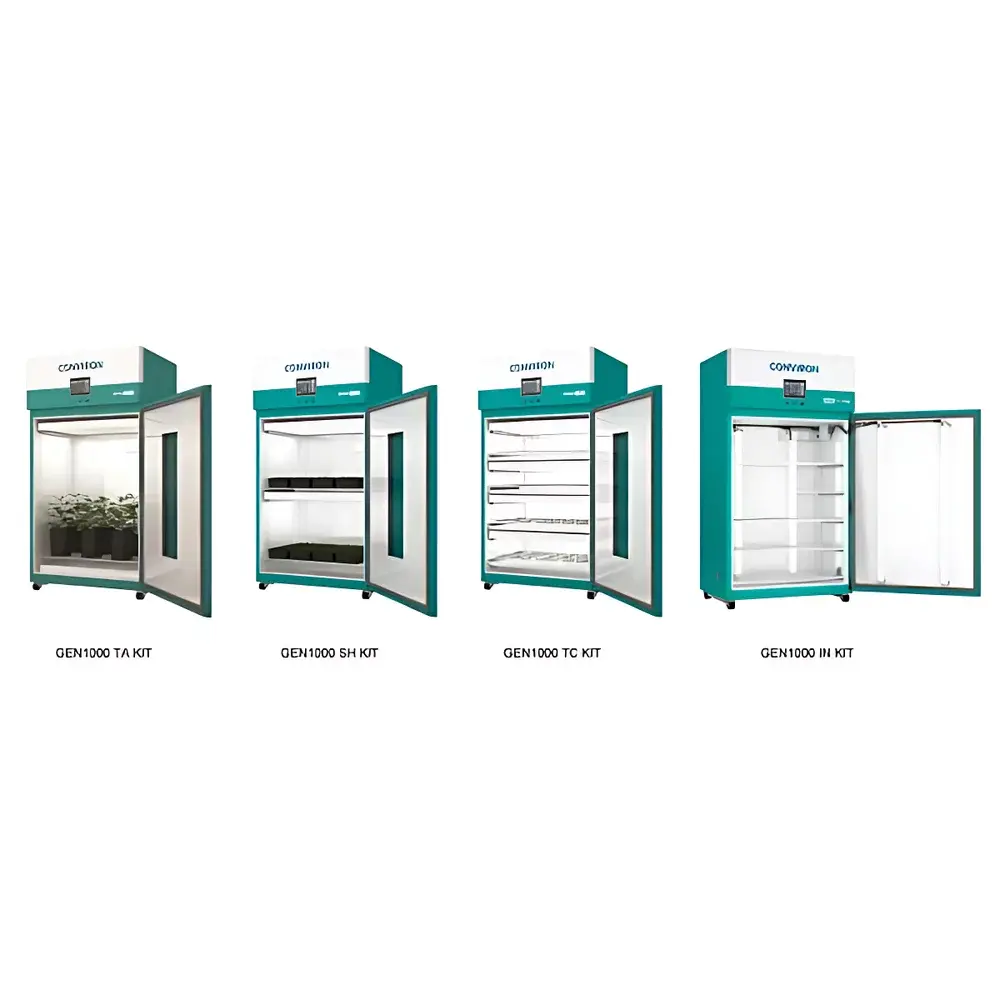
| Chamber Types | TA Kit (1-layer), SH Kit (2/3-layer), TC Kit (4-layer), IN Kit (4-layer) |
| Controller | CMP6060 industrial PLC with 7" color touchscreen, Windows SE OS |
| Temperature Range | 4–40°C (dark), 10–45°C (light) |
| SH Kit XTIER | 15–45°C (light) |
| Humidity Control | Ultrasonic humidification, 75% RH max (light), 90% RH max (dark) |
| Light Source | Standard 12W T5 full-spectrum LED |
| PAR intensity | 275–700 µmol/m²/s @ 15 cm |
| Airflow | Vertical or horizontal laminar flow via plenum chamber |
| Internal Volume | 1000 L |
| External Dimensions | 1040 × 825 × 1955 mm (W×D×H) |
| Data Logging | Local: 30-sec intervals |
| Remote (optional) | 18-sec intervals |
| Compliance | ISO 9001, QPS certified |
| Power Supply | 230 V, 1-phase, 50 Hz, 16 A] |
Overview
The CONVIRON GEN1000 Series Intrusive Plant Growth Chambers are precision-engineered environmental control systems designed for reproducible, long-term plant phenotyping, developmental biology, and controlled-environment agriculture research. Built in Canada and validated under ISO 9001 and QPS safety standards, the GEN1000 platform employs a modular architecture to support four distinct chamber configurations—TA, SH, TC, and IN Kits—each optimized for specific experimental scales and biological requirements. These chambers operate on fundamental principles of active environmental regulation: temperature is maintained via an eco-friendly refrigerant-based cooling system coupled with a bypass gas management strategy to minimize compressor cycling; humidity is controlled using ultrasonic atomization with real-time dew-point compensation; light delivery utilizes spectrally balanced T5 LED arrays with programmable photosynthetic photon flux density (PPFD) profiles; and airflow is engineered as either vertical upward or horizontal laminar flow—depending on configuration—to ensure thermal and photometric uniformity across the growth zone. The system is explicitly designed for integration into GLP-compliant laboratories and regulated research environments where traceability, audit readiness, and parameter stability are non-negotiable.
Key Features
- Industrial-grade CMP6060 controller running Windows SE OS with 7-inch capacitive touchscreen interface featuring pan-and-zoom visualization, cursor-enabled trend analysis, and multi-layer data overlay (setpoint vs. actual).
- Programmable environmental scheduling: up to 16 master programs, each supporting 48 subroutines with minimum 1-minute time resolution; multi-cycle calendar management for daily, weekly, seasonal, or annual protocols.
- Flexible control modes: standard STEP (step-change) for all parameters; optional RAMP (linear ramping) capability for temperature, humidity, light, and CO2—enabling precise simulation of diurnal transitions or stress induction protocols.
- Comprehensive alarm architecture: configurable thresholds for all monitored parameters; process-tracking alarms for temperature deviation rate; visual (RGB status LEDs) and audible (piezo buzzer) alerts; local storage of last 15 alarm events; optional SMS/email notification via integrated communication module.
- Hardware diagnostics dashboard: real-time monitoring of consumable service life—including LED driver hours, actuator cycle counts, and valve operational status—supporting predictive maintenance and regulatory documentation.
- Scalable I/O architecture: native support for third-party sensor integration (e.g., soil moisture, leaf temperature, chlorophyll fluorescence); expandable analog/digital input/output channels for custom instrumentation interfacing.
Sample Compatibility & Compliance
The GEN1000 series accommodates diverse botanical models across developmental stages. The TA Kit (1-layer, 1105 mm height, 0.58 m² area) supports large-canopy species including rice, maize, wheat, soybean, sweet potato, and ornamental shrubs. The SH Kit (2- or 3-layer, adjustable height per shelf) is optimized for Arabidopsis thaliana, lettuce, tomato seedlings, and early-stage cereal crops. The TC Kit (4-layer, 175 mm per shelf) and IN Kit (4-layer, 216 mm per shelf) provide high-density capacity for tissue culture vessels, micropropagation units, and embryogenic callus incubation. All internal surfaces feature white-galvanized steel with reflective finish to maximize light utilization and simplify decontamination. Magnetic door seals, keyed locking mechanisms, and optional observation windows (240 × 860 mm per door) ensure both biosafety and observational integrity. The system complies with ISO 9001 quality management requirements and QPS electrical safety certification. Optional CO2 modules enable concentration control from ambient baseline down to 200 ppm (scrubbing) or up to 2900 ppm (injection), supporting carbon response studies under ASTM E1918 and ISO 17025-aligned workflows.
Software & Data Management
Data acquisition occurs at user-selectable intervals: standard local logging records all environmental variables every 30 seconds; optional remote Ethernet-connected logging reduces interval to 18 seconds and enables synchronized timestamping across multiple chambers. Trend graphs display up to five consecutive days of concurrent setpoint/actual values with dynamic zoom, panning, and cursor-readout functionality. Export capabilities include CSV and Excel-compatible formats for downstream statistical analysis in R, Python, or SAS environments. The controller firmware supports 21 CFR Part 11-compliant audit trails when paired with CONVIRON’s optional secure network gateway—capturing user logins, parameter changes, alarm acknowledgments, and program executions with immutable timestamps and digital signatures. All stored programs and logs reside on encrypted internal flash memory with battery-backed SRAM retention during power loss. Optional UPS-integrated controller backup extends runtime to five hours post-outage, preserving active protocols and historical datasets.
Applications
- Photoperiodic and vernalization studies requiring precise circadian rhythm emulation.
- Abiotic stress screening (drought, heat, cold, elevated CO2) with programmable ramping profiles and real-time physiological feedback integration.
- Tissue culture propagation under low-light, high-humidity conditions with sterility-preserving airflow design.
- Seed germination assays with dual-temperature stratification and humidity-triggered dormancy release protocols.
- Phenomics pipelines integrating with automated imaging platforms via TTL-triggered synchronization ports.
- Regulatory submission support for EPA, USDA APHIS, and EFSA dossier preparation through documented environmental traceability and calibration history.
FAQ
What distinguishes the GEN1000 SH Kit from the TA Kit in terms of airflow design?
The SH Kit uses horizontal laminar airflow from rear-wall plenums to ensure uniform conditions across compact specimens; the TA Kit employs vertical upward flow through a static-pressure chamber to accommodate taller plants and mitigate thermal stratification.
Can the CMP6060 controller execute custom logic beyond standard environmental ramps?
Yes—the controller supports user-defined ladder logic programming and script-based conditional branching, enabling event-driven responses such as light dimming upon humidity threshold breach or fan speed modulation based on real-time PAR feedback.
Is remote monitoring compatible with existing institutional SCADA or BMS networks?
Yes—via Modbus TCP/IP or OPC UA protocol support, the GEN1000 integrates natively with enterprise-level building management systems and laboratory information management systems (LIMS) without proprietary middleware.
How does the system maintain temperature uniformity during extended light-on cycles?
LED heat is actively extracted via dedicated convection paths routed away from the growth zone; the air-cooled condenser operates continuously with variable-speed fans, and the bypass gas loop prevents compressor short-cycling—ensuring ±0.5°C spatial uniformity even at 45°C under full illumination.
Are calibration certificates provided for factory-installed sensors?
Each unit ships with NIST-traceable calibration reports for temperature, relative humidity, and PAR sensors, valid for 12 months; CONVIRON-certified field recalibration services are available globally with documented uncertainty budgets per ISO/IEC 17025.