
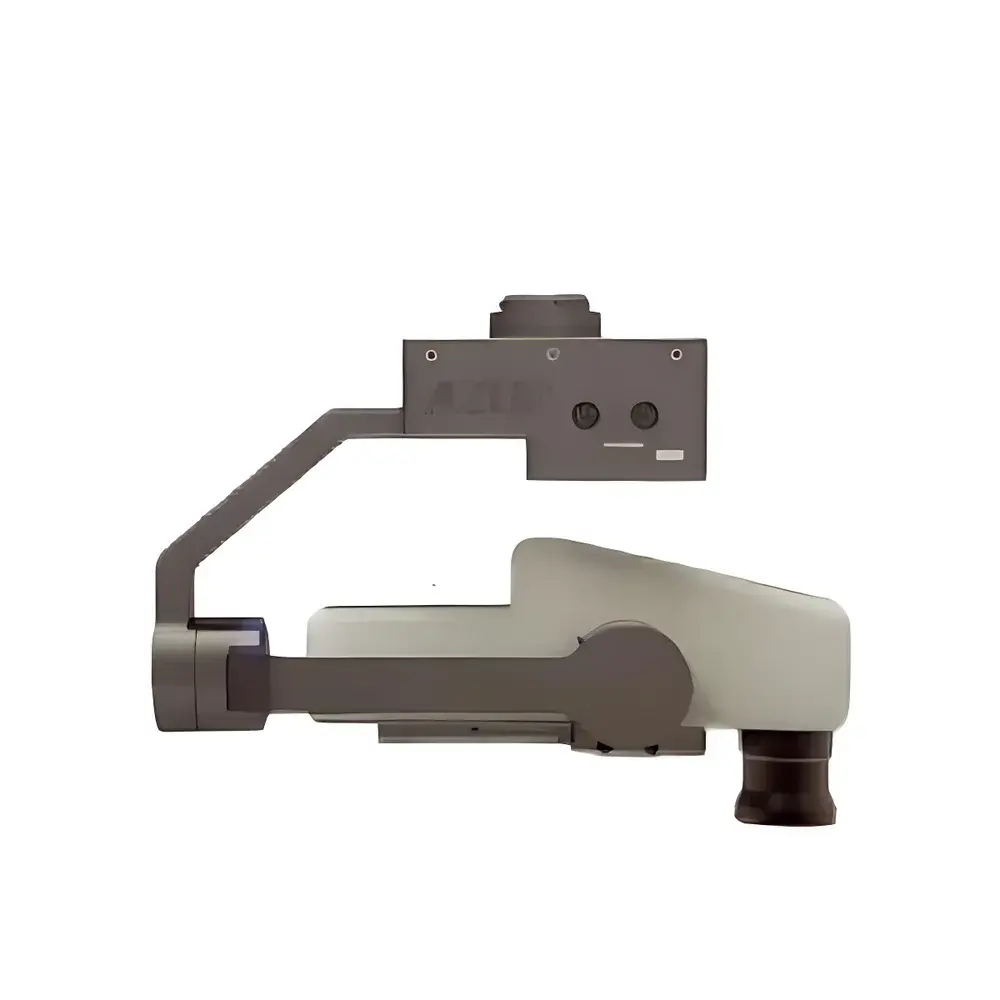
Cubert V185 Hyperspectral Imaging Camera
| Brand | Cubert |
|---|---|
| Origin | Germany |
| Model | V 185 |
| Spectral Range | 450–950 nm |
| Spectral Resolution | 8 nm @ 532 nm |
| Imaging Mode | Snapshot (Frame-Based) |
| Weight | ~500 g |
| Platform Compatibility | Ground-based and Airborne (UAV-integrated) |
| Data Acquisition Speed | Full hyperspectral cube in ≤ 1 ms |
Overview
The Cubert V185 is a snapshot-based, frame-sequential hyperspectral imaging camera engineered for high-fidelity spectral-spatial data acquisition under dynamic conditions. Unlike push-broom or scanning systems that rely on relative motion between sensor and target—introducing motion artifacts, geometric distortion, and temporal misregistration—the V185 captures the entire hyperspectral data cube (x, y, λ) simultaneously within a single exposure. This is achieved through Cubert’s proprietary dual-layer image sensor architecture, where each pixel records two orthogonal spectral bands in parallel, enabling full spectral coverage across the visible to near-infrared (VNIR) range without mechanical scanning or moving optics. The absence of moving parts ensures long-term stability, minimal calibration drift, and immunity to vibration-induced errors—critical attributes for airborne deployment on fixed-wing UAVs and lightweight rotary platforms. With a spectral range spanning 450–950 nm and a nominal spectral resolution of 8 nm at 532 nm, the V185 delivers consistent radiometric fidelity suitable for quantitative reflectance analysis, spectral unmixing, and time-resolved field monitoring.
Key Features
- Snapshot acquisition: Full 2D spatial + spectral data cube captured in ≤1 ms—eliminating motion blur and scan-line artifacts inherent in line-scanning systems.
- Compact and lightweight design: Total mass of approximately 500 g enables seamless integration onto small-format UAVs, including fixed-wing and VTOL platforms with strict payload constraints.
- Robust optical architecture: All-refractive, fixed-focus lens system with no moving elements; optimized for outdoor operation across variable thermal and mechanical environments.
- VNIR-optimized spectral response: Covers 450–950 nm with uniform quantum efficiency and low stray-light contribution—validated per ISO 15739:2013 for noise and dynamic range performance.
- Onboard metadata tagging: Embedded GPS/IMU synchronization (via optional external interface) supports georeferenced data capture compliant with OGC SensorML and ISO 19115-2 standards.
Sample Compatibility & Compliance
The V185 is designed for non-contact, standoff measurement of reflective surfaces—including vegetation canopies, soil substrates, mineral outcrops, painted materials, and agricultural crops—under ambient illumination or controlled illumination sources (e.g., calibrated halogen or LED panels). It does not require sample preparation, physical contact, or vacuum environments. Its spectral calibration is traceable to NIST-traceable reflectance standards (e.g., Spectralon®), and factory calibration includes dark current, flat-field, and wavelength registration correction. The system complies with CE marking requirements for electromagnetic compatibility (EN 61326-1) and environmental robustness (EN 60068-2 series). For regulated applications involving environmental monitoring or precision agriculture reporting, raw and processed data meet FAO’s Agri-Geospatial Data Interoperability Guidelines and support audit-ready documentation per GLP principles when used with validated workflows.
Software & Data Management
The V185 is operated via Cubert’s proprietary uSpectra software suite (Windows 10/11, 64-bit), which provides real-time preview, batch acquisition control, radiometric correction, and spectral library matching. Key capabilities include automated spectral stitching, ENVI-compatible BIL/BIP file export (IEEE 754 float32), NDVI, EVI, and PRI index computation, supervised and unsupervised classification (k-means, ISODATA), and endmember extraction (N-FINDR, VCA). All processing steps are logged with timestamped metadata, supporting 21 CFR Part 11–compliant electronic records when deployed in validated environments. Raw data files retain full bit-depth (12-bit or 16-bit, user-selectable) and include embedded calibration coefficients for traceable reprocessing.
Applications
- High-throughput phenotyping: Monitoring chlorophyll content, water stress, and nitrogen status in field trials using spectral indices derived from contiguous VNIR bands.
- Mineralogical mapping: Discrimination of iron oxides, clays, and carbonates in open-pit surveys based on diagnostic absorption features near 700 nm, 900 nm, and 1400 nm (with atmospheric correction).
- Food quality inspection: Detection of bruising, mold, or chemical residues on fruits and grains via spectral anomaly detection algorithms.
- Forensic material identification: Non-destructive differentiation of inks, paints, and polymers using spectral angle mapper (SAM) and spectral feature fitting (SFF).
- Environmental compliance monitoring: Quantitative assessment of algal blooms, sediment plumes, and oil sheens in inland and coastal waters using normalized difference water index (NDWI) and floating algae index (FAI).
FAQ
Does the V185 require external illumination for outdoor operation?
No—it is optimized for solar-illuminated reflectance measurements; however, calibrated artificial lighting may be used for controlled lab or indoor applications.
Can the V185 be integrated with third-party autopilot systems?
Yes—via TTL trigger input and optional RS232/UART interface for synchronized acquisition with flight controllers (e.g., Pixhawk, DJI Payload SDK).
Is radiometric calibration performed in-field or only at the factory?
Factory calibration is provided with each unit; users may perform optional in-field dark/white reference acquisitions prior to each mission to correct for ambient temperature drift and illumination variability.
What file formats are supported for export and interoperability?
Raw data is stored in Cubert’s binary format (.cub); export options include ENVI BIL/BIP, GeoTIFF (with georeferencing tags), and CSV spectral profiles.
How is spectral accuracy verified over time?
Users may validate wavelength registration and bandpass consistency using NIST-traceable spectral line sources (e.g., mercury-argon lamp) or certified reflectance targets with known absorption features.
Related Products



