COULBOURN ACT-100A Fear Conditioning and Behavioral Analysis System
| Brand | COULBOURN |
|---|---|
| Origin | USA |
| Model | ACT-100A |
| Channel Capacity | 4 / 8 / 12 channels |
| Video Sampling Rate | ≥4 Hz (frames per second) |
| Motion Detection Resolution | ≥1 mm |
| Compliance | FDA 21 CFR Part 11–ready software architecture, GLP/GMP-compatible data audit trail |
| Data Export | Excel (.xlsx), QuickTime (.mov) |
| Validated Concordance with Trained Human Observers | ≥90% (independently verified by Memory Pharmaceuticals, NJ) |
Overview
The COULBOURN ACT-100A Fear Conditioning and Behavioral Analysis System is a rigorously engineered video-based platform designed for quantitative assessment of associative learning, conditioned fear responses, and depression-related behavioral phenotypes—including freezing behavior, immobility in tail suspension, and exploratory micro-movements—in rodent models. Unlike conventional motion-tracking systems that rely on gross centroid displacement or infrared beam breaks, the ACT-100A implements a patented pixel-difference motion detection algorithm optimized for high-fidelity capture of subtle ethologically relevant behaviors: rearing, sniffing, grooming, head turning, and postural shifts. Operating at a minimum frame rate of 4 Hz—significantly exceeding legacy systems sampling once every 5 seconds—the system ensures temporal resolution sufficient to resolve transient behavioral states critical for accurate freezing quantification. Its architecture is grounded in validated behavioral neuroscience methodology, supporting both Pavlovian fear conditioning paradigms (e.g., tone-shock pairing in contextual/cued protocols) and ethologically aligned assays such as the tail suspension test (TST), where passive immobility must be discriminated from low-amplitude oscillatory motion induced by respiration or muscle tremor.
Key Features
- Multi-channel scalability: Configurable for 4-, 8-, or 12-animal simultaneous recording via synchronized USB 3.0 cameras—enabling high-throughput behavioral screening without compromising per-subject temporal fidelity.
- Sub-millimeter motion sensitivity: Proprietary motion-detection algorithm filters out non-biological artifacts—including ambient light fluctuations, shadow transients, and sensor noise—while resolving displacements ≥1 mm across the full field of view.
- Integrated stimulus control: Computer-synchronized delivery of aversive (foot shock) and neutral (auditory tone, visual cue) stimuli via programmable I/O modules; supports custom timing sequences and conditional logic for complex protocol design.
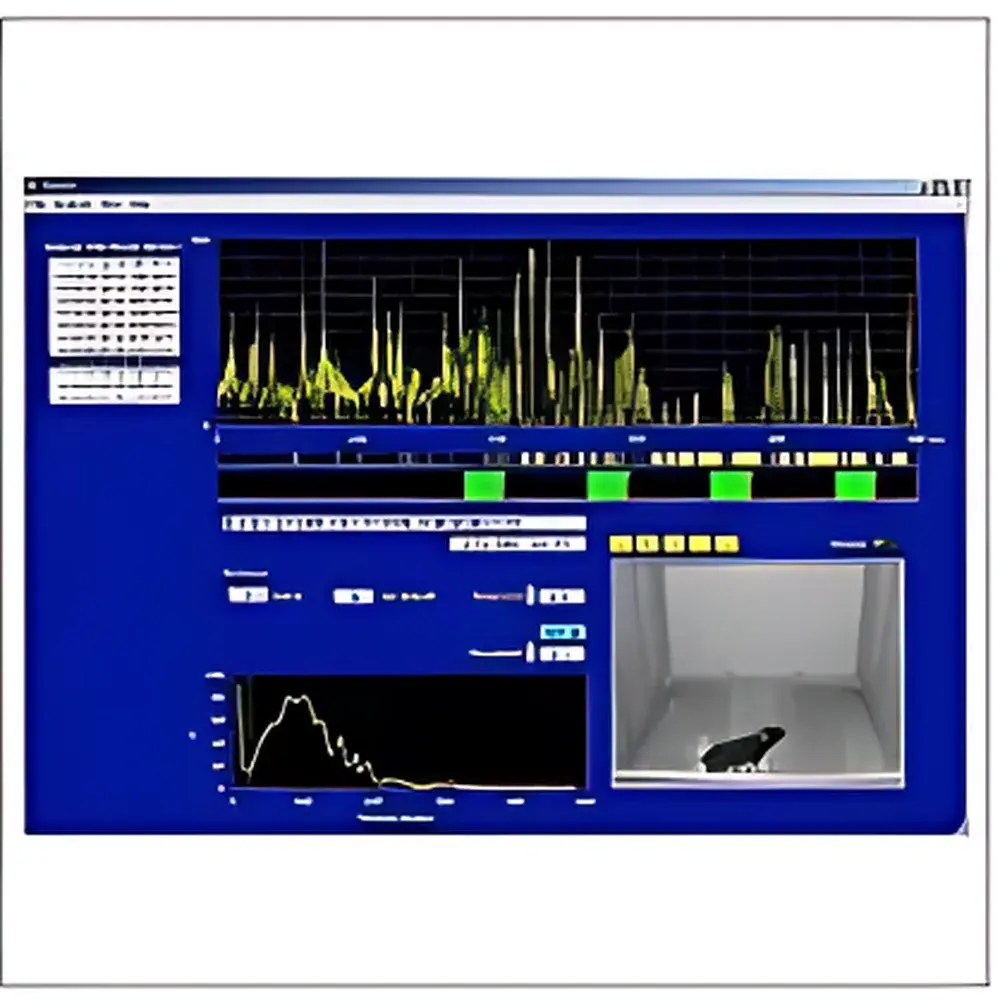
- FreezeFrame® analytics engine: Provides automated, threshold-agnostic classification of freezing episodes based on velocity variance, duration, and inter-episode intervals—outputting standardized metrics including % freezing time, freezing bout count, mean bout duration, and latency to first freeze.
- Full-video archival: Captures raw and annotated video streams in QuickTime (.mov) format with embedded timestamps and metadata; supports retrospective frame-by-frame review and manual annotation overlay.
- Regulatory-compliant data management: Software architecture supports user access controls, electronic signatures, and immutable audit trails—aligned with GLP and GMP requirements and compatible with FDA 21 CFR Part 11 validation frameworks.
Sample Compatibility & Compliance
The ACT-100A is validated for use with mice (C57BL/6, BALB/c, FVB, etc.) and rats (Sprague-Dawley, Wistar) across standard behavioral chambers (e.g., Coulbourn HABITEST® enclosures) and TST rigs. All hardware components meet UL/CE safety standards; camera modules utilize low-noise CMOS sensors with adjustable gain and exposure control to ensure consistent performance under variable lighting conditions—no specialized IR illumination or reflective floor treatments required. The system complies with ISO/IEC 17025 principles for measurement uncertainty estimation in behavioral scoring, and its analytical output has been cross-validated against expert human scorers (inter-rater concordance ≥90%, per independent assessment at Memory Pharmaceuticals, Montvale, NJ). Documentation packages include IQ/OQ protocols and traceable calibration records for laboratory accreditation workflows.
Software & Data Management
The ACT-100A runs FreezeFrame v4.x software—a Windows-based application built on a modular, scriptable framework supporting batch processing, protocol templating, and dynamic parameter adjustment during acquisition. Users define stimulus schedules, motion thresholds, and analysis windows via intuitive graphical interfaces; all configurations are saved as encrypted project files with version history. Analytical outputs—including freezing statistics, mobility heatmaps, and TST immobility profiles—are exportable in native Excel (.xlsx) format with column headers compliant with MIAME and MINIMAR reporting standards. Raw video archives retain embedded SMPTE timecode and hardware synchronization markers, enabling precise alignment with electrophysiological or optogenetic event logs. Optional API integration supports direct data ingestion into LabArchives ELN or custom LIMS platforms.
Applications
- Contextual and cued fear conditioning: Quantitative assessment of hippocampal- and amygdala-dependent memory consolidation and extinction.
- Tail suspension test (TST): Objective discrimination of passive immobility versus respiratory artifact—critical for antidepressant efficacy screening.
- Prepulse inhibition (PPI) and startle response profiling: When integrated with acoustic startle systems (e.g., Coulbourn SR-LAB).
- Pharmacological validation studies: Dose-response characterization of anxiolytics, NMDA antagonists, or epigenetic modulators on fear memory acquisition and retrieval.
- Genetic model phenotyping: High-reproducibility behavioral profiling in transgenic, knockout, or CRISPR-edited lines.
- Longitudinal behavioral monitoring: Multi-session tracking of behavioral plasticity across weeks with automated session alignment and baseline normalization.
FAQ
Does the ACT-100A require infrared lighting or retroreflective floor coatings?
No—operation relies on standard visible-light CMOS imaging; no specialized illumination or chamber modifications are necessary.
Can the system distinguish freezing from sleep-like immobility?
Yes—the algorithm incorporates temporal variance metrics and micro-movement persistence thresholds to differentiate true fear-induced freezing from quiescent states.
Is the software compatible with modern Windows OS versions (e.g., Windows 11)?
Yes—FreezeFrame v4.5+ is certified for Windows 10 and Windows 11 (64-bit), with driver signing and UAC-compliant installation.
How is data integrity ensured during long-duration experiments?
All acquisitions write to redundant storage paths with cyclic redundancy checksums; video segments are auto-split at configurable intervals to prevent file corruption.
Can third-party stimulus generators be integrated?
Yes—via TTL-triggered I/O expansion modules or serial/USB command scripting within FreezeFrame’s protocol editor.