
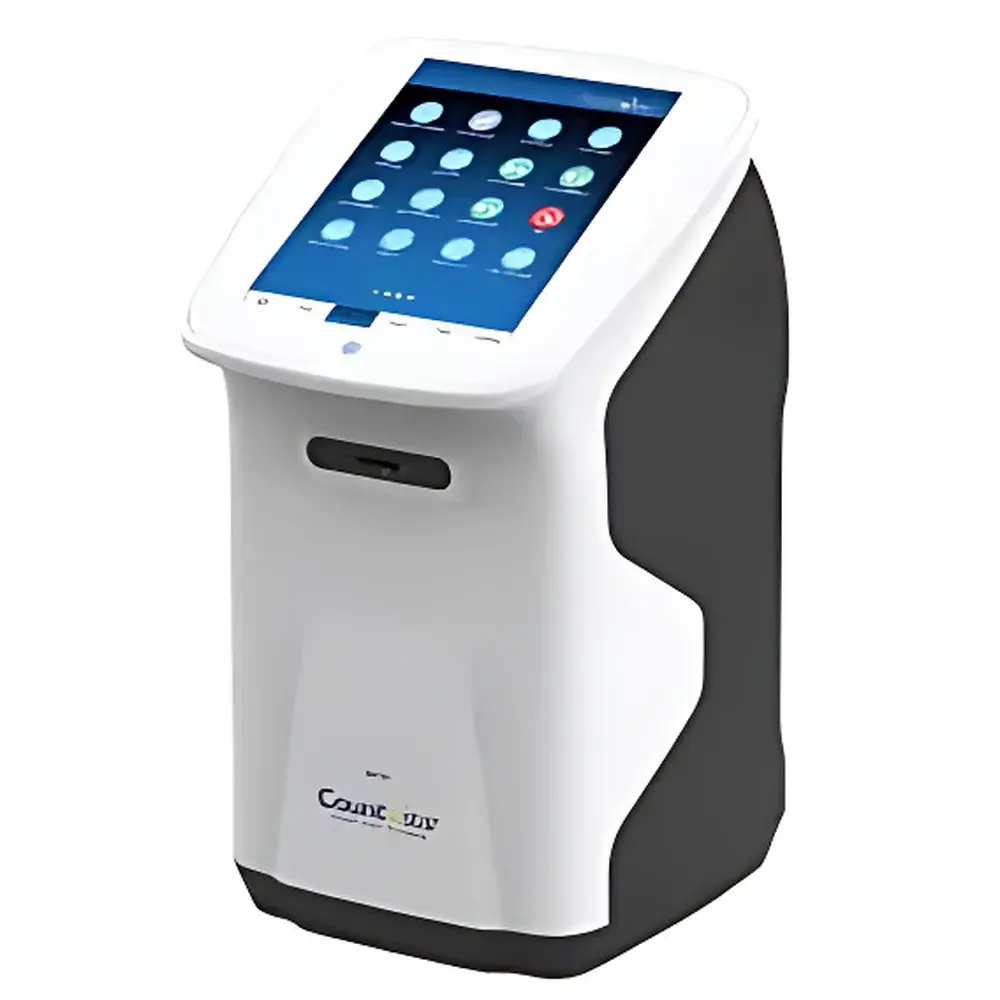
Countstar Altair Automated Cell Counter
| Brand | Countstar |
|---|---|
| Origin | Shanghai, China |
| Model | AItair |
| Detection Time | 150 s |
| Cell Concentration Range | 1×10⁴–3×10⁷ cells/mL |
| Sample Volume | 20 µL |
| Throughput | 5 samples per run |
| Detectable Cell Diameter | 3–180 µm |
Overview
The Countstar Altair Automated Cell Counter is an integrated, touch-screen-enabled instrument engineered for high-precision, rapid, and fully automated cell analysis in biopharmaceutical process development and quality control environments. It employs the trypan blue exclusion principle—validated by ISO 20391-1:2018 for viability assessment—combined with high-resolution optical imaging and proprietary image segmentation algorithms to deliver quantitative metrics including total cell count, viable cell density, viability percentage, mean cell diameter, coefficient of variation (CV) in size distribution, and aggregation rate. Unlike conventional hemocytometer-based or flow cytometry methods, the Altair eliminates manual focusing, stage adjustment, or subjective gating through its patented Fixed-Focus Optical Architecture—a mechanically stabilized imaging system calibrated at factory level and maintained across operational lifetime. This architecture ensures measurement repeatability ≤3% CV (n=10, standardized yeast suspension), independent of operator skill or environmental vibration. The device operates as a standalone unit with embedded computing hardware, requiring no external PC or driver installation.
Key Features
- Patented Fixed-Focus Imaging System: Eliminates manual focus calibration, lens swapping, or field-of-view repositioning—ensuring consistent magnification (40× effective) and depth-of-field stability across all sample types.
- 5-Megapixel Full-Color CMOS Sensor: Captures high-fidelity brightfield images with dynamic range >60 dB, enabling reliable discrimination of subtle morphological features (e.g., membrane blebbing, cytoplasmic granularity) critical for viability interpretation.
- AI-Enhanced Cell Segmentation Engine: Uses convolutional neural network (CNN)-based pixel classification to resolve clustered cells and irregularly shaped debris without user-defined thresholds—validated against NIST-traceable microsphere standards.
- Integrated Touchscreen Control Interface: Android-based OS with intuitive icon-driven workflow navigation; supports multi-user profiles with role-based access permissions (e.g., analyst, supervisor, administrator).
- Onboard Data Storage: 500 GB SSD capacity, supporting ≥160,000 sample records with full metadata (timestamp, operator ID, assay parameters, raw image thumbnails, audit trail logs).
- Regulatory-Ready Software Architecture: Compliant with FDA 21 CFR Part 11 requirements—including electronic signatures, audit trails with immutable timestamps, and user authentication via password + optional LDAP integration.
Sample Compatibility & Compliance
The Altair accommodates suspension cultures of mammalian (e.g., CHO, HEK293), insect (Sf9, Sf21), hybridoma, and tumor cell lines—as well as yeasts (S. cerevisiae), algae, and selected protozoa—within the 3–180 µm detection range. It accepts standard 20 µL volumes loaded via disposable counting slides (Cat. No. CS-SLIDE-20), which are manufactured under ISO 13485-certified conditions and supplied with lot-specific calibration certificates. All firmware and software revisions undergo formal change control per ICH Q9 principles. Instrument qualification packages—including Installation Qualification (IQ), Operational Qualification (OQ), and Performance Qualification (PQ) protocols—are provided with pre-executed templates and blank worksheets aligned with ASTM E2500-13 and EU Annex 15 guidance. Routine Instrument Stability Testing (IST) procedures are embedded in the software to support cGMP-aligned preventive maintenance scheduling.
Software & Data Management
Data acquisition, processing, and reporting occur within the embedded Countstar Analysis Suite v4.x. Each measurement generates a structured dataset containing raw image files (.tiff), processed binary masks, statistical summaries (mean, SD, %CV, histogram bins), and export-ready reports. Output formats include PDF (with digital signature block), Excel (.xlsx) with formula-locked calculation sheets, and JPEG previews. USB 2.0/3.0 ports enable secure offline data transfer; optional Ethernet/Wi-Fi modules support integration into LIMS or MES systems via HL7 or ASTM E1384-compliant interfaces. Database organization follows project-centric hierarchy: users define custom experiment types (e.g., “Fed-Batch Day 3 QC”, “Transfection Efficiency Screen”) with configurable parameter sets (dilution factor, staining time, threshold sensitivity). Search functionality supports Boolean queries across project name, date range, operator ID, or keyword tags—returning results that can be re-analyzed, annotated, or batch-exported.
Applications
- Bioreactor Inoculum Verification: Rapid confirmation of viable cell density prior to seed train expansion, reducing risk of suboptimal inoculation.
- Process Characterization Studies: Quantitative tracking of cell size distribution shifts during fed-batch culture—correlating morphology changes with metabolic activity or product titer.
- Cell Line Development Screening: High-throughput comparison of clone viability and growth kinetics under varying media formulations or transfection reagents.
- Downstream Process Support: Monitoring aggregate formation during harvest or clarification steps—providing early indicators of shear stress or protein precipitation.
- QC Release Testing: Integration into SOPs for routine lot release of cell banks (Master/Working Cell Banks) per USP and Ph. Eur. 5.2.12 guidelines.
FAQ
Does the Altair require daily calibration?
No. The Fixed-Focus system is factory-calibrated and does not require user-performed optical recalibration. IST routines verify system performance at user-defined intervals (e.g., weekly), generating pass/fail reports traceable to internal reference standards.
Can the instrument be connected to a corporate network?
Yes—via optional Gigabit Ethernet or Wi-Fi module. Network configuration adheres to IEEE 802.1X authentication and TLS 1.2 encryption standards for secure data transmission.
Is raw image data retained with each measurement?
Yes. Every analysis stores the original 5-megapixel TIFF image alongside processed data, accessible for retrospective review or regulatory inspection.
What validation documentation is included with purchase?
A complete IQ/OQ/PQ kit is shipped, including executed protocols, equipment specification sheets, test failure resolution logs, and a Certificate of Conformance compliant with ISO 9001:2015.
How is software version control managed during upgrades?
Firmware updates are delivered as signed .pkg files with SHA-256 checksum verification. Each update triggers automatic backup of existing configuration and audit trail databases prior to installation.
Related Products




