
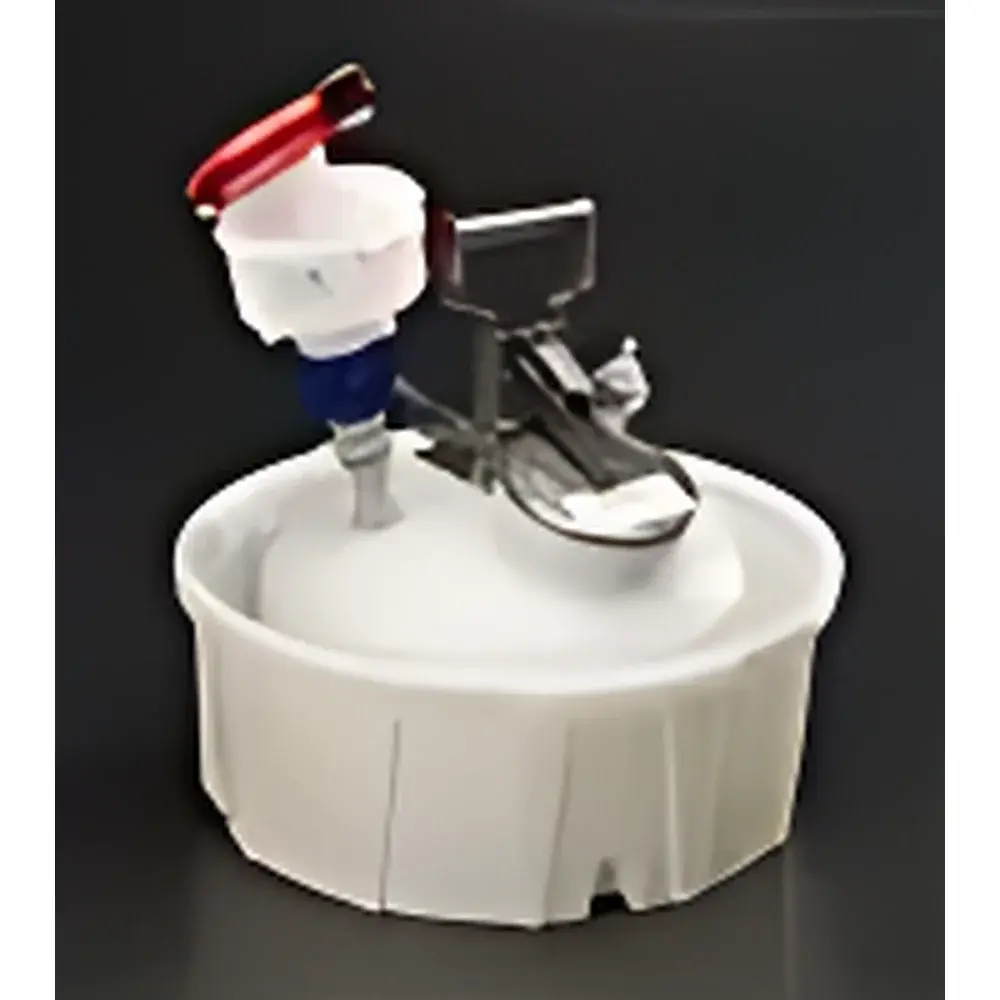
CP Lab Safety EF-4-38-62-SYS ECO Waste Collection Funnel System
| Brand | CP Lab Safety |
|---|---|
| Origin | USA |
| Manufacturer Type | Authorized Distributor |
| Import Status | Imported |
| Model | EF-4-38-62-SYS |
| Funnel Diameter | 4 in (101.6 mm) |
| Capacity | 450 mL |
| Neck Length | 11 in (279 mm) |
| Neck Thread | 38-430 |
| Top Dimensions | 5 in × 7 in (127 mm × 178 mm) |
| Material | High-Density Polyethylene (HDPE) |
| Filter Included | Yes |
| Max HPLC Fittings | 6 |
| Compliance | Meets OSHA, ANSI Z9.5, and EPA waste containment best practices |
Overview
The CP Lab Safety EF-4-38-62-SYS ECO Waste Collection Funnel System is an engineered solution for safe, compliant, and vapor-reduced disposal of hazardous organic solvents and liquid laboratory waste. Designed specifically to replace open-beaker or uncapped bottle waste collection methods, this system operates on the principle of passive vapor suppression through physical barrier isolation and extended neck geometry. The 11-inch elongated neck creates a diffusion-limited path that significantly reduces solvent vapor escape—validated to retain >99% of volatile organic compounds (VOCs) including acetonitrile, methanol, chloroform, ethyl acetate, and hexane under standard lab conditions (23 °C, 50% RH). Unlike conventional funnels, the EF-4-38-62-SYS integrates seamlessly with certified HDPE and polypropylene waste containers, forming a closed-loop interim storage system compatible with downstream hazardous waste manifesting protocols.
Key Features
- 4-inch (101.6 mm) funnel aperture with precision-machined 38-430 threaded neck for secure, leak-resistant coupling to standard laboratory waste bottles (2 L, 4 L, and custom configurations)
- 11-inch vertical neck design extends vapor diffusion path length, minimizing headspace concentration gradients and reducing VOC emission rates per Fick’s first law of diffusion
- High-density polyethylene (HDPE) construction provides broad chemical resistance—validated against ASTM D543 exposure testing for >72 hours with Class I–III solvents
- Integrated sintered polyethylene filter (nominal pore size: 100 µm) retains particulate matter without compromising flow rate or inducing backpressure during HPLC, GC, or synthesis workflows
- Compact footprint (5″ × 7″ top envelope) enables stable placement inside fume hoods, sink basins, or under instrument drip trays without obstructing workflow ergonomics
- Modular compatibility with up to six standardized HPLC waste line adapters (e.g., 1/16″ OD PEEK tubing ports), supporting multi-instrument consolidation into a single collection point
Sample Compatibility & Compliance
This funnel system accommodates aqueous, polar aprotic, and halogenated organic waste streams commonly generated by analytical and synthetic laboratories. It is routinely deployed with HPLC, UPLC, GC, DNA synthesizers, peptide synthesizers, and low-/medium-pressure chromatography systems. The HDPE body complies with FDA 21 CFR §177.1520 for incidental food contact (relevant for pharmaceutical QC labs), and its static-dissipative formulation meets ANSI/ESD S20.20 requirements when used with grounded waste containers. The system supports GLP- and GMP-aligned waste handling: each unit carries permanent laser-etched lot traceability, and installation documentation satisfies EPA 40 CFR Part 262 generator responsibilities for container integrity verification. It is explicitly endorsed by multiple state environmental agencies—including CA DTSC and NY DEC—as a Tier-1 engineering control for VOC abatement in academic and industrial research settings.
Software & Data Management
While the EF-4-38-62-SYS is a passive mechanical device with no embedded electronics or firmware, it is fully compatible with digital laboratory infrastructure. Its standardized dimensions and thread specification enable integration into electronic waste tracking platforms (e.g., LabVantage LIMS, Thermo Fisher SampleManager) via barcode-labeled container pairing. When used with CP Lab Safety’s optional RFID-tagged waste bottles (sold separately), the system supports automated fill-level logging, waste stream categorization, and audit-ready chain-of-custody reporting. All configuration variants—including EF-4-38Y (yellow cap), EF-4-38-400 (red cap), and EF-4-Justrite-B (Justrite® drum adapter)—are cataloged in UL’s Chemical Compatibility Database and referenced in ANSI Z9.5-2022 Annex D for ventilation-integrated waste management.
Applications
- HPLC/UPLC fraction collection where acetonitrile/methanol mixtures require vapor containment prior to off-site disposal
- DNA and oligonucleotide synthesis workflows generating cyanide-containing cleavage cocktails (e.g., ammonium hydroxide + methylamine)
- Protein sequencing and mass spectrometry sample prep involving trifluoroacetic acid (TFA) and formic acid
- Organometallic catalysis and Grignard reactions requiring controlled quenching and solvent recovery staging
- Environmental testing labs processing EPA Method 525.3 extracts (pesticides in water) using dichloromethane and hexane
- Academic teaching labs implementing OSHA Lab Standard (29 CFR 1910.1450) compliance for undergraduate organic chemistry instruction
FAQ
Can this funnel be autoclaved?
No. HDPE has a maximum continuous service temperature of 60 °C; autoclaving (121 °C, 15 psi) will deform the neck threads and compromise seal integrity.
Is the filter replaceable?
Yes. The sintered polyethylene filter is user-serviceable and available as CP Lab Safety part #FIL-PE-100. Replacement requires only a 7-mm hex key.
Does it meet NFPA 30 requirements for flammable liquid storage?
The funnel itself is not rated as a storage container per NFPA 30. However, when mated to UL-listed, FM-approved HDPE safety cans (e.g., Justrite® models), the assembled system satisfies Chapter 9.5.2.2 for interim collection prior to transfer.
Can it be used with corrosive acids like concentrated HCl or HNO₃?
Not recommended. HDPE exhibits limited resistance to oxidizing mineral acids above 20% concentration. For such applications, specify the optional PP-bodied variant (EF-4-38-PP-SYS).
How often should the filter be cleaned or replaced?
Under typical HPLC use (≤50 mL/day of 0.1% TFA in water), inspect monthly and replace every 3–6 months. In high-particulate environments (e.g., column packing waste), replace after each 5 L of filtered volume.



