
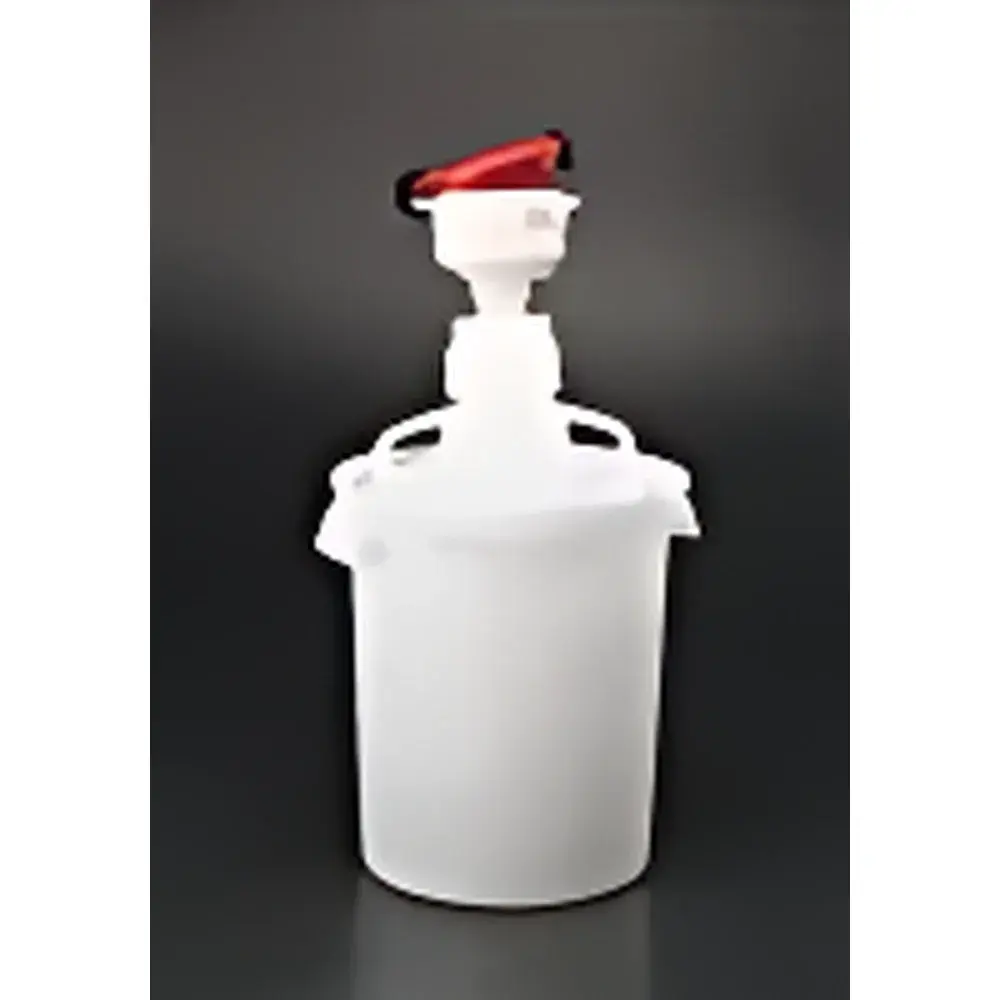
CP Lab Safety EF-4-83C-SYS 4″ ECO Waste Collection Funnel System
| Brand | CP Lab Safety |
|---|---|
| Origin | USA |
| Manufacturer Type | Authorized Distributor |
| Product Origin | Imported |
| Model | EF-4-83C-SYS |
| Pricing | Available Upon Request |
Overview
The CP Lab Safety EF-4-83C-SYS is a 4-inch (101.6 mm) engineered waste collection funnel system designed for safe, compliant, and vapor-reduced disposal of organic solvents and hazardous liquid waste in analytical and synthetic laboratories. It operates on a sealed containment principle—replacing open beakers and unvented containers with a chemically resistant, threaded-neck funnel assembly that mates directly with standard laboratory reagent bottles or certified safety cans. This design mitigates volatile organic compound (VOC) emissions by up to 99%, as validated under controlled fume hood airflow conditions per ANSI/ASHRAE 110–2016 methodology. The system is purpose-built for integration with HPLC, GC, DNA synthesizers, protein sequencers, low- to medium-pressure preparative chromatography systems, and peptide synthesis platforms where repeated solvent transfers generate cumulative exposure risks. Its compact footprint (5″ × 7″ top aperture) enables stable placement inside standard laboratory fume hoods (minimum 24″ depth) or over sink basins without obstructing workflow.
Key Features
- Chemically inert high-density polyethylene (HDPE) construction—resistant to alcohols, chlorinated solvents, esters, ketones, and dilute acids/bases per ASTM D543-22
- 4-inch (101.6 mm) top diameter with integrated 11-inch (279 mm) extended neck—minimizes headspace vapor accumulation and reduces evaporation rate by >90% versus conventional funnels
- Threaded neck interface compatible with industry-standard closures: 38-430, 38-400, 53 mm, 63 mm, 70 mm, 83 mm, and 100 mm bottle necks
- Integrated sintered polypropylene filter (nominal pore size: 100 µm) prevents particulate ingress into waste vessels while maintaining flow integrity
- Modular configuration supports up to six HPLC-compatible quick-disconnect (QD) ports—enabling simultaneous multi-stream waste routing from parallel instruments
- Color-coded cap options (e.g., yellow for acetone/methanol, red for flammable hydrocarbons) support visual hazard identification per NFPA 704 and GHS labeling conventions
Sample Compatibility & Compliance
The EF-4-83C-SYS accommodates liquid waste streams from routine analytical instrumentation including reversed-phase HPLC mobile phases (acetonitrile/water, methanol/water), GC carrier gases with solvent traps, peptide coupling reagents (DMF, DCM), and oligonucleotide deprotection solutions (ammonia, methylamine). It complies with OSHA 29 CFR 1910.1200 (Hazard Communication), EPA 40 CFR Part 262 (Lab Safety Standards), and meets structural requirements for use with UN-certified LDPE, PP, and HDPE waste containers rated for Class I flammable liquids. The HDPE body passes UL 94 HB flame resistance testing and is suitable for installation in laboratories operating under ISO/IEC 17025:2017 quality management frameworks.
Software & Data Management
While the EF-4-83C-SYS is a passive mechanical device with no embedded electronics or firmware, its physical design supports full traceability within digital lab infrastructure. Cap-compatible barcoded labels (e.g., GS1-128) can be affixed to both funnel and mating container for integration with LIMS platforms such as LabWare LIMS, Thermo Fisher SampleManager, or Agilent OpenLab ECM. When used with smart safety cans equipped with RFID tags or fill-level sensors, the system contributes to automated waste log generation, regulatory reporting (EPA Form 8700-22), and audit-ready chain-of-custody documentation aligned with FDA 21 CFR Part 11 electronic record requirements.
Applications
- HPLC and UHPLC waste capture during method development and QC batch analysis
- GC solvent trap drainage in environmental and pharmaceutical residue testing labs
- DNA/RNA synthesizer cleavage and deprotection effluent handling
- Protein sequencing instrument wash buffer collection (e.g., Edman degradation reagents)
- Low- and medium-pressure flash chromatography fraction pooling under inert atmosphere
- Peptide synthesis reactor quench solution containment (TFA, DCM, DIPEA mixtures)
- Academic teaching labs requiring OSHA-compliant waste handling for organic chemistry coursework
FAQ
Is the EF-4-83C-SYS compatible with explosion-proof safety cans?
Yes—it interfaces mechanically with UL-listed Type I and Type II safety cans featuring 38-430, 53 mm, or 83 mm neck threads, including Justrite, Eagle, and Buckhorn models rated for Class I, Division 1 hazardous locations.
Can the funnel be autoclaved?
No—HDPE softens above 120 °C; cleaning is recommended via isopropanol rinse followed by air drying. Sterilization is not required for waste containment applications.
Does it meet GLP/GMP documentation requirements?
Yes—the standardized dimensions, material traceability (ASTM D4976 resin code), and compatibility with barcode-enabled containers support ALCOA+ data integrity principles when deployed within validated lab workflows.
What is the maximum continuous operating temperature?
The HDPE body maintains structural integrity up to 60 °C ambient; prolonged exposure to solvents above 40 °C may accelerate stress cracking and is not advised.
How often should the filter be replaced?
Filter replacement is event-driven—not time-based. Inspect before each use; replace if clogged, cracked, or exposed to particulates exceeding 100 µm nominal retention capacity.



