
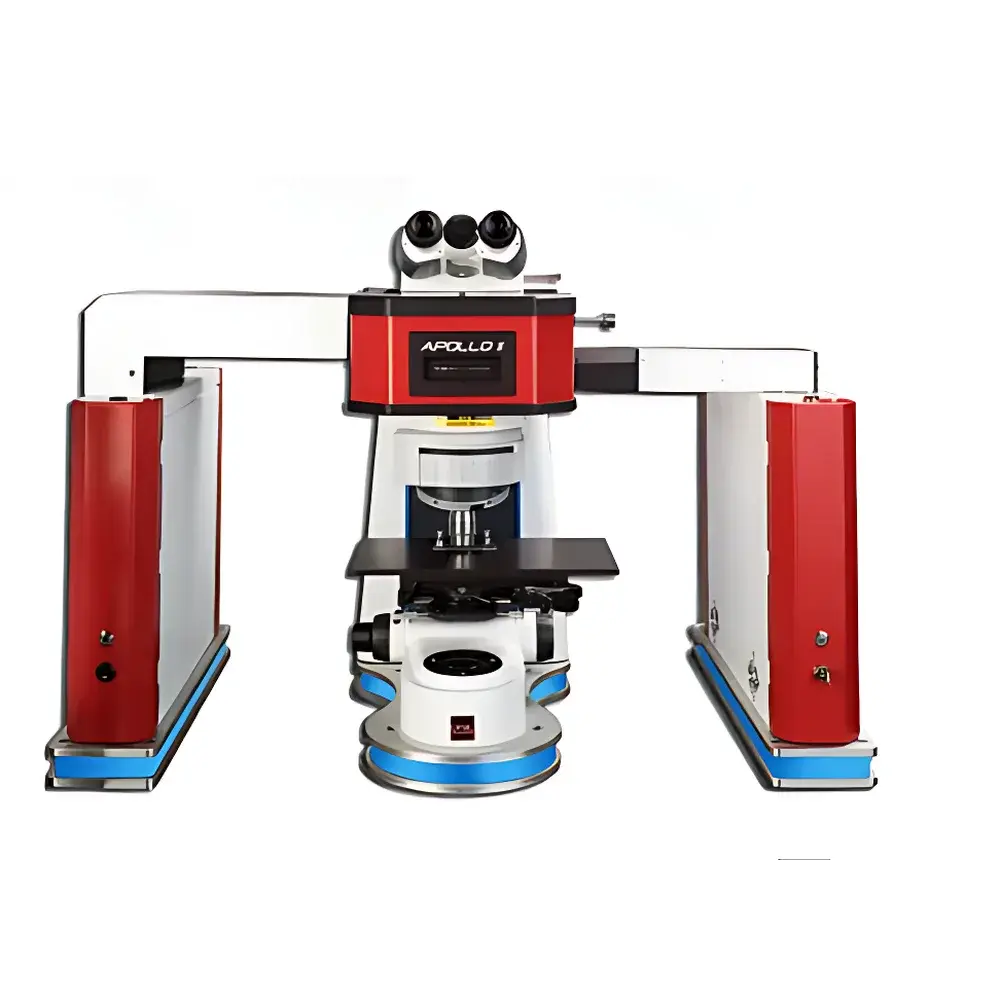
CRAIC Apollo II™ Raman Microspectrometer
| Brand | CRAIC |
|---|---|
| Origin | USA |
| Manufacturer Type | Authorized Distributor |
| Product Origin | Imported |
| Model | Apollo II™ Raman Microspectrometer — Advanced Raman Microscope |
| Pricing | Available Upon Request |
Overview
The CRAIC Apollo II™ Raman Microspectrometer is a high-performance, research-grade microanalytical instrument engineered for spatially resolved vibrational spectroscopy at the microscopic level. Based on confocal Raman scattering principles, it integrates a precision optical microscope with modular laser excitation sources and high-throughput spectrometers to deliver quantitative molecular fingerprinting of solid, liquid, or thin-film samples with micron-scale spatial resolution. Unlike conventional benchtop Raman systems, the Apollo II™ employs a solid-state, vibration-isolated optical architecture optimized for long-term stability and signal reproducibility—critical for time-series measurements, spectral mapping, and correlative multimodal analysis. Its design enables seamless integration with CRAIC’s UV-Vis-NIR Microspectrophotometers, allowing concurrent acquisition of Raman, absorbance, reflectance, fluorescence, and polarization spectra from the same microregion—making it particularly suited for materials science, pharmaceutical QA/QC, forensic trace evidence analysis, geoscience, and semiconductor process characterization.
Key Features
- Modular laser configuration supporting one, two, or three independently aligned solid-state lasers (e.g., 532 nm, 638 nm, and 785 nm), each optimized for spectral throughput, signal-to-noise ratio, and photostability
- Confocal optical path with motorized XYZ stage and autofocus capability for high-fidelity Raman mapping and depth profiling
- High-resolution spectrograph options with selectable gratings (e.g., 1200–2400 grooves/mm) enabling spectral resolution down to <2 cm⁻¹ (FWHM) across 100–4000 cm⁻¹ range
- Integrated UV-Vis-NIR microspectrophotometry capability via optional CRAIC 20/30 PV™ platform, enabling simultaneous acquisition of absorption, reflectance, fluorescence, and polarized spectra
- Automated spectral database search engine supporting 5D hyperspectral data cubes (x, y, λ, intensity, time)
- Rugged, air-table-free mechanical design with thermally stabilized optics and low-drift alignment—engineered for daily use in regulated laboratory environments
Sample Compatibility & Compliance
The Apollo II™ accommodates diverse sample types—including single crystals, biological tissues, polymer films, semiconductor wafers, forensic particulates, and mineral thin sections—without requiring conductive coating or vacuum conditions. Its non-destructive, label-free measurement modality complies with ASTM E1840 (Standard Guide for Raman Microspectroscopy), ISO 21542 (Building construction — Accessibility and usability of the built environment), and supports GLP/GMP workflows through audit-trail-enabled software logging. While not FDA-cleared as a diagnostic device, its data output meets analytical requirements for USP (Raman Spectroscopy) and ICH Q5E (Comparability of Biotechnological/Biological Products), facilitating use in pharmaceutical raw material identification and counterfeit drug screening.
Software & Data Management
Controlled via CRAIC’s proprietary Lambda™ software suite, the system provides intuitive instrument orchestration, real-time spectral preview, automated background subtraction, cosmic ray removal, and multivariate curve resolution (MCR). The embedded spectral library manager supports user-defined and commercial databases—including Forensic Spectral Database, Dye & Pigment Reference Library, Mineralogical Raman Atlas, Pharmaceutical Active Ingredient Library, Polymer Additives Compendium, and Semiconductor Defect Signature Repository. All spectral acquisitions are timestamped, metadata-tagged (laser power, integration time, objective magnification, grating selection), and exportable in ASTM E131-compliant JCAMP-DX format. Software validation documentation is available for laboratories operating under 21 CFR Part 11 requirements.
Applications
- Pharmaceutical: Polymorph identification, API-excipient interaction mapping, tablet coating uniformity assessment
- Materials Science: Strain distribution in 2D materials (e.g., graphene, MoS₂), phase segregation in battery cathodes, defect density quantification in SiC wafers
- Forensics: Microtrace analysis of paint chips, textile fibers, gunshot residue particles, and ink differentiation
- Geosciences: In-situ mineral phase identification in fluid inclusions and metamorphic thin sections
- Life Sciences: Label-free cellular component localization (lipids, proteins, nucleic acids) in fixed or live-cell preparations using low-power NIR excitation
- Nanotechnology: Plasmon-enhanced Raman mapping of Au/Ag nanostructures and SERS substrate characterization
FAQ
Can the Apollo II™ be configured for both Raman and UV-Vis-NIR microspectrophotometry simultaneously?
Yes—the system is designed for co-aligned optical paths; when integrated with a CRAIC 20/30 PV™ Microspectrophotometer, users acquire complementary Raman and broadband optical spectra from identical microregions without realignment.
Does the system support automated Raman mapping with stage synchronization?
Yes—motorized XYZ stages with sub-micron repeatability enable programmable grid-based or feature-targeted mapping; acquisition parameters (laser power, exposure, grating) are fully scriptable per pixel.
Are spectral libraries included with the base system?
The system ships with a core reference library; domain-specific databases (e.g., forensic, pharmaceutical, mineral) are licensed separately and updated quarterly.
Is remote operation supported for multi-user lab environments?
Lambda™ software supports secure client-server deployment over local networks, with role-based access control and session logging compliant with ISO/IEC 27001 information security standards.
What maintenance protocols are recommended for long-term optical alignment stability?
CRAIC recommends annual calibration verification using NIST-traceable Raman standards (e.g., silicon, cyclohexane); no routine realignment is required due to the monolithic optical mount design.





