
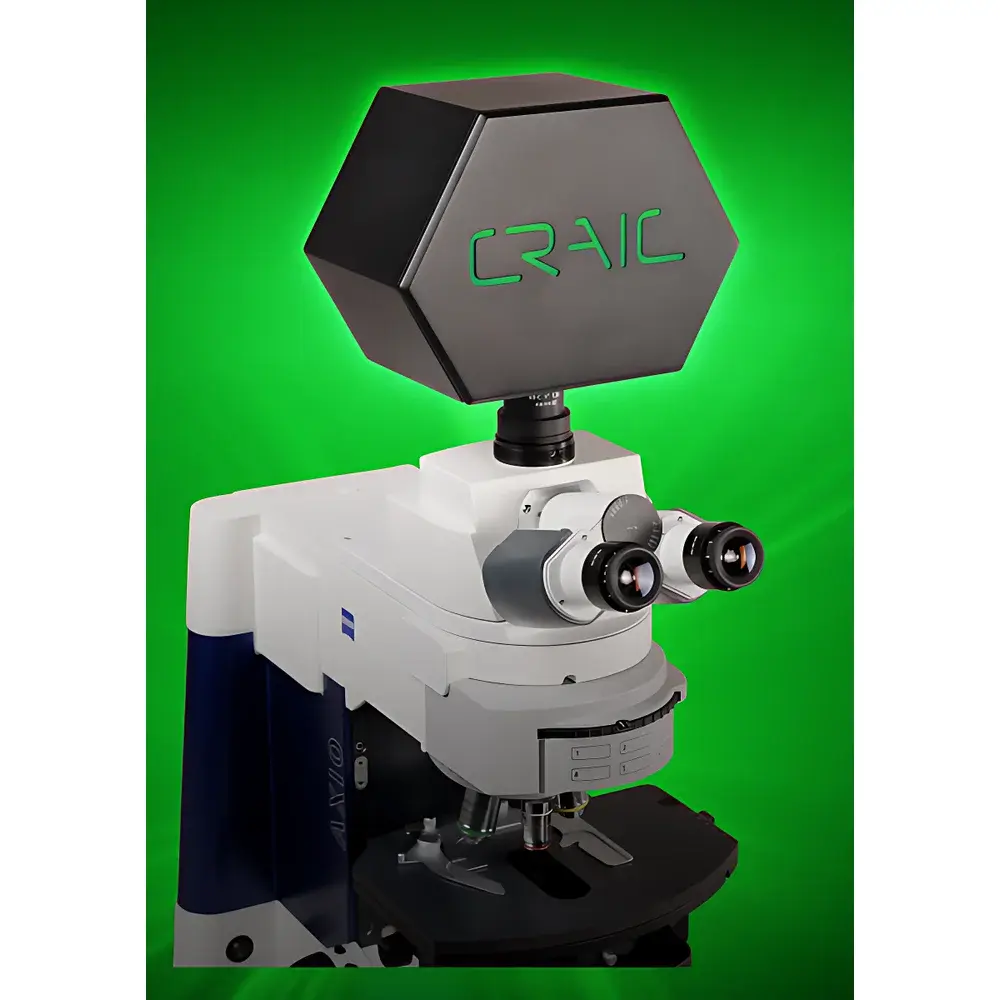
CRAIC CoalPro III™ Microspectrophotometer and Reflectometer
| Brand | CRAIC |
|---|---|
| Origin | USA |
| Model | CoalPro III™ |
| Compliance | ISO 7404-5, ASTM D2798 |
| Measurement Principle | Microscale Reflectance Spectrophotometry at 546 nm |
| Detector Type | High-Sensitivity, Low-Noise Silicon Photodiode Array |
| Imaging Capability | Integrated Full-Color Digital Microscopy |
| Automation Level | Manual or Fully Automated Operation |
| Upgrade Path | Compatible with CRAIC 308 Coal™ Microspectrophotometer Platform |
| Temperature Control | Precision Sample Stage Thermostat (±0.1 °C) |
| Software Suite | CRAIC CoalPro™ v5.x (Includes Reflectance Calculation Engine, Spectral Database, Image Analysis Module, GLP-Compliant Audit Trail) |
Overview
The CRAIC CoalPro III™ Microspectrophotometer and Reflectometer is a purpose-built analytical instrument engineered for quantitative organic petrography—specifically the measurement of vitrinite reflectance (Ro %) in coal, kerogen, and source rocks. Operating on the principle of microscale reflectance spectrophotometry, the system delivers traceable, standardized measurements at the industry-critical wavelength of 546 nm, fully compliant with ISO 7404-5 and ASTM D2798. Unlike general-purpose spectrometers, the CoalPro III™ integrates a calibrated photometric optical path, fixed-aperture illumination geometry, and a thermally stabilized sample stage to ensure high reproducibility across laboratories and over time. Its solid-state optical architecture contains no moving parts—eliminating mechanical drift and reducing calibration frequency—while maintaining full compatibility with standard petrographic microscopes. Designed for geological laboratories conducting routine coal rank assessment, petroleum system evaluation, and basin modeling, the system bridges classical petrographic observation with digital spectral quantification.
Key Features
- High-sensitivity, low-noise silicon photodiode array detector optimized for 546 nm monochromatic reflectance measurement with <0.01% relative standard deviation (RSD) repeatability
- Integrated full-color digital imaging system co-registered with the photometric aperture—enabling real-time visual verification of measurement location and focus
- CRAIC CoalPro™ software v5.x featuring automated vitrinite identification algorithms, Ro % calculation per ISO 7404-5 Annex B, and built-in uncertainty propagation reporting
- Precision temperature-controlled sample stage (±0.1 °C) for thermal stability during extended acquisition sequences
- Modular platform supporting field-upgradable expansion to full-range microspectrophotometry (200–2500 nm) and microfluorimetry via the 308 Coal™ upgrade kit
- GLP-compliant data management including electronic signatures, audit trail logging, and 21 CFR Part 11–ready user access controls
- No-movement optical design ensuring long-term alignment stability and minimal maintenance requirements
Sample Compatibility & Compliance
The CoalPro III™ is validated for polished coal blocks, kerogen-rich shales, and source rock thin sections mounted on standard glass slides. It accommodates samples up to 1 mm thick with surface roughness <0.05 µm Ra. All reflectance measurements conform to ISO 7404-5:2022 (Determination of vitrinite reflectance of coal—Part 5: Method of measurement using a microphotometer) and ASTM D2798-23 (Standard Test Method for Microscopic Determination of the Reflectance of Vitrinite in Coal). The system meets the optical validation criteria specified in ISO/IEC 17025:2017 for accredited testing laboratories and supports documentation required for GMP-aligned geological data packages. Optional certified reference materials—including NIST-traceable vitrinite standards—are available for daily performance verification.
Software & Data Management
CRAIC CoalPro™ software provides a dedicated workflow environment for organic petrography labs. Core modules include: (1) Reflectance Acquisition Manager with auto-exposure control and drift compensation; (2) Vitrinite Identification Assistant using contrast- and texture-based segmentation; (3) Spectral Database Engine supporting custom spectral libraries for kerogen typing; (4) Image Analysis Toolkit with particle sizing, area fraction mapping, and fluorescence intensity profiling; and (5) Reporting Module generating ISO-compliant PDF reports with embedded raw spectra, metadata, and uncertainty budgets. All data files are stored in vendor-neutral HDF5 format with embedded EXIF-style metadata. Audit trails record operator actions, parameter changes, and calibration events—fully traceable for regulatory review.
Applications
- Vitrinite reflectance determination for coal rank classification (ASTM D388, ISO 11760)
- Kerogen maturity assessment in unconventional reservoir characterization
- Source rock evaluation via fluorescence spectral profiling and QEMSCAN-integrated mineralogical correlation
- Fluid inclusion thermometry through microfluorescence excitation-emission matrix (EEM) analysis
- Reflectance-based maceral group quantification in ASTM D7708 workflows
- Digital petrographic archiving with georeferenced spectral metadata
- Method development for multi-wavelength reflectance indices (e.g., TAI, FAI) beyond 546 nm
FAQ
Does the CoalPro III™ require external calibration standards for daily operation?
Yes—daily verification using CRAIC-certified vitrinite reference slides (e.g., NIST SRM 2913a-equivalent) is recommended per ISO 7404-5 Section 8.3.
Can the system measure fluorescence without hardware modification?
Fluorescence intensity measurement is supported in the base configuration; full excitation-emission spectral acquisition requires the 308 Coal™ upgrade module.
Is the software compatible with LIMS integration?
Yes—CoalPro™ v5.x includes configurable ODBC and REST API endpoints for bidirectional data exchange with laboratory information management systems.
What microscope brands does the CoalPro III™ interface with?
It mounts natively to Olympus BX53, Zeiss Axio Imager, and Leica DM2700M platforms via standard C-mount adapters; custom couplers available upon request.
How is measurement uncertainty reported in final Ro % values?
Uncertainty is calculated per GUM (JCGM 100:2008) incorporating contributions from detector noise, stage positioning error, and reference standard uncertainty—displayed as expanded uncertainty (k=2) in all export reports.
Related Products





